<?xml version="1.0" encoding="utf-8"?><feed xmlns="http://www.w3.org/2005/Atom" ><generator uri="https://jekyllrb.com/" version="3.10.0">Jekyll</generator><link href="https://fairflow.github.io/writing/feed.xml" rel="self" type="application/atom+xml" /><link href="https://fairflow.github.io/writing/" rel="alternate" type="text/html" /><updated>2026-10-08T19:50:37+00:00</updated><id>https://fairflow.github.io/writing/feed.xml</id><title type="html">AI Writing and Tools</title><subtitle>My writing on AI-related topics, including emerging tools and discussions</subtitle><author><name>fairflow</name></author><entry><title type="html">ledgerforge: bank statements into a self-checking account book</title><link href="https://fairflow.github.io/writing/ledgerforge/" rel="alternate" type="text/html" title="ledgerforge: bank statements into a self-checking account book" /><published>2026-08-23T12:01:26+00:00</published><updated>2026-08-23T12:01:26+00:00</updated><id>https://fairflow.github.io/writing/ledgerforge</id><content type="html" xml:base="https://fairflow.github.io/writing/ledgerforge/"><![CDATA[<p>A bank gives you statements: a folder of OFX, QIF or CSV files, one per account,
full of lines like <code class="language-plaintext highlighter-rouge">CARD PAYMENT TO TESCO STORES 3456, £23.71</code>. To turn that into
an account book you can actually trust, every one of those lines needs an answer to
a single question: <strong>what is the other account?</strong> A grocery payment’s partner is
<code class="language-plaintext highlighter-rouge">Expenses:Groceries</code>; a salary line’s is <code class="language-plaintext highlighter-rouge">Income:Salary</code>; a £500 move to your own
savings is a transfer between two of your own accounts — emphatically <em>not</em> income and
<em>not</em> an expense. Answering that question a few thousand times, correctly and
repeatably, is the real work of bookkeeping.
<a href="https://github.com/fairflow/ledgerforge">ledgerforge</a> automates it.</p>

<p>It is a small Python engine that reads bank exports and writes a proper double-entry
<a href="https://www.gnucash.org/">GnuCash</a> book — multi-currency, with a coded chart of
accounts and FX prices. GnuCash is a good foundation for two reasons: its file format
is open (a book is just an XML or SQLite file that any program can read), and it does
real double-entry, the 500-year-old idea that makes a book <em>self-checking</em>. Because
every transaction moves value between accounts and the amounts always sum to zero, the
book obeys one identity at every moment — <em>Assets − Liabilities = Equity</em> — and a
stricter test underneath it: take every account at its recorded value and the signed
total across all of them is exactly nought. When it isn’t, something concrete is broken
— a missing statement, a duplicated import, a miscoded transfer — and the size of the
residual tells you what to hunt for. That is a number you can chase, instead of a
mystery.</p>

<p>The pipeline is deliberately boring:</p>

<div class="language-plaintext highlighter-rouge"><div class="highlight"><pre class="highlight"><code>statements (OFX / QIF / CSV)
    → parsers        one small parser per bank format
    → rules          categorise(description) → account, first match wins
    → transfers      detect own-account moves so they never count as income/expense
    → overrides      date- or currency-scoped exceptions that beat the rules
    → GnuCash book   coded, multi-currency, self-checking
    → review toolkit four local HTML pages for the human to check and refine
</code></pre></div></div>

<p>The subtle piece is transfer detection. Move money from current to savings and it
appears in <em>two</em> statements — out of one, into the other. Categorised naively, it
becomes both a phantom expense and a phantom income, and both of your totals are now
wrong. ledgerforge recognises your own-account markers and books the pair as what it
is: an internal transfer between two of your asset accounts.</p>

<p>The design decision I am most pleased with is that <strong>the engine carries no private data
at all</strong> — no account names, no numbers, no filesystem paths. Everything specific to a
given ledger arrives through a configuration object loaded from a git-ignored file, and
the account numbers used for transfer detection are read at runtime from registries kept
<em>outside</em> any repository. That is a hard rule, and it is what lets the engine live in a
public repo while the ledgers that use it — in my case a household and a small business,
plus a public demo — stay entirely private. The review server is loopback- and
LAN-gated for the same reason: you can share the review pages to your own wifi without
exposing anything to the internet.</p>

<p>If you want the whole shape of it from first principles — what a GnuCash book is, why
double-entry is worth the ceremony, how a shoebox of statements becomes a book — the
repository’s
<a href="https://github.com/fairflow/ledgerforge/blob/main/docs/HOW_IT_WORKS.md">HOW_IT_WORKS</a>
explains it assuming no accounting background.</p>

<p>You can also <strong><a href="https://fairflow.github.io/ledgerforge/">try the toolkit live</a></strong> — an
interactive demo on entirely fictional data. Browse the resulting GnuCash book (balances,
the P&amp;L, and the accounting equation with its double-entry check), tune the categorisation
rules, and download the book to open in GnuCash yourself. The repository’s self-contained
demo also includes a headless <a href="https://plaid.com/">Plaid</a> sandbox rehearsal of the
statement-fetch flow against a fake bank — no real accounts involved.</p>

<p>Like most of what I have built this year, ledgerforge was written in close collaboration
with Claude. I brought the accounting model, the security rule, and the judgement about
what the books should say; the AI brought the parsers, the piecash plumbing, and the
patience for the thousand small categorisation cases. It is MIT licensed — take it, fork
it, point it at your own statements.</p>]]></content><author><name>fairflow</name></author><category term="ai" /><category term="tools" /><category term="finance" /><summary type="html"><![CDATA[A bank gives you statements: a folder of OFX, QIF or CSV files, one per account, full of lines like CARD PAYMENT TO TESCO STORES 3456, £23.71. To turn that into an account book you can actually trust, every one of those lines needs an answer to a single question: what is the other account? A grocery payment’s partner is Expenses:Groceries; a salary line’s is Income:Salary; a £500 move to your own savings is a transfer between two of your own accounts — emphatically not income and not an expense. Answering that question a few thousand times, correctly and repeatably, is the real work of bookkeeping. ledgerforge automates it.]]></summary></entry><entry><title type="html">Alternating bit protocol in Mathematica</title><link href="https://fairflow.github.io/writing/alternating-bit-protocol-in-mathematica/" rel="alternate" type="text/html" title="Alternating bit protocol in Mathematica" /><published>2026-03-28T01:20:04+00:00</published><updated>2026-03-28T01:20:04+00:00</updated><id>https://fairflow.github.io/writing/alternating-bit-protocol-in-mathematica</id><content type="html" xml:base="https://fairflow.github.io/writing/alternating-bit-protocol-in-mathematica/"><![CDATA[<h1 id="verifying-the-alternating-bit-protocol-in-mathematica">Verifying the Alternating Bit Protocol in Mathematica</h1>

<p>Imagine two people passing notes across a classroom through unreliable messengers.
The sender writes a message, tags it with a 0 or 1, and hands it off. The messenger
might drop it. If the sender doesn’t hear back, they try again. When the receiver gets
a new message, they send an acknowledgement – which might also get dropped. Despite
all this unreliability, every message eventually arrives, exactly once, in order. One solution to this challenge is the
algorithm called the Alternating Bit Protocol (ABP), Proving that the ABP <em>works</em> – that this complex network
of retries and drops behaves identically to a simple reliable buffer – is a benchmark
problem in formal verification, first established by Milner in CCS and revisited by
dozens of researchers since.</p>

<p>We built a tool that carries out this proof mechanically for a finite-state instance of ABP
(with 1-capacity lossy channels), in around 2,100 lines of Mathematica. The codebase, RCA,
implements CCS with value-passing: processes communicate by synchronising on named channels,
optionally exchanging data. The core is a transition function that computes every possible
next step of a process expression — parallel composition with synchronisation, channel
restriction, nondeterministic choice, and recursive definitions via a lightweight equation
registry. On top of this sits a weak bisimulation game: a two-phase algorithm that explores
the paired state space of two processes and determines whether they are observationally
equivalent up to internal steps. For the 1-capacity ABP vs. a one-place buffer, the game
explores 112 pairs across 114 reachable states and confirms the equivalence. The tool also
provides strong bisimulation checking, symbolic transitions with constraints, and an
interactive simulator with fold-back display of named agents.</p>

<p>For context, the Edinburgh Concurrency Workbench (CWB), the standard reference tool
for this kind of analysis, was built by Cleaveland, Parrow, and Steffen at Edinburgh
LFCS over 1987–1989, with Perdita Stevens later maintaining and extending the
Edinburgh version from the mid-1990s. The CWB-NC successor comprises roughly 18,000
lines of Standard ML. RCA covers a meaningful fragment of the same ground in an order
of magnitude less code — partly because Mathematica’s pattern-matching and symbolic
rewriting are a natural fit for process algebra (CCS transition rules map almost
directly to rewrite rules), and partly because the development was a close
collaboration between a researcher with background in process calculus and Claude
Opus 4.6, Anthropic’s AI coding agent. The human brought domain knowledge, design
taste, and experienced testing; the AI contributed rapid implementation, bug
diagnosis, and the ability to hold the full codebase in context while iterating.
Neither could have done it alone at this pace.</p>

<hr />

<p>~2,100 lines of code, ~20 commits, ABP verified. Happy to adjust tone, length, or emphasis.</p>]]></content><author><name>fairflow</name></author><category term="ai" /><category term="theory" /><summary type="html"><![CDATA[Verifying the Alternating Bit Protocol in Mathematica]]></summary></entry><entry><title type="html">Brazil itinerary</title><link href="https://fairflow.github.io/writing/brazil-itinerary/" rel="alternate" type="text/html" title="Brazil itinerary" /><published>2026-01-07T09:50:49+00:00</published><updated>2026-01-07T09:50:49+00:00</updated><id>https://fairflow.github.io/writing/brazil-itinerary</id><content type="html" xml:base="https://fairflow.github.io/writing/brazil-itinerary/"><![CDATA[<h1 id="roça-de-ogum-onirê-bahia-2026">Roça de Ogum Onirê, Bahia, 2026</h1>

<h2 id="itinerary-aka-matthews-2nd-phd--bahia-retreat--beach-trip-2026">ITINERARY (aka Matthew’s 2nd PhD) – BAHIA RETREAT &amp; BEACH TRIP 2026</h2>

<p><strong>Travelers:</strong> Matthew + Benita (2 adults)
<strong>Trip Duration:</strong> 08 January – 1 March 2026
<strong>Contact:</strong> <a href="mailto:matthew@fairtlough.net">matthew@fairtlough.net</a></p>

<h3 id="outbound-journey"><strong>OUTBOUND JOURNEY</strong></h3>

<h4 id="thursday-08-january-2026">Thursday, 08 January 2026</h4>

<h4 id="gwr-train-booking-confirmed---totnes-to-forest-hill">GWR Train Booking Confirmed - Totnes to Forest Hill</h4>

<p><strong>Booking reference</strong>: B27H8937
<strong>Outbound journey</strong><sup id="fnref:1" role="doc-noteref"><a href="#fn:1" class="footnote" rel="footnote">1</a></sup><sup id="fnref:2" role="doc-noteref"><a href="#fn:2" class="footnote" rel="footnote">2</a></sup>:</p>

<ul>
  <li><strong>Depart Totnes</strong>: 09:42</li>
  <li><strong>Arrive Forest Hill</strong>: 13:42</li>
  <li><strong>Duration</strong>: 4 hours 0 minutes</li>
  <li><strong>Changes</strong>: 2 changes</li>
  <li><strong>Ticket type</strong>: Advance Single (only valid on booked trains and required connecting services)</li>
</ul>

<h3 id="seat-reservations">Seat Reservations</h3>

<ul>
  <li>Coach H</li>
  <li>Seat 57: Window, Forwards, Table</li>
  <li>Seat 58: Aisle, Forwards, Table</li>
  <li><strong>Railcard reminder</strong>: we must carry our Railcards</li>
</ul>

<h3 id="summary">Summary</h3>

<ul>
  <li>Journey 1: Totnes to Forest Hill - £84.50</li>
  <li>departs Totnes at 09:42</li>
  <li>Great Western Railway to London Paddington arrives 12:29</li>
  <li>12:44 travel by London Underground to London Bridge arrives at 13:14</li>
  <li>13:28 travel by Southern Railways to Forest Hill arrives 13:42</li>
</ul>

<p>This gives us plenty of time to settle in before our early 06:07 departure to Gatwick on<br />
Saturday morning for our 10:10 TAP flight to Lisbon.</p>

<p>To do still: book taxi to Forest Hill from 20 Fermor Road.</p>

<ul>
  <li>Possibly useful links:<sup id="fnref:1_2" role="doc-noteref"><a href="#fn:1_2" class="footnote" rel="footnote">3</a></sup>
<sup id="fnref:1_10" role="doc-noteref"><a href="#fn:1_10" class="footnote" rel="footnote">4</a></sup><sup id="fnref:1_11" role="doc-noteref"><a href="#fn:1_11" class="footnote" rel="footnote">5</a></sup><sup id="fnref:1_12" role="doc-noteref"><a href="#fn:1_12" class="footnote" rel="footnote">6</a></sup><sup id="fnref:1_13" role="doc-noteref"><a href="#fn:1_13" class="footnote" rel="footnote">7</a></sup><sup id="fnref:1_14" role="doc-noteref"><a href="#fn:1_14" class="footnote" rel="footnote">8</a></sup><sup id="fnref:1_15" role="doc-noteref"><a href="#fn:1_15" class="footnote" rel="footnote">9</a></sup><sup id="fnref:1_16" role="doc-noteref"><a href="#fn:1_16" class="footnote" rel="footnote">10</a></sup><sup id="fnref:1_17" role="doc-noteref"><a href="#fn:1_17" class="footnote" rel="footnote">11</a></sup><sup id="fnref:1_18" role="doc-noteref"><a href="#fn:1_18" class="footnote" rel="footnote">12</a></sup><sup id="fnref:1_19" role="doc-noteref"><a href="#fn:1_19" class="footnote" rel="footnote">13</a></sup><sup id="fnref:1_20" role="doc-noteref"><a href="#fn:1_20" class="footnote" rel="footnote">14</a></sup><sup id="fnref:1_21" role="doc-noteref"><a href="#fn:1_21" class="footnote" rel="footnote">15</a></sup><sup id="fnref:1_22" role="doc-noteref"><a href="#fn:1_22" class="footnote" rel="footnote">16</a></sup><sup id="fnref:1_3" role="doc-noteref"><a href="#fn:1_3" class="footnote" rel="footnote">17</a></sup><sup id="fnref:1_4" role="doc-noteref"><a href="#fn:1_4" class="footnote" rel="footnote">18</a></sup><sup id="fnref:1_5" role="doc-noteref"><a href="#fn:1_5" class="footnote" rel="footnote">19</a></sup><sup id="fnref:1_6" role="doc-noteref"><a href="#fn:1_6" class="footnote" rel="footnote">20</a></sup><sup id="fnref:1_7" role="doc-noteref"><a href="#fn:1_7" class="footnote" rel="footnote">21</a></sup><sup id="fnref:1_8" role="doc-noteref"><a href="#fn:1_8" class="footnote" rel="footnote">22</a></sup><sup id="fnref:1_9" role="doc-noteref"><a href="#fn:1_9" class="footnote" rel="footnote">23</a></sup></li>
</ul>

<h2 id="train-booking-confirmed---forest-hill-to-gatwick-airport">Train Booking Confirmed - Forest Hill to Gatwick Airport</h2>

<p><strong>Booking reference</strong>: 595019627668[^6_1]
<strong>Confirmation sent to</strong>: <a href="mailto:fairtlough@gmail.com">fairtlough@gmail.com</a> and <a href="mailto:26@fairtlough.net">26@fairtlough.net</a>[^6_1]</p>

<h3 id="journey-details---saturday-10-january-2026">Journey Details - Saturday, 10 January 2026</h3>

<ul>
  <li><strong>Depart Forest Hill</strong>: 06:07</li>
  <li><strong>Arrive Gatwick Airport</strong>: 07:50 (if on time)[^6_1]</li>
  <li><strong>Duration</strong>: 1 hour 43 minutes</li>
  <li><strong>Changes</strong>: 3 changes[^6_1]</li>
  <li><strong>Passengers</strong>: 2 Adults with 2 Senior Railcards applied</li>
  <li><strong>Collection reference</strong>: 59CW6B59[^6_1]</li>
</ul>

<h3 id="important-notes">Important Notes</h3>

<p><strong>Engineering Works</strong>: There is a <strong>rail replacement bus service</strong> covering the route between
East Grinstead and Gatwick Airport due to January engineering works. No direct trains are
reaching the airport at that time on 10 January 2026, which explains the 3-change journey
with bus replacement.<sup id="fnref:6_2" role="doc-noteref"><a href="#fn:6_2" class="footnote" rel="footnote">24</a></sup>[^6_1]</p>

<p><strong>Airport arrival</strong>: We arrive at <strong>07:50</strong>, which is <strong>2 hours 20 minutes</strong> before our 10:10 
TAP flight departure to Lisbon—adequate time for check-in and security.</p>

<p><strong>Ticket collection</strong>: Collect from station using reference 59CW6B59. 
The tickets show “Sit in any vacant unreserved seat except first class”.[^6_1]</p>

<ul>
  <li><strong>Flight 1:</strong> TP1329
<strong>London Gatwick (LGW) Terminal S → Porto (OPO)</strong>
Operated by TAP Air Portugal (A320)
Departs: 10:00 GMT</li>
  <li><strong>Flight 2:</strong> TP93
<strong>Porto (OPO) → São Paulo Guarulhos (GRU) Terminal 3</strong>
Operated by TAP Air Portugal (A320)
Arrives: 21:45 local time (Saturday, 10 Jan)</li>
  <li><strong>Transfer:</strong> Taxi/Uber from GRU Airport to hotel (~10 min with free shuttle)</li>
  <li>
    <p><strong>Overnight:</strong> <strong>Hampton by Hilton Guarulhos Airport</strong> ✅ <strong>BOOKED</strong></p>

    <ul>
      <li>Address: Near São Paulo Guarulhos Airport (GRU), free shuttle service</li>
      <li>Confirmation: Check email (<a href="mailto:matthew@fairtlough.net">matthew@fairtlough.net</a>) or add to Hilton Honors account</li>
      <li>Cost: approx. £50–£65 for double room with breakfast</li>
    </ul>
  </li>
</ul>

<hr />

<h2 id="outward-journey-overview">Outward Journey overview</h2>

<ul>
  <li>From: London Gatwick (LGW, South Terminal) → To: São Paulo Guarulhos (GRU, Terminal 3), via Porto (OPO)<sup id="fnref:1a" role="doc-noteref"><a href="#fn:1a" class="footnote" rel="footnote">25</a></sup></li>
  <li>Date: Sat 10 January 2026 (same‑day arrival)<sup id="fnref:1a:1" role="doc-noteref"><a href="#fn:1a" class="footnote" rel="footnote">25</a></sup></li>
  <li>Total travel time: 14h 35m (including Porto layover)<sup id="fnref:1a:2" role="doc-noteref"><a href="#fn:1a" class="footnote" rel="footnote">25</a></sup></li>
  <li>Airline: TAP Air Portugal, flights TP 1329 (LGW → OPO) and TP 93 (OPO → GRU)<sup id="fnref:1a:3" role="doc-noteref"><a href="#fn:1a" class="footnote" rel="footnote">25</a></sup></li>
  <li>Notes: Short layover in Porto; long-haul sector on A330neo with on-board wi‑fi, quieter cabin, and lower emissions.<sup id="fnref:1a:4" role="doc-noteref"><a href="#fn:1a" class="footnote" rel="footnote">25</a></sup></li>
</ul>

<h2 id="return-journey-overview">Return Journey overview</h2>

<ul>
  <li>From: São Paulo Guarulhos (GRU, T3) → To: London Heathrow (LHR, T2), via Lisbon (LIS, T1)<sup id="fnref:1:1" role="doc-noteref"><a href="#fn:1" class="footnote" rel="footnote">1</a></sup></li>
  <li>Date: Overnight Sat 28 Feb – Sun 1 Mar 2026<sup id="fnref:1b" role="doc-noteref"><a href="#fn:1b" class="footnote" rel="footnote">26</a></sup></li>
  <li>Total travel time: 19h 20m (including Lisbon layover)<sup id="fnref:1b:1" role="doc-noteref"><a href="#fn:1b" class="footnote" rel="footnote">26</a></sup></li>
  <li>Airline: TAP Air Portugal, flights TP 88 (GRU → LIS) and TP 1358 (LIS → LHR)<sup id="fnref:1b:2" role="doc-noteref"><a href="#fn:1b" class="footnote" rel="footnote">26</a></sup></li>
  <li>Notes: Long daytime layover in Lisbon; aircraft offer on-board wi‑fi, quieter cabins, and reduced emissions on the A330.<sup id="fnref:1b:3" role="doc-noteref"><a href="#fn:1b" class="footnote" rel="footnote">26</a></sup></li>
</ul>

<h3 id="sunday-11-january-2026">Sunday, 11 January 2026</h3>

<ul>
  <li><strong>Morning:</strong> Hotel shuttle to GRU Terminal (domestic departures)</li>
  <li><strong>Flight:</strong> ✅ <strong>BOOKED – Premium Package (Refundable/Changeable)</strong>
<strong>GRU (São Paulo Guarulhos) → IOS (Ilhéus)</strong>
Arrive 17.35 local time
<strong>Airline:</strong> GOL Linhas Aéreas
<strong>Booking code</strong> GGPYGL
<strong>Expedia Itinerary Number:</strong> 73305505241481</li>
</ul>

<p><strong>Package includes:</strong></p>

<ul>
  <li>Refundable tickets</li>
  <li>Changeable (pay fare difference only)</li>
  <li>Seat selection included (contact GOL to reserve)
<strong>Confirmation email:</strong> <a href="mailto:matthew@fairtlough.net">matthew@fairtlough.net</a></li>
  <li><strong>Hand baggage allowance:</strong> 1 cabin bag per person (max 55 x 35 x 25 cm, 10 kg) + 1 personal item</li>
  <li><strong>Checked baggage:</strong> Paid extra for 1 x 25kg bag</li>
  <li><strong>Seat selection:</strong>
    <ul>
      <li>Visit voegol.com.br/en → “My Trips” → enter booking PNR</li>
    </ul>
  </li>
  <li><strong>Transfer:</strong> Pre-arranged Uber from Ilhéus Airport to retreat centre</li>
  <li><strong>Overnight:</strong> Retreat centre (Sunday, 11 Jan)</li>
</ul>

<hr />

<h3 id="retreat-phase"><strong>RETREAT PHASE</strong></h3>

<h4 id="monday-12-january--sunday-19-january-2026">Monday, 12 January – Sunday, 19 January 2026</h4>

<ul>
  <li><strong>Location:</strong> Pedra do Sabiá Farm Retreat centre near Itacaré, Bahia</li>
  <li><strong>Dates:</strong> 12–22 January (10 days/11 nights)</li>
  <li><strong>Accommodation &amp; Meals:</strong> Fully included</li>
  <li><strong>Activities:</strong> Yoga, wellness, communal living, organic food, singing/art sessions</li>
</ul>

<hr />

<h3 id="bahia-beach-rest--exploration"><strong>BAHIA BEACH REST &amp; EXPLORATION</strong></h3>

<h3 id="serra-grande">Serra Grande</h3>

<h4 id="sunday-22-january--31-january-2026">Sunday, 22 January – 31 January 2026</h4>

<ul>
  <li><strong>Address:</strong> R. sete Setembro, 118, Centro, Serra Grande, Uruçuca, Bahia 45680-000, Brazil</li>
  <li><strong>Host:</strong> Fábio WhatsApp. 73 999052328</li>
</ul>

<p>Directions from your host
para quem chegar de ônibus, descerá no Ponto da Praça Principal de Serra Grande.
Caminhando para a Microcasa em torno de 5 a 10 minutos.
A localização tem variado uns 5 metros. Pelas fotos e número da casa fica fácil.</p>

<p>Nielsen taxi +55 73 99937-2318
Matheus taxi (cousin) +55 73 99828-3249
Host contact* +55 73 99905-2328</p>

<p><strong>Potential activities:</strong></p>

<ul>
  <li><strong>Ilhéus:</strong> Praia do Sul, Millionários Beach, Casa de Cultura Jorge Amado, Mirante da Piedade</li>
  <li><strong>Itacaré:</strong> Surf, waterfalls, SUP tours, cacao farm visits, Atlantic Forest hikes</li>
  <li><strong>Península de Maraú / Barra Grande:</strong> Shoal pools at Taipu-de-Fora, tranquil beaches</li>
  <li><strong>Trancoso / Arraial d’Ajuda:</strong> Chic beach villages, Quadrado square, boutique shopping</li>
  <li>Workaway/HelpStay projects (permaculture, art, communal living)</li>
  <li>Yoga studios and holistic wellness centers</li>
  <li>Language exchange meetups in Salvador/Itacaré</li>
</ul>

<hr />

<h3 id="salvador">SALVADOR</h3>

<h4 id="january-31--february-5-2026">January 31 – February 5, 2026</h4>

<p><strong>Room in Salvador</strong> hosted by Robson
Avenida Sete de Setembro, 2906, Salvador, Bahia 40130-001, Brazil</p>

<h4 id="trip-information-salvador---rio">Trip information Salvador -&gt; Rio</h4>

<ul>
  <li>Reservation code DURWGT Order No. LA0454595BLWB</li>
  <li>Issued London, United Kingdom 06/01/26</li>
  <li>MATTHEW FAIRTLOUGH Adult 543562877</li>
  <li>MARIA VERNIERS Adult GB3663140</li>
</ul>

<p><strong>Flight Details:</strong><sup id="fnref:3trav" role="doc-noteref"><a href="#fn:3trav" class="footnote" rel="footnote">27</a></sup></p>

<ul>
  <li><strong>Flight No.:</strong> 9A - LA3629
    <ul>
      <li><strong>Origin:</strong> Salvador de Bahía</li>
      <li><strong>Destination:</strong> São Paulo</li>
      <li><strong>Date:</strong> 05/02/26</li>
      <li><strong>Departure Time:</strong> 11:05</li>
      <li><strong>Arrival Time:</strong> 13:45</li>
      <li><strong>Cabin:</strong> Economy</li>
      <li><strong>Fare:</strong> Light</li>
      <li><strong>Seat:</strong> (Congonhas) 9B E Magalhães</li>
    </ul>
  </li>
  <li><strong>Flight No.:</strong> 9A - LA3918
    <ul>
      <li><strong>Origin:</strong> Río de Janeiro</li>
      <li><strong>Destination:</strong> São Paulo</li>
      <li><strong>Date:</strong> 05/02/26</li>
      <li><strong>Departure Time:</strong> 15:00</li>
      <li><strong>Arrival Time:</strong> 16:00</li>
      <li><strong>Cabin:</strong> Economy</li>
      <li><strong>Fare:</strong> Light</li>
      <li><strong>Seat:</strong> (Congonhas) (Santos Dumont)</li>
    </ul>
  </li>
</ul>

<hr />

<h3 id="rio-de-janeiro">RIO DE JANEIRO</h3>

<h4 id="where-we-stay-in-rio">Where we stay in Rio</h4>

<ul>
  <li><strong>Checkin:</strong> Thursday February 5, 2026, 2:00 PM</li>
  <li><strong>Checkout:</strong> Saturday February 14, 2026 11:00 AM</li>
  <li><strong>Venue:</strong> R. Murtinho Nobre, 42 - Santa Teresa, Rio de Janeiro - RJ, 20241-050, Brazil</li>
  <li><strong>Contact:</strong> Carolina Anahi</li>
</ul>

<h4 id="trip-information-rio---paraty">Trip information Rio -&gt; Paraty</h4>

<hr />

<h3 id="paraty">PARATY</h3>

<h4 id="stay-in-paraty">Stay in Paraty</h4>

<ul>
  <li>Check-in Saturday February 14, 2026 2:00 PM</li>
  <li>Checkout Saturday February 28, 2026 12:00 PM</li>
  <li><strong>Contact:</strong> Ricardo Marques Ellena WhatsApp = +55 24 993026618</li>
</ul>

<p>Estalagem Colonial<br />
Historic Center<br />
Ricardo Marques Elena</p>

<h4 id="recommended-transfer-services">Recommended Transfer Services</h4>

<p>excellent options for getting from Paraty to São Paulo Guarulhos Airport (GRU) by bus, arriving by early afternoon:</p>

<p><strong>Green Toad Bus - Shared Transfer</strong><sup id="fnref:1par" role="doc-noteref"><a href="#fn:1par" class="footnote" rel="footnote">28</a></sup><sup id="fnref:2par" role="doc-noteref"><a href="#fn:2par" class="footnote" rel="footnote">29</a></sup></p>

<ul>
  <li><strong>Morning departure</strong>: 08:30 from Paraty → Estimated arrival: 13:30-14:30 at GRU ✓</li>
  <li><strong>Afternoon departure</strong>: 13:30 from Paraty → Estimated arrival: 18:30-19:30 at GRU</li>
  <li><strong>Price</strong>: $83 USD (approximately £65) per person</li>
  <li><strong>Pick-up</strong>: Direct from your accommodation in Paraty or Jabaquara</li>
  <li><strong>Service</strong>: Daily departures, shared air-conditioned van/minibus</li>
  <li><strong>Journey time</strong>: 5-6 hours<sup id="fnref:1par:1" role="doc-noteref"><a href="#fn:1par" class="footnote" rel="footnote">28</a></sup></li>
</ul>

<p><strong>Alternative Public Bus Options</strong><sup id="fnref:3par" role="doc-noteref"><a href="#fn:3par" class="footnote" rel="footnote">30</a></sup><sup id="fnref:4par" role="doc-noteref"><a href="#fn:4par" class="footnote" rel="footnote">31</a></sup></p>

<ol>
  <li><strong>Via Ubatuba</strong> (most common route):
    <ul>
      <li>Paraty → Ubatuba (1 hour, R$25-60)</li>
      <li>Ubatuba → GRU Airport (4h 20m, R$80-110)<sup id="fnref:3par:1" role="doc-noteref"><a href="#fn:3par" class="footnote" rel="footnote">30</a></sup></li>
      <li>Total journey: ~6h 20m</li>
      <li>Multiple departures throughout the day</li>
    </ul>
  </li>
  <li><strong>Direct overnight buses</strong> from Paraty bus terminal:
    <ul>
      <li>FlixBus/Reunidas Paulista to São Paulo</li>
      <li>Departures: 09:00 and evening services</li>
      <li>Duration: 6-7 hours<sup id="fnref:4par:1" role="doc-noteref"><a href="#fn:4par" class="footnote" rel="footnote">31</a></sup><sup id="fnref:5par" role="doc-noteref"><a href="#fn:5par" class="footnote" rel="footnote">32</a></sup></li>
      <li>Cost: R$60-85 (approximately £9-13)</li>
    </ul>
  </li>
</ol>

<h2 id="recommendation">Recommendation</h2>

<p>For arriving by <strong>early afternoon</strong>, take the <strong>Green Toad 08:30 morning departure</strong>. 
This gives you plenty of time to<br />
reach GRU by 13:30-14:30, allowing 2-3 hours before an international flight<br />
(as recommended by the airport). The service includes:<sup id="fnref:1par:2" role="doc-noteref"><a href="#fn:1par" class="footnote" rel="footnote">28</a></sup></p>

<ul>
  <li>Door-to-door pick-up from your Paraty accommodation</li>
  <li>Modern air-conditioned vehicles</li>
  <li>Professional drivers with excellent reviews<sup id="fnref:1par:3" role="doc-noteref"><a href="#fn:1par" class="footnote" rel="footnote">28</a></sup></li>
</ul>

<p>The public bus via Ubatuba is cheaper but requires a transfer and doesn’t offer the convenience of accommodation pick-up.</p>

<h3 id="key-booking-details--contacts"><strong>KEY BOOKING DETAILS &amp; CONTACTS</strong></h3>

<h2 id="family-numbers-for-emergencies-print-out">Family numbers for emergencies (print out!)</h2>

<ul>
  <li>Hannah    +44 (0)7955 186377</li>
  <li>Judi      07999 048021</li>
  <li>Matthew   07717 672481</li>
  <li>Anna Fairtlough 07773 283467</li>
  <li>Benita    07799 410729</li>
  <li>Walter Verniers +32 475 950597</li>
  <li>Rory      07527 548679</li>
  <li>Farrah    07967 756506</li>
</ul>

<h2 id="british-consulates">British consulates</h2>

<ul>
  <li><strong>Rio de Janeiro – British Consulate-General</strong>
Phone: +55 21 2555 9600<sup id="fnref:1con" role="doc-noteref"><a href="#fn:1con" class="footnote" rel="footnote">33</a></sup><sup id="fnref:2con" role="doc-noteref"><a href="#fn:2con" class="footnote" rel="footnote">34</a></sup></li>
  <li><strong>São Paulo – British Consulate-General</strong>
Phone: +55 11 3094 2700<sup id="fnref:3con" role="doc-noteref"><a href="#fn:3con" class="footnote" rel="footnote">35</a></sup><sup id="fnref:4con" role="doc-noteref"><a href="#fn:4con" class="footnote" rel="footnote">36</a></sup><sup id="fnref:2con:1" role="doc-noteref"><a href="#fn:2con" class="footnote" rel="footnote">34</a></sup><sup id="fnref:5con" role="doc-noteref"><a href="#fn:5con" class="footnote" rel="footnote">37</a></sup></li>
  <li><strong>Salvador – former/secondary contact (check first, status may change)</strong>
Older listing for British Consulate in Salvador:
Phones: +55 71 3247 8216, +55 71 3235 3442<sup id="fnref:6con" role="doc-noteref"><a href="#fn:6con" class="footnote" rel="footnote">38</a></sup>
For current urgent assistance in Bahia, the FCDO now routes emergencies via the main<br />
Brazil network (Brasilia/Rio/São Paulo) using the Rio and São Paulo numbers above.<sup id="fnref:5con:1" role="doc-noteref"><a href="#fn:5con" class="footnote" rel="footnote">37</a></sup><sup id="fnref:1con:1" role="doc-noteref"><a href="#fn:1con" class="footnote" rel="footnote">33</a></sup></li>
</ul>

<h2 id="belgian-consulates">Belgian consulates</h2>

<ul>
  <li><strong>Salvador – Honorary Consulate of Belgium (Lauro de Freitas)</strong>
Phone: +55 71 3288 0338<sup id="fnref:7con" role="doc-noteref"><a href="#fn:7con" class="footnote" rel="footnote">39</a></sup><sup id="fnref:8con" role="doc-noteref"><a href="#fn:8con" class="footnote" rel="footnote">40</a></sup></li>
  <li><strong>Rio de Janeiro – Consulate General of Belgium</strong>
Phones:
    <ul>
      <li>+55 21 2543 8558</li>
      <li>+55 21 2543 8878<sup id="fnref:9con" role="doc-noteref"><a href="#fn:9con" class="footnote" rel="footnote">41</a></sup><sup id="fnref:10con" role="doc-noteref"><a href="#fn:10con" class="footnote" rel="footnote">42</a></sup></li>
    </ul>
  </li>
  <li><strong>São Paulo – Consulate General of Belgium</strong>
Phones (two commonly listed sets; the first is more up to date):
    <ul>
      <li>+55 11 3145 7500 (emergency: +55 11 93316 3203)<sup id="fnref:11con" role="doc-noteref"><a href="#fn:11con" class="footnote" rel="footnote">43</a></sup></li>
      <li>Alternative listing: +55 11 314 575 00 and +55 11 992 249 866<sup id="fnref:12con" role="doc-noteref"><a href="#fn:12con" class="footnote" rel="footnote">44</a></sup></li>
    </ul>
  </li>
</ul>

<p>For emergencies, it is worth saving both the Rio and São Paulo numbers for each country,<br />
plus your usual travel insurance contacts.
<sup id="fnref:13con" role="doc-noteref"><a href="#fn:13con" class="footnote" rel="footnote">45</a></sup><sup id="fnref:14con" role="doc-noteref"><a href="#fn:14con" class="footnote" rel="footnote">46</a></sup><sup id="fnref:15con" role="doc-noteref"><a href="#fn:15con" class="footnote" rel="footnote">47</a></sup><sup id="fnref:16con" role="doc-noteref"><a href="#fn:16con" class="footnote" rel="footnote">48</a></sup><sup id="fnref:17con" role="doc-noteref"><a href="#fn:17con" class="footnote" rel="footnote">49</a></sup><sup id="fnref:18con" role="doc-noteref"><a href="#fn:18con" class="footnote" rel="footnote">50</a></sup><sup id="fnref:19con" role="doc-noteref"><a href="#fn:19con" class="footnote" rel="footnote">51</a></sup><sup id="fnref:20con" role="doc-noteref"><a href="#fn:20con" class="footnote" rel="footnote">52</a></sup><sup id="fnref:21con" role="doc-noteref"><a href="#fn:21con" class="footnote" rel="footnote">53</a></sup></p>

<h2 id="core-emergency-numbers">Core emergency numbers</h2>

<ul>
  <li><strong>Police (Militar): 190</strong>
Primary number for crime, violence, and most emergencies; calls from 112 or 911 are redirected here on Brazilian networks.<sup id="fnref:1em" role="doc-noteref"><a href="#fn:1em" class="footnote" rel="footnote">54</a></sup><sup id="fnref:2em" role="doc-noteref"><a href="#fn:2em" class="footnote" rel="footnote">55</a></sup><sup id="fnref:3em" role="doc-noteref"><a href="#fn:3em" class="footnote" rel="footnote">56</a></sup><sup id="fnref:4em" role="doc-noteref"><a href="#fn:4em" class="footnote" rel="footnote">57</a></sup></li>
  <li><strong>Ambulance / medical (SAMU): 192</strong>
For serious medical emergencies and ambulance dispatch.<sup id="fnref:5em" role="doc-noteref"><a href="#fn:5em" class="footnote" rel="footnote">58</a></sup><sup id="fnref:2em:1" role="doc-noteref"><a href="#fn:2em" class="footnote" rel="footnote">55</a></sup><sup id="fnref:4em:1" role="doc-noteref"><a href="#fn:4em" class="footnote" rel="footnote">57</a></sup><sup id="fnref:6em" role="doc-noteref"><a href="#fn:6em" class="footnote" rel="footnote">59</a></sup><sup id="fnref:1em:1" role="doc-noteref"><a href="#fn:1em" class="footnote" rel="footnote">54</a></sup></li>
  <li><strong>Fire department (Bombeiros): 193</strong>
For fires, rescues, serious traffic accidents, and similar.<sup id="fnref:2em:2" role="doc-noteref"><a href="#fn:2em" class="footnote" rel="footnote">55</a></sup><sup id="fnref:4em:2" role="doc-noteref"><a href="#fn:4em" class="footnote" rel="footnote">57</a></sup><sup id="fnref:7em" role="doc-noteref"><a href="#fn:7em" class="footnote" rel="footnote">60</a></sup><sup id="fnref:1em:2" role="doc-noteref"><a href="#fn:1em" class="footnote" rel="footnote">54</a></sup><sup id="fnref:5em:1" role="doc-noteref"><a href="#fn:5em" class="footnote" rel="footnote">58</a></sup></li>
  <li><strong>Federal police: 194</strong>
For reporting crimes such as passport theft</li>
</ul>

<h2 id="other-useful-public-numbers">Other useful public numbers</h2>

<ul>
  <li><strong>Civil Defense:</strong> 199 (floods, landslides, structural risks).<sup id="fnref:3em:1" role="doc-noteref"><a href="#fn:3em" class="footnote" rel="footnote">56</a></sup><sup id="fnref:7em:1" role="doc-noteref"><a href="#fn:7em" class="footnote" rel="footnote">60</a></sup><sup id="fnref:1em:3" role="doc-noteref"><a href="#fn:1em" class="footnote" rel="footnote">54</a></sup><sup id="fnref:2em:3" role="doc-noteref"><a href="#fn:2em" class="footnote" rel="footnote">55</a></sup></li>
  <li><strong>Federal Highway Police:</strong> 191 (crashes or incidents on federal highways).<sup id="fnref:8em" role="doc-noteref"><a href="#fn:8em" class="footnote" rel="footnote">61</a></sup><sup id="fnref:1em:4" role="doc-noteref"><a href="#fn:1em" class="footnote" rel="footnote">54</a></sup><sup id="fnref:2em:4" role="doc-noteref"><a href="#fn:2em" class="footnote" rel="footnote">55</a></sup><sup id="fnref:3em:2" role="doc-noteref"><a href="#fn:3em" class="footnote" rel="footnote">56</a></sup></li>
  <li><strong>Women’s assistance / violence against women:</strong> 180.<sup id="fnref:5em:2" role="doc-noteref"><a href="#fn:5em" class="footnote" rel="footnote">58</a></sup><sup id="fnref:2em:5" role="doc-noteref"><a href="#fn:2em" class="footnote" rel="footnote">55</a></sup></li>
</ul>

<h2 id="from-foreign-mobiles-112--911">From foreign mobiles (112 / 911)</h2>

<ul>
  <li><strong>112:</strong> Standard GSM emergency code; in Brazil it automatically redirects to 190 (police).<sup id="fnref:9em" role="doc-noteref"><a href="#fn:9em" class="footnote" rel="footnote">62</a></sup><sup id="fnref:2em:6" role="doc-noteref"><a href="#fn:2em" class="footnote" rel="footnote">55</a></sup><sup id="fnref:3em:3" role="doc-noteref"><a href="#fn:3em" class="footnote" rel="footnote">56</a></sup><sup id="fnref:8em:1" role="doc-noteref"><a href="#fn:8em" class="footnote" rel="footnote">61</a></sup></li>
  <li><strong>911:</strong> Also redirected to 190 nationwide under Brazilian regulations.<sup id="fnref:10em" role="doc-noteref"><a href="#fn:10em" class="footnote" rel="footnote">63</a></sup><sup id="fnref:9em:1" role="doc-noteref"><a href="#fn:9em" class="footnote" rel="footnote">62</a></sup><sup id="fnref:3em:4" role="doc-noteref"><a href="#fn:3em" class="footnote" rel="footnote">56</a></sup></li>
</ul>

<p>For your purposes: save 190, 192, 193, plus 112 as a backup on your phones, 
and assume initial operators will speak Portuguese, with English only sometimes available in big-city centers.
<sup id="fnref:11em" role="doc-noteref"><a href="#fn:11em" class="footnote" rel="footnote">64</a></sup><sup id="fnref:4em:3" role="doc-noteref"><a href="#fn:4em" class="footnote" rel="footnote">57</a></sup><sup id="fnref:2em:7" role="doc-noteref"><a href="#fn:2em" class="footnote" rel="footnote">55</a></sup><sup id="fnref:12em" role="doc-noteref"><a href="#fn:12em" class="footnote" rel="footnote">65</a></sup><sup id="fnref:13em" role="doc-noteref"><a href="#fn:13em" class="footnote" rel="footnote">66</a></sup><sup id="fnref:14em" role="doc-noteref"><a href="#fn:14em" class="footnote" rel="footnote">67</a></sup><sup id="fnref:15em" role="doc-noteref"><a href="#fn:15em" class="footnote" rel="footnote">68</a></sup><sup id="fnref:16em" role="doc-noteref"><a href="#fn:16em" class="footnote" rel="footnote">69</a></sup><sup id="fnref:17em" role="doc-noteref"><a href="#fn:17em" class="footnote" rel="footnote">70</a></sup><sup id="fnref:18em" role="doc-noteref"><a href="#fn:18em" class="footnote" rel="footnote">71</a></sup></p>

<table>
  <thead>
    <tr>
      <th style="text-align: left">Item</th>
      <th style="text-align: left">Details</th>
    </tr>
  </thead>
  <tbody>
    <tr>
      <td style="text-align: left"><strong>Travelers</strong></td>
      <td style="text-align: left">Matthew + Benita</td>
    </tr>
    <tr>
      <td style="text-align: left"><strong>Contact Email</strong></td>
      <td style="text-align: left"><a href="mailto:matthew@fairtlough.net">matthew@fairtlough.net</a></td>
    </tr>
    <tr>
      <td style="text-align: left"><strong>Expedia Itinerary</strong></td>
      <td style="text-align: left">73305505241481</td>
    </tr>
    <tr>
      <td style="text-align: left"><strong>GOL Flight (GRU–IOS)</strong></td>
      <td style="text-align: left">Premium package: refundable, changeable, seat selection included</td>
    </tr>
    <tr>
      <td style="text-align: left"><strong>Manage GOL booking</strong></td>
      <td style="text-align: left">voegol.com.br/en (“My Trips”) or call +55 11 5504-4410</td>
    </tr>
    <tr>
      <td style="text-align: left"><strong>Hampton by Hilton GRU</strong></td>
      <td style="text-align: left">✅ Booked for 10 Jan; free shuttle; add to Hilton Honors account</td>
    </tr>
    <tr>
      <td style="text-align: left"><strong>Ilhéus Airport Transfer</strong></td>
      <td style="text-align: left">Arrange with retreat or book Marau Transfer/Easydrop</td>
    </tr>
    <tr>
      <td style="text-align: left"><strong>Expedia hotel discount</strong></td>
      <td style="text-align: left">25% off hotels unlocked after flight booking</td>
    </tr>
  </tbody>
</table>

<hr />

<h3 id="travel-essentials-checklist"><strong>TRAVEL ESSENTIALS CHECKLIST</strong></h3>

<p>✅ <strong>Passports:</strong> Valid 6+ months</p>

<ul>
  <li>Matthew: UK passport</li>
  <li>Benita: Belgian (EU) passport</li>
</ul>

<p>✅ <strong>Visas:</strong> None required</p>

<p>✅ <strong>Travel Insurance:</strong> Comprehensive medical, cancellation, baggage cover</p>

<p>✅ <strong>Payment Cards:</strong> <strong>Wise</strong> for best FX rates</p>

<ul>
  <li>Notify all providers of Brazil travel dates</li>
  <li>Always decline dynamic currency conversion—pay in BRL</li>
</ul>

<p>✅ <strong>Hand Baggage Dimensions:</strong> Max 55 x 35 x 20 cm, 10 kg (meets both international + Brazilian limits)</p>

<p>✅ <strong>Accommodation:</strong></p>

<ul>
  <li>10 Jan: Hampton by Hilton GRU ✅</li>
  <li>11 Jan: Retreat centre ✅</li>
</ul>

<div class="footnotes" role="doc-endnotes">
  <ol>
    <li id="fn:1" role="doc-endnote">
      <p><a href="https://www.gwr.com/tickets/mobile/\#/confirmation?sk=9630c329-5150-4036-9b93-9487826d074e">https://www.gwr.com/tickets/mobile/\#/confirmation?sk=9630c329-5150-4036-9b93-9487826d074e</a> <a href="#fnref:1" class="reversefootnote" role="doc-backlink">&#8617;</a> <a href="#fnref:1:1" class="reversefootnote" role="doc-backlink">&#8617;<sup>2</sup></a></p>
    </li>
    <li id="fn:2" role="doc-endnote">
      <p><a href="https://www.gwr.com/tickets/mobile/\#/confirmation?sk=9630c329-5150-4036-9b93-9487826d074e">https://www.gwr.com/tickets/mobile/\#/confirmation?sk=9630c329-5150-4036-9b93-9487826d074e</a> <a href="#fnref:2" class="reversefootnote" role="doc-backlink">&#8617;</a></p>
    </li>
    <li id="fn:1_2" role="doc-endnote">
      <p><a href="https://www.perplexity.ai/search/2d169369-d8ba-40ec-a8a2-0527bda4c207">https://www.perplexity.ai/search/2d169369-d8ba-40ec-a8a2-0527bda4c207</a> <a href="#fnref:1_2" class="reversefootnote" role="doc-backlink">&#8617;</a></p>
    </li>
    <li id="fn:1_10" role="doc-endnote">
      <p><a href="https://www.exchangerates.org.uk/EUR-GBP-spot-exchange-rates-history-2025.html">https://www.exchangerates.org.uk/EUR-GBP-spot-exchange-rates-history-2025.html</a> <a href="#fnref:1_10" class="reversefootnote" role="doc-backlink">&#8617;</a></p>
    </li>
    <li id="fn:1_11" role="doc-endnote">
      <p><a href="https://retreat.guru/be/5-star-retreats/brazil">https://retreat.guru/be/5-star-retreats/brazil</a> <a href="#fnref:1_11" class="reversefootnote" role="doc-backlink">&#8617;</a></p>
    </li>
    <li id="fn:1_12" role="doc-endnote">
      <p><a href="https://www.facebook.com/photo.php?fbid=1033694905432085&amp;id=100063747542475&amp;set=a.619516773516569">https://www.facebook.com/photo.php?fbid=1033694905432085&amp;id=100063747542475&amp;set=a.619516773516569</a> <a href="#fnref:1_12" class="reversefootnote" role="doc-backlink">&#8617;</a></p>
    </li>
    <li id="fn:1_13" role="doc-endnote">
      <p><a href="https://www.poundsterlinglive.com/history/EUR-GBP-2025">https://www.poundsterlinglive.com/history/EUR-GBP-2025</a> <a href="#fnref:1_13" class="reversefootnote" role="doc-backlink">&#8617;</a></p>
    </li>
    <li id="fn:1_14" role="doc-endnote">
      <p><a href="https://retreat.guru/be/source-healing-retreats/brazil">https://retreat.guru/be/source-healing-retreats/brazil</a> <a href="#fnref:1_14" class="reversefootnote" role="doc-backlink">&#8617;</a></p>
    </li>
    <li id="fn:1_15" role="doc-endnote">
      <p><a href="https://dandelion.events/e/umbanda-gira-2023">https://dandelion.events/e/umbanda-gira-2023</a> <a href="#fnref:1_15" class="reversefootnote" role="doc-backlink">&#8617;</a></p>
    </li>
    <li id="fn:1_16" role="doc-endnote">
      <p><a href="https://wise.com/gb/currency-converter/eur-to-gbp-rate/history">https://wise.com/gb/currency-converter/eur-to-gbp-rate/history</a> <a href="#fnref:1_16" class="reversefootnote" role="doc-backlink">&#8617;</a></p>
    </li>
    <li id="fn:1_17" role="doc-endnote">
      <p><a href="https://retreat.guru/be/conference-center-retreats/brazil">https://retreat.guru/be/conference-center-retreats/brazil</a> <a href="#fnref:1_17" class="reversefootnote" role="doc-backlink">&#8617;</a></p>
    </li>
    <li id="fn:1_18" role="doc-endnote">
      <p><a href="https://www.instagram.com/p/DMLBxW0NEh2/">https://www.instagram.com/p/DMLBxW0NEh2/</a> <a href="#fnref:1_18" class="reversefootnote" role="doc-backlink">&#8617;</a></p>
    </li>
    <li id="fn:1_19" role="doc-endnote">
      <p><a href="https://retreat.guru/be/yage-shaman-journey-retreats/brazil">https://retreat.guru/be/yage-shaman-journey-retreats/brazil</a> <a href="#fnref:1_19" class="reversefootnote" role="doc-backlink">&#8617;</a></p>
    </li>
    <li id="fn:1_20" role="doc-endnote">
      <p><a href="https://www.facebook.com/groups/zustudios/posts/26133231489597916/">https://www.facebook.com/groups/zustudios/posts/26133231489597916/</a> <a href="#fnref:1_20" class="reversefootnote" role="doc-backlink">&#8617;</a></p>
    </li>
    <li id="fn:1_21" role="doc-endnote">
      <p><a href="https://www.ofx.com/en-gb/forex-news/historical-exchange-rates/eur/gbp/">https://www.ofx.com/en-gb/forex-news/historical-exchange-rates/eur/gbp/</a> <a href="#fnref:1_21" class="reversefootnote" role="doc-backlink">&#8617;</a></p>
    </li>
    <li id="fn:1_22" role="doc-endnote">
      <p><a href="https://retreat.guru/be/full-moon-retreats/brazil">https://retreat.guru/be/full-moon-retreats/brazil</a> <a href="#fnref:1_22" class="reversefootnote" role="doc-backlink">&#8617;</a></p>
    </li>
    <li id="fn:1_3" role="doc-endnote">
      <p><a href="https://www.perplexity.ai/spaces/travel-UTVzGzWUTO6sGRvoYEYsxA">https://www.perplexity.ai/spaces/travel-UTVzGzWUTO6sGRvoYEYsxA</a> <a href="#fnref:1_3" class="reversefootnote" role="doc-backlink">&#8617;</a></p>
    </li>
    <li id="fn:1_4" role="doc-endnote">
      <p><a href="https://retreat.guru/events/1301-122/7-nights-holistic-retreat-in-bahia-yary-immersion-summer-edition">https://retreat.guru/events/1301-122/7-nights-holistic-retreat-in-bahia-yary-immersion-summer-edition</a> <a href="#fnref:1_4" class="reversefootnote" role="doc-backlink">&#8617;</a></p>
    </li>
    <li id="fn:1_5" role="doc-endnote">
      <p><a href="https://bookretreats.com/s/other-retreats/psychedelic-retreats/brazil">https://bookretreats.com/s/other-retreats/psychedelic-retreats/brazil</a> <a href="#fnref:1_5" class="reversefootnote" role="doc-backlink">&#8617;</a></p>
    </li>
    <li id="fn:1_6" role="doc-endnote">
      <p><a href="https://dandelion.events/e/umbanda-ecstatic-dance">https://dandelion.events/e/umbanda-ecstatic-dance</a> <a href="#fnref:1_6" class="reversefootnote" role="doc-backlink">&#8617;</a></p>
    </li>
    <li id="fn:1_7" role="doc-endnote">
      <p><a href="https://www.tripaneer.com/all/c/spiritual-retreats/d/brazil">https://www.tripaneer.com/all/c/spiritual-retreats/d/brazil</a> <a href="#fnref:1_7" class="reversefootnote" role="doc-backlink">&#8617;</a></p>
    </li>
    <li id="fn:1_8" role="doc-endnote">
      <p><a href="https://www.bookyogaretreats.com/all/c/yoga-spiritual-retreats/d/the-americas-and-caribbean/brazil/goias?search=&amp;show_all=">https://www.bookyogaretreats.com/all/c/yoga-spiritual-retreats/d/the-americas-and-caribbean/brazil/goias?search=&amp;show_all=</a> <a href="#fnref:1_8" class="reversefootnote" role="doc-backlink">&#8617;</a></p>
    </li>
    <li id="fn:1_9" role="doc-endnote">
      <p><a href="https://umbandaime.araratravel.com">https://umbandaime.araratravel.com</a> <a href="#fnref:1_9" class="reversefootnote" role="doc-backlink">&#8617;</a></p>
    </li>
    <li id="fn:6_2" role="doc-endnote">
      <p><a href="https://www.thetrainline.com/book/confirmation">https://www.thetrainline.com/book/confirmation</a> <a href="#fnref:6_2" class="reversefootnote" role="doc-backlink">&#8617;</a></p>
    </li>
    <li id="fn:1a" role="doc-endnote">
      <p><a href="https://myb.flytap.com/my-bookings/details/ZHIUC4/FAIRTLOUGH(sidebar:flight-details;flight=1)?flight=1">https://myb.flytap.com/my-bookings/details/ZHIUC4/FAIRTLOUGH(sidebar:flight-details;flight=1)?flight=1</a> <a href="#fnref:1a" class="reversefootnote" role="doc-backlink">&#8617;</a> <a href="#fnref:1a:1" class="reversefootnote" role="doc-backlink">&#8617;<sup>2</sup></a> <a href="#fnref:1a:2" class="reversefootnote" role="doc-backlink">&#8617;<sup>3</sup></a> <a href="#fnref:1a:3" class="reversefootnote" role="doc-backlink">&#8617;<sup>4</sup></a> <a href="#fnref:1a:4" class="reversefootnote" role="doc-backlink">&#8617;<sup>5</sup></a></p>
    </li>
    <li id="fn:1b" role="doc-endnote">
      <p><a href="https://myb.flytap.com/my-bookings/details/ZHIUC4/FAIRTLOUGH(sidebar:flight-details;flight=2)?flight=2">https://myb.flytap.com/my-bookings/details/ZHIUC4/FAIRTLOUGH(sidebar:flight-details;flight=2)?flight=2</a> <a href="#fnref:1b" class="reversefootnote" role="doc-backlink">&#8617;</a> <a href="#fnref:1b:1" class="reversefootnote" role="doc-backlink">&#8617;<sup>2</sup></a> <a href="#fnref:1b:2" class="reversefootnote" role="doc-backlink">&#8617;<sup>3</sup></a> <a href="#fnref:1b:3" class="reversefootnote" role="doc-backlink">&#8617;<sup>4</sup></a></p>
    </li>
    <li id="fn:3trav" role="doc-endnote">
      <p><a href="https://maps.app.goo.gl/iyDezjVVoYgDaFqT8">https://maps.app.goo.gl/iyDezjVVoYgDaFqT8</a> <a href="#fnref:3trav" class="reversefootnote" role="doc-backlink">&#8617;</a></p>
    </li>
    <li id="fn:1par" role="doc-endnote">
      <p><a href="https://greentoadbus.com/transfer/paraty-to-guarulhos-sao-paulo-airport/">https://greentoadbus.com/transfer/paraty-to-guarulhos-sao-paulo-airport/</a> <a href="#fnref:1par" class="reversefootnote" role="doc-backlink">&#8617;</a> <a href="#fnref:1par:1" class="reversefootnote" role="doc-backlink">&#8617;<sup>2</sup></a> <a href="#fnref:1par:2" class="reversefootnote" role="doc-backlink">&#8617;<sup>3</sup></a> <a href="#fnref:1par:3" class="reversefootnote" role="doc-backlink">&#8617;<sup>4</sup></a></p>
    </li>
    <li id="fn:2par" role="doc-endnote">
      <p><a href="https://greentoadbus.com/transfer/paraty-to-guarulhos-sao-paulo-airport/">https://greentoadbus.com/transfer/paraty-to-guarulhos-sao-paulo-airport/</a> <a href="#fnref:2par" class="reversefootnote" role="doc-backlink">&#8617;</a></p>
    </li>
    <li id="fn:3par" role="doc-endnote">
      <p><a href="https://www.rome2rio.com/s/Paraty/Sao-Paulo-Airport-GRU">https://www.rome2rio.com/s/Paraty/Sao-Paulo-Airport-GRU</a> <a href="#fnref:3par" class="reversefootnote" role="doc-backlink">&#8617;</a> <a href="#fnref:3par:1" class="reversefootnote" role="doc-backlink">&#8617;<sup>2</sup></a></p>
    </li>
    <li id="fn:4par" role="doc-endnote">
      <p><a href="https://www.busbrazil.com/bus-from-paraty-to-sao-paulo">https://www.busbrazil.com/bus-from-paraty-to-sao-paulo</a> <a href="#fnref:4par" class="reversefootnote" role="doc-backlink">&#8617;</a> <a href="#fnref:4par:1" class="reversefootnote" role="doc-backlink">&#8617;<sup>2</sup></a></p>
    </li>
    <li id="fn:5par" role="doc-endnote">
      <p><a href="https://www.flixbus.co.uk/bus-routes/paraty-rj-sao-paulo-sp">https://www.flixbus.co.uk/bus-routes/paraty-rj-sao-paulo-sp</a> <a href="#fnref:5par" class="reversefootnote" role="doc-backlink">&#8617;</a></p>
    </li>
    <li id="fn:1con" role="doc-endnote">
      <p><a href="https://www.gov.uk/world/organisations/british-consulate-general-rio-de-janeiro/office/british-consulate-general-rio-de-janeiro">https://www.gov.uk/world/organisations/british-consulate-general-rio-de-janeiro/office/british-consulate-general-rio-de-janeiro</a> <a href="#fnref:1con" class="reversefootnote" role="doc-backlink">&#8617;</a> <a href="#fnref:1con:1" class="reversefootnote" role="doc-backlink">&#8617;<sup>2</sup></a></p>
    </li>
    <li id="fn:2con" role="doc-endnote">
      <p><a href="https://visawebservices.com/embassies/GB/">https://visawebservices.com/embassies/GB/</a> <a href="#fnref:2con" class="reversefootnote" role="doc-backlink">&#8617;</a> <a href="#fnref:2con:1" class="reversefootnote" role="doc-backlink">&#8617;<sup>2</sup></a></p>
    </li>
    <li id="fn:3con" role="doc-endnote">
      <p><a href="https://www.gov.uk/world/organisations/british-consulate-general-sao-paulo/office/british-consulate-general-sao-paulo">https://www.gov.uk/world/organisations/british-consulate-general-sao-paulo/office/british-consulate-general-sao-paulo</a> <a href="#fnref:3con" class="reversefootnote" role="doc-backlink">&#8617;</a></p>
    </li>
    <li id="fn:4con" role="doc-endnote">
      <p><a href="https://embassies.info/BritishConsulateGeneralinSaoPauloBrazil">https://embassies.info/BritishConsulateGeneralinSaoPauloBrazil</a> <a href="#fnref:4con" class="reversefootnote" role="doc-backlink">&#8617;</a></p>
    </li>
    <li id="fn:5con" role="doc-endnote">
      <p><a href="https://www.gov.uk/world/organisations/british-embassy-brazil/office/british-embassy-brasilia">https://www.gov.uk/world/organisations/british-embassy-brazil/office/british-embassy-brasilia</a> <a href="#fnref:5con" class="reversefootnote" role="doc-backlink">&#8617;</a> <a href="#fnref:5con:1" class="reversefootnote" role="doc-backlink">&#8617;<sup>2</sup></a></p>
    </li>
    <li id="fn:6con" role="doc-endnote">
      <p><a href="https://www.british-consulate.net/uk/United-Kingdom-Consular-Assistance-Salvador">https://www.british-consulate.net/uk/United-Kingdom-Consular-Assistance-Salvador</a> <a href="#fnref:6con" class="reversefootnote" role="doc-backlink">&#8617;</a></p>
    </li>
    <li id="fn:7con" role="doc-endnote">
      <p><a href="https://www.consulate-info.com/consulate/2867/Belgium-in-Salvador">https://www.consulate-info.com/consulate/2867/Belgium-in-Salvador</a> <a href="#fnref:7con" class="reversefootnote" role="doc-backlink">&#8617;</a></p>
    </li>
    <li id="fn:8con" role="doc-endnote">
      <p><a href="https://embassies.net/belgium-in-brazil/salvador">https://embassies.net/belgium-in-brazil/salvador</a> <a href="#fnref:8con" class="reversefootnote" role="doc-backlink">&#8617;</a></p>
    </li>
    <li id="fn:9con" role="doc-endnote">
      <p><a href="https://embassies.net/belgium-in-brazil/rio-de-janeiro">https://embassies.net/belgium-in-brazil/rio-de-janeiro</a> <a href="#fnref:9con" class="reversefootnote" role="doc-backlink">&#8617;</a></p>
    </li>
    <li id="fn:10con" role="doc-endnote">
      <p><a href="https://www.consulate-info.com/consulate/2859/Belgium-in-Rio-de-Janeiro">https://www.consulate-info.com/consulate/2859/Belgium-in-Rio-de-Janeiro</a> <a href="#fnref:10con" class="reversefootnote" role="doc-backlink">&#8617;</a></p>
    </li>
    <li id="fn:11con" role="doc-endnote">
      <p><a href="https://embassies.info/BelgianConsulateinSaoPauloBrazil">https://embassies.info/BelgianConsulateinSaoPauloBrazil</a> <a href="#fnref:11con" class="reversefootnote" role="doc-backlink">&#8617;</a></p>
    </li>
    <li id="fn:12con" role="doc-endnote">
      <p><a href="https://embassies.net/belgium-in-brazil/sao-paulo">https://embassies.net/belgium-in-brazil/sao-paulo</a> <a href="#fnref:12con" class="reversefootnote" role="doc-backlink">&#8617;</a></p>
    </li>
    <li id="fn:13con" role="doc-endnote">
      <p><a href="https://fairflow.github.io/writing/murtwell-trouble-shooting/">https://fairflow.github.io/writing/murtwell-trouble-shooting/</a> <a href="#fnref:13con" class="reversefootnote" role="doc-backlink">&#8617;</a></p>
    </li>
    <li id="fn:14con" role="doc-endnote">
      <p><a href="https://www.gov.uk/world/organisations/british-consulate-general-sao-paulo">https://www.gov.uk/world/organisations/british-consulate-general-sao-paulo</a> <a href="#fnref:14con" class="reversefootnote" role="doc-backlink">&#8617;</a></p>
    </li>
    <li id="fn:15con" role="doc-endnote">
      <p><a href="https://www.gov.uk/world/organisations/british-consulate-general-rio-de-janeiro">https://www.gov.uk/world/organisations/british-consulate-general-rio-de-janeiro</a> <a href="#fnref:15con" class="reversefootnote" role="doc-backlink">&#8617;</a></p>
    </li>
    <li id="fn:16con" role="doc-endnote">
      <p><a href="https://ukimmigration.org.uk/uk-embassies.php">https://ukimmigration.org.uk/uk-embassies.php</a> <a href="#fnref:16con" class="reversefootnote" role="doc-backlink">&#8617;</a></p>
    </li>
    <li id="fn:17con" role="doc-endnote">
      <p><a href="https://www.paulwilliamsfunerals.co.uk/international-repatriation/british-embassies-abroad/embassies-in-south-america">https://www.paulwilliamsfunerals.co.uk/international-repatriation/british-embassies-abroad/embassies-in-south-america</a> <a href="#fnref:17con" class="reversefootnote" role="doc-backlink">&#8617;</a></p>
    </li>
    <li id="fn:18con" role="doc-endnote">
      <p><a href="https://assets.publishing.service.gov.uk/media/5a78ae28e5274a2acd188f65/embassy-list.pdf">https://assets.publishing.service.gov.uk/media/5a78ae28e5274a2acd188f65/embassy-list.pdf</a> <a href="#fnref:18con" class="reversefootnote" role="doc-backlink">&#8617;</a></p>
    </li>
    <li id="fn:19con" role="doc-endnote">
      <p><a href="https://www.gov.uk/world/organisations/british-embassy-brazil/office/british-consulate-general-sao-paulo">https://www.gov.uk/world/organisations/british-embassy-brazil/office/british-consulate-general-sao-paulo</a> <a href="#fnref:19con" class="reversefootnote" role="doc-backlink">&#8617;</a></p>
    </li>
    <li id="fn:20con" role="doc-endnote">
      <p><a href="https://www.british-consulate.net/uk/United-Kingdom-Consular-Assistance-Sao-Paulo">https://www.british-consulate.net/uk/United-Kingdom-Consular-Assistance-Sao-Paulo</a> <a href="#fnref:20con" class="reversefootnote" role="doc-backlink">&#8617;</a></p>
    </li>
    <li id="fn:21con" role="doc-endnote">
      <p><a href="https://www.gov.uk/world/organisations/british-embassy-san-salvador">https://www.gov.uk/world/organisations/british-embassy-san-salvador</a> <a href="#fnref:21con" class="reversefootnote" role="doc-backlink">&#8617;</a></p>
    </li>
    <li id="fn:1em" role="doc-endnote">
      <p><a href="https://brasilatm.com/extra-tips/useful-telephone-numbers/">https://brasilatm.com/extra-tips/useful-telephone-numbers/</a> <a href="#fnref:1em" class="reversefootnote" role="doc-backlink">&#8617;</a> <a href="#fnref:1em:1" class="reversefootnote" role="doc-backlink">&#8617;<sup>2</sup></a> <a href="#fnref:1em:2" class="reversefootnote" role="doc-backlink">&#8617;<sup>3</sup></a> <a href="#fnref:1em:3" class="reversefootnote" role="doc-backlink">&#8617;<sup>4</sup></a> <a href="#fnref:1em:4" class="reversefootnote" role="doc-backlink">&#8617;<sup>5</sup></a></p>
    </li>
    <li id="fn:2em" role="doc-endnote">
      <p><a href="https://talkpal.ai/culture/what-are-the-emergency-numbers-in-portugal-and-brazil/">https://talkpal.ai/culture/what-are-the-emergency-numbers-in-portugal-and-brazil/</a> <a href="#fnref:2em" class="reversefootnote" role="doc-backlink">&#8617;</a> <a href="#fnref:2em:1" class="reversefootnote" role="doc-backlink">&#8617;<sup>2</sup></a> <a href="#fnref:2em:2" class="reversefootnote" role="doc-backlink">&#8617;<sup>3</sup></a> <a href="#fnref:2em:3" class="reversefootnote" role="doc-backlink">&#8617;<sup>4</sup></a> <a href="#fnref:2em:4" class="reversefootnote" role="doc-backlink">&#8617;<sup>5</sup></a> <a href="#fnref:2em:5" class="reversefootnote" role="doc-backlink">&#8617;<sup>6</sup></a> <a href="#fnref:2em:6" class="reversefootnote" role="doc-backlink">&#8617;<sup>7</sup></a> <a href="#fnref:2em:7" class="reversefootnote" role="doc-backlink">&#8617;<sup>8</sup></a></p>
    </li>
    <li id="fn:3em" role="doc-endnote">
      <p><a href="https://en.wikipedia.org/wiki/Telephone_numbers_in_Brazil">https://en.wikipedia.org/wiki/Telephone_numbers_in_Brazil</a> <a href="#fnref:3em" class="reversefootnote" role="doc-backlink">&#8617;</a> <a href="#fnref:3em:1" class="reversefootnote" role="doc-backlink">&#8617;<sup>2</sup></a> <a href="#fnref:3em:2" class="reversefootnote" role="doc-backlink">&#8617;<sup>3</sup></a> <a href="#fnref:3em:3" class="reversefootnote" role="doc-backlink">&#8617;<sup>4</sup></a> <a href="#fnref:3em:4" class="reversefootnote" role="doc-backlink">&#8617;<sup>5</sup></a></p>
    </li>
    <li id="fn:4em" role="doc-endnote">
      <p><a href="https://www.gov.uk/foreign-travel-advice/brazil/getting-help">https://www.gov.uk/foreign-travel-advice/brazil/getting-help</a> <a href="#fnref:4em" class="reversefootnote" role="doc-backlink">&#8617;</a> <a href="#fnref:4em:1" class="reversefootnote" role="doc-backlink">&#8617;<sup>2</sup></a> <a href="#fnref:4em:2" class="reversefootnote" role="doc-backlink">&#8617;<sup>3</sup></a> <a href="#fnref:4em:3" class="reversefootnote" role="doc-backlink">&#8617;<sup>4</sup></a></p>
    </li>
    <li id="fn:5em" role="doc-endnote">
      <p><a href="https://brazil.embassy.gov.au/bras/consular.html">https://brazil.embassy.gov.au/bras/consular.html</a> <a href="#fnref:5em" class="reversefootnote" role="doc-backlink">&#8617;</a> <a href="#fnref:5em:1" class="reversefootnote" role="doc-backlink">&#8617;<sup>2</sup></a> <a href="#fnref:5em:2" class="reversefootnote" role="doc-backlink">&#8617;<sup>3</sup></a></p>
    </li>
    <li id="fn:6em" role="doc-endnote">
      <p><a href="https://trekmedics.org/database/brazil-2/">https://trekmedics.org/database/brazil-2/</a> <a href="#fnref:6em" class="reversefootnote" role="doc-backlink">&#8617;</a></p>
    </li>
    <li id="fn:7em" role="doc-endnote">
      <p><a href="http://www.riocomsaude.rj.gov.br/hotsite/english/telefonesuteis.php">http://www.riocomsaude.rj.gov.br/hotsite/english/telefonesuteis.php</a> <a href="#fnref:7em" class="reversefootnote" role="doc-backlink">&#8617;</a> <a href="#fnref:7em:1" class="reversefootnote" role="doc-backlink">&#8617;<sup>2</sup></a></p>
    </li>
    <li id="fn:8em" role="doc-endnote">
      <p><a href="https://doc.didww.com/voice/emergency-calling/supported-emergency-numbers.html">https://doc.didww.com/voice/emergency-calling/supported-emergency-numbers.html</a> <a href="#fnref:8em" class="reversefootnote" role="doc-backlink">&#8617;</a> <a href="#fnref:8em:1" class="reversefootnote" role="doc-backlink">&#8617;<sup>2</sup></a></p>
    </li>
    <li id="fn:9em" role="doc-endnote">
      <p><a href="https://www.reddit.com/r/Brazil/comments/1cx9bcj/emergency_numbers_for_brazil_can_someone_clarify/">https://www.reddit.com/r/Brazil/comments/1cx9bcj/emergency_numbers_for_brazil_can_someone_clarify/</a> <a href="#fnref:9em" class="reversefootnote" role="doc-backlink">&#8617;</a> <a href="#fnref:9em:1" class="reversefootnote" role="doc-backlink">&#8617;<sup>2</sup></a></p>
    </li>
    <li id="fn:10em" role="doc-endnote">
      <p><a href="https://www.alloverthemap.net/know-emergency-numbers-brazil/">https://www.alloverthemap.net/know-emergency-numbers-brazil/</a> <a href="#fnref:10em" class="reversefootnote" role="doc-backlink">&#8617;</a></p>
    </li>
    <li id="fn:11em" role="doc-endnote">
      <p><a href="https://www.youtube.com/watch?v=NbcE7ickXyc">https://www.youtube.com/watch?v=NbcE7ickXyc</a> <a href="#fnref:11em" class="reversefootnote" role="doc-backlink">&#8617;</a></p>
    </li>
    <li id="fn:12em" role="doc-endnote">
      <p><a href="https://fairflow.github.io/writing/murtwell-trouble-shooting/">https://fairflow.github.io/writing/murtwell-trouble-shooting/</a> <a href="#fnref:12em" class="reversefootnote" role="doc-backlink">&#8617;</a></p>
    </li>
    <li id="fn:13em" role="doc-endnote">
      <p><a href="https://www.youtube.com/watch?v=ITv_hAq73q0">https://www.youtube.com/watch?v=ITv_hAq73q0</a> <a href="#fnref:13em" class="reversefootnote" role="doc-backlink">&#8617;</a></p>
    </li>
    <li id="fn:14em" role="doc-endnote">
      <p><a href="https://www.dt.com/ca/wp-content/uploads/2017/03/Global-_911_Emergency-Contacts.pdf">https://www.dt.com/ca/wp-content/uploads/2017/03/Global-_911_Emergency-Contacts.pdf</a> <a href="#fnref:14em" class="reversefootnote" role="doc-backlink">&#8617;</a></p>
    </li>
    <li id="fn:15em" role="doc-endnote">
      <p><a href="https://www.globalrescue.com/common/blog/detail/european-emergency-numbers/">https://www.globalrescue.com/common/blog/detail/european-emergency-numbers/</a> <a href="#fnref:15em" class="reversefootnote" role="doc-backlink">&#8617;</a></p>
    </li>
    <li id="fn:16em" role="doc-endnote">
      <p><a href="https://www.gov.br/mre/en/access-to-information/frequently-asked-questions/assistance-to-brazilians-abroad">https://www.gov.br/mre/en/access-to-information/frequently-asked-questions/assistance-to-brazilians-abroad</a> <a href="#fnref:16em" class="reversefootnote" role="doc-backlink">&#8617;</a></p>
    </li>
    <li id="fn:17em" role="doc-endnote">
      <p><a href="https://www.internationalsos.com/locations/brazil">https://www.internationalsos.com/locations/brazil</a> <a href="#fnref:17em" class="reversefootnote" role="doc-backlink">&#8617;</a></p>
    </li>
    <li id="fn:18em" role="doc-endnote">
      <p><a href="https://travel.state.gov/content/dam/students-abroad/pdfs/911_ABROAD.pdf">https://travel.state.gov/content/dam/students-abroad/pdfs/911_ABROAD.pdf</a> <a href="#fnref:18em" class="reversefootnote" role="doc-backlink">&#8617;</a></p>
    </li>
  </ol>
</div>]]></content><author><name>fairflow</name></author><category term="ai" /><summary type="html"><![CDATA[Roça de Ogum Onirê, Bahia, 2026]]></summary></entry><entry><title type="html">Murtwell Trouble Shooting</title><link href="https://fairflow.github.io/writing/murtwell-trouble-shooting/" rel="alternate" type="text/html" title="Murtwell Trouble Shooting" /><published>2026-01-04T17:01:45+00:00</published><updated>2026-01-04T17:01:45+00:00</updated><id>https://fairflow.github.io/writing/murtwell-trouble-shooting</id><content type="html" xml:base="https://fairflow.github.io/writing/murtwell-trouble-shooting/"><![CDATA[<h2 id="murtwell-farm-troubleshooting-guide--heating-hot-water-and-water-pressure">Murtwell Farm Troubleshooting Guide – Heating, Hot Water and Water Pressure</h2>

<h2 id="our-services">Our services</h2>

<p>Here at Murtwell Farm we are substantially off-grid.</p>

<h3 id="1-spring-water">1 Spring water</h3>

<p>The water comes from a spring on the other side of the road, by the pumphouse.<br />
It is pumped from there to a private reservoir in a nearby field. It is clean,
free of harmful bacteria and has a very low mineral content.
Each household has its own filter and UV sterilisation system.<br />
It is compulsorily tested every 5 years by the council.</p>

<p>We share our water supply with our neighbours at Murtwell Barn (Liv and Jamie) and
Hidden Oak (Nick and Elle).  Nick is our resident engineer and designed and built the
water management system.  Matthew and Nick installed a new water pump in 2025; the reservoir,
which had been leaking for over 10 years, has been given a butyl lining and manhole covers,
also in 2025.</p>

<h3 id="2-sewage">2 Sewage</h3>

<p>We also share a cesspit and soakaway with Murtwell Barn and Hidden Oak.<br />
The cesspit is emptied once or twice a year and there is a charge for this.<br />
It is important not to use a lot of toilet cleaning products, especially bleach,
as these chemicals interfere with the natural bacterial breakdown of sewage.</p>

<h3 id="3-electricity">3 Electricity</h3>

<p>Our electricity supplier is Octopus <sup id="fnref:3a" role="doc-noteref"><a href="#fn:3a" class="footnote" rel="footnote">1</a></sup> and the distributor is National Grid Electricity Distribution;
in case of a general power cut call 105 for more information or check their website <sup id="fnref:3b" role="doc-noteref"><a href="#fn:3b" class="footnote" rel="footnote">2</a></sup>.</p>

<p>We are quite dependent on a power supply for heating, hot water and water supply.<br />
Our backup for heating is the woodburning stoves; in a critical situation,<br />
use wood from the shed outside or share wood with neighbours.
As there will be no water pressure inside the house in a power cut, the easiest way to get water
is to use the outside tap at the side of Murtwell Farm.</p>

<h2 id="if-there-is-no-water-pressure-in-the-house">If there is no water pressure in the house</h2>

<ul>
  <li>Check the power to the cold water tank: if a switch has tripped, follow instructions below.</li>
  <li>Check the <strong>pressure pump on top of the cold water tank</strong>:
    <ul>
      <li><img src="/writing/assets/images/IMG_8924 Small.jpeg" alt="Pressure" /></li>
      <li>Look at the pressure gauge (normal is around 3 bar).</li>
      <li>Look at the indicator light on the pump button.</li>
      <li>If the light is solid the pump should be functioning normally: if there is still no water pressure this might mean
the main water supply has failed and the water tank has emptied.</li>
      <li>If the light is flashing rapidly and the pressure gauge shows 0 bar, the pump has a temp  orary fault: long‑press the
Stop/Start button until it changes to a slow flash (stopped), then short‑press to restart.</li>
      <li>If the pump will not restart or pressure does not return, call a plumber or water‑system engineer.</li>
    </ul>
  </li>
  <li>If the water supply from outside has failed, firstly check for frozen pipes, if not then check
the outside tap at the far side of the house.  If that has no water, the reservoir is likely empty and you need to alert
Nick and other neighbours.</li>
</ul>

<h2 id="if-there-is-pressure-but-no-hot-water">If there is pressure but no hot water</h2>

<ul>
  <li>Check the ground source heat pump display is on when you touch the screen.</li>
  <li>Check other electrics work; if not, it may be a power cut or a tripped circuit in the main board.</li>
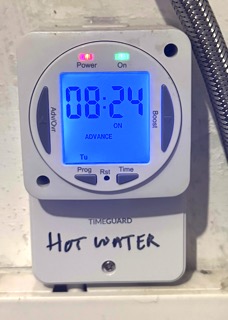
  <li>At the hot water control
<img src="/writing/assets/images/HotWaterGSHP Small.jpeg" alt="Hotwater" />
press the <strong>Advance/Override</strong> (left‑hand) button once to call for hot water from the heat pump;
listen for the unit starting and give it time to heat the cylinder.</li>

  <li>If the return temperature quickly rises to the mid‑40°C range and the heat pump stops, the tank is already hot
enough; check if the hot outlet pipe from the top of the tank warms up after running a hot tap for a short while.</li>
  <li>If extra hot water is needed and the heat pump has finished its HW cycle,
use the <strong>solar boost</strong>:
<img src="/writing/assets/images/IMG_8934 Small.jpeg" alt="Boost" /></li>
</ul>

<p>press the Boost button to add 15‑minute blocks (up to 2 hours) of immersion heating from solar PV
  and grid.</p>

<h2 id="if-the-heating-is-not-working">If the heating is not working</h2>

<ul>
  <li>Confirm the ground source heat pump has power, the touch screen lights up on a firm press and shows no error.</li>
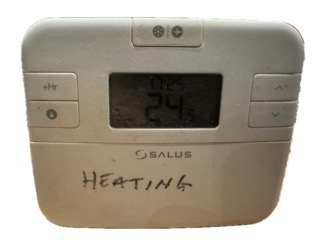
  <li>Check the <strong>thermostat in bedroom 2</strong>: <img src="/writing/assets/images/IMG_8919 Background Removed Small.jpeg" alt="Salus gadget" />
    <ul>
      <li>Make sure the set point is above the current room temperature by pressing either right hand button.
You can increase the set point by pressing the ^ button, and decrease it using the ˅ button.</li>
      <li>Make sure “Manual” or “Frost” modes are not preventing heating.
The Frost mode is set by pressing the top button; the Manual mode by pressing the
hand symbol on the left. Once Manual mode is set the set point remains where it is
until pressed again!</li>
    </ul>
  </li>
  <li>If the pump is running but some radiators are still cold after 30–60 minutes, bleed them: the keys are in the box.</li>
</ul>

<h2 id="if-the-power-has-tripped">If the power has tripped</h2>

<ul>
  <li>Go to the main consumer unit (large circuit board).</li>
  <li>If the main switch has tripped (very unsual)
try resetting it, if it keeps tripping and you can’t find a faulty device, call electrician.</li>
  <li>Check which side has tripped; remember the <strong>right‑hand section</strong> also feeds the <strong>water pump</strong>, so if this is off,
the reservoir will no longer fill.</li>
  <li>Try resetting the tripped switch.</li>
  <li>If a specific circuit keeps tripping, switch that individual circuit off so the <strong>water pump circuit</strong> can stay on,
then arrange an electrician to investigate.</li>
</ul>

<h2 id="meters">Meters</h2>

<ul>
  <li>If needed, or interested, there are a number of electricity meters at Murtwell Farm.</li>
  <li>Main meter <img src="/writing/assets/images/IMG_8918 Background Removed Small.jpeg" alt="Main meter" /></li>
  <li>Solar panel meter <img src="/writing/assets/images/IMG_8916 Background Removed Small.jpeg" alt="Solar meter" /></li>
  <li>Swallow’s nest meter <img src="/writing/assets/images/IMG_8915 Background Removed Small.jpeg" alt="Swallow meter" /></li>
  <li>GSHP meter <img src="/writing/assets/images/GSHP_meter Small.jpeg" alt="GSHP meter" /></li>
</ul>

<h2 id="contacts">Contacts</h2>

<h3 id="we-have-a-kensa-heat-pump-installed-by-ecotrades">We have a Kensa heat pump; installed by EcoTrades</h3>

<p>The thermostat controller in bedroom 2 is a Salus RT510TX taking 2 x AA batteries.</p>

<h3 id="ecotrades-contact-options-">EcoTrades contact options <sup id="fnref:21" role="doc-noteref"><a href="#fn:21" class="footnote" rel="footnote">3</a></sup></h3>

<ul>
  <li>In an emergency, please contact the installers.</li>
  <li><strong>Main office phone</strong>: 01803 393530 (primary contact for Eco Trades South West Ltd).<sup id="fnref:4" role="doc-noteref"><a href="#fn:4" class="footnote" rel="footnote">4</a></sup></li>
  <li>Address: 224 Torquay Road, Paignton, Devon, TQ3 2HN.</li>
  <li>General email: <a href="mailto:sales@eco-trades.co.uk">sales@eco-trades.co.uk</a>.<sup id="fnref:4:1" role="doc-noteref"><a href="#fn:4" class="footnote" rel="footnote">4</a></sup><sup id="fnref:2" role="doc-noteref"><a href="#fn:2" class="footnote" rel="footnote">5</a></sup></li>
</ul>

<h3 id="other-tradespeople">other tradespeople</h3>

<ul>
  <li>Plumber / water system support: [PLUMBER NAME + NUMBER – fill in].</li>
  <li>Solar PV / solar boost support: [INSTALLER NAME + NUMBER – fill in].</li>
  <li><strong>Spring water supply – Nick Franklin</strong>: [see folder].</li>
</ul>

<div class="footnotes" role="doc-endnotes">
  <ol>
    <li id="fn:3a" role="doc-endnote">
      <p><a href="https://octopus.energy">https://octopus.energy</a> <a href="#fnref:3a" class="reversefootnote" role="doc-backlink">&#8617;</a></p>
    </li>
    <li id="fn:3b" role="doc-endnote">
      <p><a href="https://www.nationalgrid.com/power-cuts">https://www.nationalgrid.com/power-cuts</a> <a href="#fnref:3b" class="reversefootnote" role="doc-backlink">&#8617;</a></p>
    </li>
    <li id="fn:21" role="doc-endnote">
      <p><a href="https://www.trustmark.org.uk/firms/Eco Trades South West Ltd-336034-TQ3 2HN?id=95348cda-3df9-4eea-8afa-30361ba9287e">https://www.trustmark.org.uk/firms/Eco Trades South West Ltd-336034-TQ3 2HN?id=95348cda-3df9-4eea-8afa-30361ba9287e</a> <a href="#fnref:21" class="reversefootnote" role="doc-backlink">&#8617;</a></p>
    </li>
    <li id="fn:4" role="doc-endnote">
      <p><a href="https://www.placesforpeople.co.uk/helpful-guides-tips/my-place-blog/what-to-do-if-you-have-no-hot-water/">https://www.placesforpeople.co.uk/helpful-guides-tips/my-place-blog/what-to-do-if-you-have-no-hot-water/</a> <a href="#fnref:4" class="reversefootnote" role="doc-backlink">&#8617;</a> <a href="#fnref:4:1" class="reversefootnote" role="doc-backlink">&#8617;<sup>2</sup></a></p>
    </li>
    <li id="fn:2" role="doc-endnote">
      <p><a href="https://www.viessmann.co.uk/en/heating-advice/boilers/no-hot-water-heres-what-to-check.html">https://www.viessmann.co.uk/en/heating-advice/boilers/no-hot-water-heres-what-to-check.html</a> <a href="#fnref:2" class="reversefootnote" role="doc-backlink">&#8617;</a></p>
    </li>
  </ol>
</div>]]></content><author><name>fairflow</name></author><category term="ai" /><summary type="html"><![CDATA[Murtwell Farm Troubleshooting Guide – Heating, Hot Water and Water Pressure]]></summary></entry><entry><title type="html">Cultural Theory: Summary</title><link href="https://fairflow.github.io/writing/cultural-theory-summary/" rel="alternate" type="text/html" title="Cultural Theory: Summary" /><published>2025-11-05T14:07:30+00:00</published><updated>2025-11-05T14:07:30+00:00</updated><id>https://fairflow.github.io/writing/cultural-theory-summary</id><content type="html" xml:base="https://fairflow.github.io/writing/cultural-theory-summary/"><![CDATA[<p><img src="https://r2cdn.perplexity.ai/pplx-full-logo-primary-dark%402x.png" alt="Perplexity AI Logo" /></p>

<h2 id="cultural-theory-overview">Cultural Theory Overview</h2>

<p>Please provide the broad outlines of Cultural Theory as originated by the anthropologist Mary Douglas and co-authors and
further developed by academics such as Michael Thompson and his co-authors. Sketch the origin and overall development of
the theory and in particular explain in detail the meaning and origin of the dimensions of Group and Grid and how they
interact with distinct ways of life. Then draft a research plan and recommended readings that will allow your users to
develop a thorough understanding of Cultural Theory and its current frontiers.</p>

<p>I have gathered sufficient information to provide a comprehensive response. Let me now synthesize this into a detailed
report on Cultural Theory.</p>

<h2 id="cultural-theory-origins-development-and-research-frontiers">Cultural Theory: Origins, Development, and Research Frontiers</h2>

<p>Cultural Theory represents one of the most influential yet parsimonious frameworks in the social sciences for
understanding how social organization and cultural worldviews mutually constitute one another. Originating in the
pioneering work of British anthropologist Mary Douglas and subsequently developed through collaborations with political
scientists Aaron Wildavsky, Richard Ellis, and anthropologist Michael Thompson, the theory offers a systematic approach
to analyzing the “grid” and “group” dimensions that structure human social life and the distinct ways of life they
generate. At its core, Cultural Theory proposes that beneath the luxuriant diversity of human customs and languages,
there exist just four (or five) viable forms of social solidarity, all of which will be found in varying strengths and
patterns of interaction in any social system.<sup id="fnref:1_1" role="doc-noteref"><a href="#fn:1_1" class="footnote" rel="footnote">1</a></sup><sup id="fnref:1_2" role="doc-noteref"><a href="#fn:1_2" class="footnote" rel="footnote">2</a></sup><sup id="fnref:1_3" role="doc-noteref"><a href="#fn:1_3" class="footnote" rel="footnote">3</a></sup></p>

<h2 id="origins-and-intellectual-development">Origins and Intellectual Development</h2>

<h3 id="early-foundations-in-anthropology">Early Foundations in Anthropology</h3>

<p>Mary Douglas first introduced the grid-group framework in her 1970 book <em>Natural Symbols: Explorations in Cosmology</em>,
which she later described as “a simple idea presented in a complicated way”. This work emerged as a sequel to her
earlier masterpiece <em>Purity and Danger</em> (1966), which had challenged Western ideas about pollution and clarified how
social context and history shape concepts of cleanliness and contamination. Douglas herself acknowledged that the
development of grid-group analysis was significantly influenced by conversations with linguist Basil Bernstein, who
challenged her universalist assumptions about classification systems. Bernstein’s distinction between “positional” and
“personal” forms of family control, based on his work on elaborated and restricted linguistic codes, provided the
conceptual scaffolding for Douglas’s two-dimensional typology.<sup id="fnref:1_3:1" role="doc-noteref"><a href="#fn:1_3" class="footnote" rel="footnote">3</a></sup><sup id="fnref:1_4" role="doc-noteref"><a href="#fn:1_4" class="footnote" rel="footnote">4</a></sup><sup id="fnref:1_5" role="doc-noteref"><a href="#fn:1_5" class="footnote" rel="footnote">5</a></sup><sup id="fnref:1_6" role="doc-noteref"><a href="#fn:1_6" class="footnote" rel="footnote">6</a></sup><sup id="fnref:1_7" role="doc-noteref"><a href="#fn:1_7" class="footnote" rel="footnote">7</a></sup></p>

<p>The original motivation for developing this framework was deeply rooted in anthropological concerns of the 1960s.
Douglas and her colleagues were engaged in dismantling intellectual barriers that distinguished “primitive” societies
from modern ones, demonstrating that supposedly exotic concepts like pollution taboos and ritual observances were
universal human phenomena. The grid-group model emerged from Douglas’s attempt to create a typology of cultures based
on people’s need for classification, emphasizing the division of labor and organization of work. She initially plotted
the main varieties of social organization using Bernstein’s two-dimensional scheme of family organizations, then
derived logically compatible values for each variety.<sup id="fnref:1_3:2" role="doc-noteref"><a href="#fn:1_3" class="footnote" rel="footnote">3</a></sup></p>

<h3 id="the-transformation-through-collaboration">The Transformation Through Collaboration</h3>

<p>The framework underwent radical transformation through Douglas’s collaboration with Aaron Wildavsky at the Russell Sage
Foundation in New York, beginning in 1976. Wildavsky, a policy analyst, was baffled by sudden shifts in public anxiety
about nuclear power and environmental risks in the United States. Their joint work, culminating in <em>Risk and Culture: An
Essay on the Selection of Technical and Environmental Dangers</em> (1982), applied grid-group analysis to modern political
controversies, particularly conflicts over air pollution and nuclear power. This collaboration moved the theory from its
African ethnographic origins toward a general theory of culture applicable to contemporary policy
debates.<sup id="fnref:1_8" role="doc-noteref"><a href="#fn:1_8" class="footnote" rel="footnote">8</a></sup><sup id="fnref:1_9" role="doc-noteref"><a href="#fn:1_9" class="footnote" rel="footnote">9</a></sup><sup id="fnref:1_10" role="doc-noteref"><a href="#fn:1_10" class="footnote" rel="footnote">10</a></sup><sup id="fnref:1_3:3" role="doc-noteref"><a href="#fn:1_3" class="footnote" rel="footnote">3</a></sup></p>

<p>The most significant theoretical breakthrough came in 1992 when Michael Thompson and Aaron Wildavsky produced their
seminal textbook <em>Cultural Theory</em>, which introduced the revolutionary concept of competition between cultures. Rather
than viewing grid-group as a static mapping of cultures onto organizations, they proposed that any community contains
several cultures simultaneously, each defining itself by opposition to the others. This “impossibility theorem” posits
that these competing forms of social solidarity necessarily coexist in tension, with members of each culture maintaining
enthusiasm for their way of life by charging other cultures with moral failure. This insight transformed grid-group
analysis into Cultural Theory proper—a dynamic theoretical system that attacked both methodological individualism and
philosophical relativism while placing cultural analysis at the heart of policy studies and ethical
theory.<sup id="fnref:1_2:1" role="doc-noteref"><a href="#fn:1_2" class="footnote" rel="footnote">2</a></sup><sup id="fnref:1_1:1" role="doc-noteref"><a href="#fn:1_1" class="footnote" rel="footnote">1</a></sup><sup id="fnref:1_3:4" role="doc-noteref"><a href="#fn:1_3" class="footnote" rel="footnote">3</a></sup></p>

<h2 id="the-grid-and-group-dimensions-meaning-and-interaction">The Grid and Group Dimensions: Meaning and Interaction</h2>

<h3 id="understanding-group">Understanding Group</h3>

<p>The <strong>group</strong> dimension measures the extent to which an individual’s life is absorbed in and sustained by group
membership. It taps into social integration and collective control, ranging from low to high along a horizontal axis. At
the low end of the group spectrum, individuals spend their mornings in one group, evenings in another, appear on Sundays
in a third, and get their livelihood in a fourth—maintaining autonomy and avoiding binding commitments. At the high end,
exemplified by communities like the Amish, members join together in “common residence, shared work, shared resources and
recreation,” with their lives thoroughly absorbed by collective membership.<sup id="fnref:1_11" role="doc-noteref"><a href="#fn:1_11" class="footnote" rel="footnote">11</a></sup><sup id="fnref:1_2:2" role="doc-noteref"><a href="#fn:1_2" class="footnote" rel="footnote">2</a></sup><sup id="fnref:1_3:5" role="doc-noteref"><a href="#fn:1_3" class="footnote" rel="footnote">3</a></sup></p>

<p>A high-group context exhibits a strong external boundary around the community, with requirements to signal loyalty and
accept constraints on individual behavior simply by virtue of belonging. The degree of group control varies
considerably:
at one extreme, membership might require only Sunday attendance or annual participation; at the other, groups like
convents and monasteries demand full-time, lifetime commitment. For a group to continue existing, there must be some
collective pressure to demonstrate allegiance, and this varies in strength across different social
formations.<sup id="fnref:1_3:6" role="doc-noteref"><a href="#fn:1_3" class="footnote" rel="footnote">3</a></sup></p>

<h3 id="understanding-grid">Understanding Grid</h3>

<p>The <strong>grid</strong> dimension, less familiar to social scientists but conceptually similar to Émile Durkheim’s notion of
“regulation,” measures the extent to which an individual’s social role is defined by external prescriptions within
networks of social privileges, claims, and obligations. A high-grid (highly regulated) social context is characterized
by “an explicit set of institutionalized classifications that keeps individuals apart and regulates their interactions”.
In such settings, roles are primarily ascribed rather than achieved—male does not compete in female spheres, and social
differentiation is based on birth, gender, age, or family position.<sup id="fnref:1_5:1" role="doc-noteref"><a href="#fn:1_5" class="footnote" rel="footnote">5</a></sup><sup id="fnref:1_2:3" role="doc-noteref"><a href="#fn:1_2" class="footnote" rel="footnote">2</a></sup><sup id="fnref:1_8:1" role="doc-noteref"><a href="#fn:1_8" class="footnote" rel="footnote">8</a></sup><sup id="fnref:1_3:7" role="doc-noteref"><a href="#fn:1_3" class="footnote" rel="footnote">3</a></sup></p>

<p>At the zero point of the grid dimension, individuals exist in a social environment free of structural constraints, where
everything must be negotiated ad hoc. Moving along the spectrum toward more comprehensive regulation, societies become
more hierarchical, with extensive classification and programming to solve problems of coordination. Grid regulation can
manifest in various contexts: household chores allocated by age and gender, meal times rigidly fixed with assigned
seating, bedtimes determined by age rather than negotiation. Conversely, in low-grid contexts characterized by “personal
control,” children may demand explanations for rules, bedtime is individually negotiated, and seating arrangements
remain
fluid.<sup id="fnref:1_3:8" role="doc-noteref"><a href="#fn:1_3" class="footnote" rel="footnote">3</a></sup></p>

<h3 id="the-four-or-five-ways-of-life">The Four (or Five) Ways of Life</h3>

<p>The intersection of these two dimensions generates four fundamental ways of life, each representing a viable and stable
form of social organization with its own characteristic worldview, values, and cultural
bias:<sup id="fnref:1_1:2" role="doc-noteref"><a href="#fn:1_1" class="footnote" rel="footnote">1</a></sup><sup id="fnref:1_2:4" role="doc-noteref"><a href="#fn:1_2" class="footnote" rel="footnote">2</a></sup><sup id="fnref:1_8:2" role="doc-noteref"><a href="#fn:1_8" class="footnote" rel="footnote">8</a></sup><sup id="fnref:1_3:9" role="doc-noteref"><a href="#fn:1_3" class="footnote" rel="footnote">3</a></sup></p>

<p><strong>Hierarchy (Positional Culture)</strong>: High grid, high group. This quadrant represents societies where all roles are
ascribed, all behavior governed by positional rules, and constituent groups contained within a comprehensive larger
structure. Originally termed “hierarchy” in the sense of a rational system, Douglas later adopted the term “positional”
after facing criticism from radical ideologists. This form of society uses extensive classification and programming for
coordination, sustaining itself with a cosmic theory of a hierarchical universe. Its cultural bias supports tradition,
order, and loyalty, with a theory of justice that takes status into account. Max Weber’s rational bureaucracy
exemplifies
this cultural type.<sup id="fnref:1_2:5" role="doc-noteref"><a href="#fn:1_2" class="footnote" rel="footnote">2</a></sup><sup id="fnref:1_3:10" role="doc-noteref"><a href="#fn:1_3" class="footnote" rel="footnote">3</a></sup></p>

<p><strong>Individualism</strong>: Low grid, low group. This quadrant is defined by weakness in both group controls and grid controls,
where the main form of control available is competition. Dominant positions are open to merit rather than ascription,
and
individuals primarily concern themselves with private benefit. This is Max Weber’s commercial society, where the
individual operates with minimal group commitment. While in principle egalitarian, individualism fails to realize its
egalitarian ideals because it defers to wealth and power. Individualists perceive risks, particularly from new
technologies, as opportunities for self-advancement and profit, and they fear risks that limit their freedoms to
bargain.<sup id="fnref:1_12" role="doc-noteref"><a href="#fn:1_12" class="footnote" rel="footnote">12</a></sup><sup id="fnref:1_2:6" role="doc-noteref"><a href="#fn:1_2" class="footnote" rel="footnote">2</a></sup><sup id="fnref:1_3:11" role="doc-noteref"><a href="#fn:1_3" class="footnote" rel="footnote">3</a></sup></p>

<p><strong>Egalitarianism (Enclave Culture)</strong>: High group, low grid. This quadrant features a strongly bounded group with no
ranking or grading rules between members. Derived from the properties of the diagram showing strong external boundaries
but internal lack of regulatory controls, this form suits dissident minorities or sects. Leaders support group
boundaries
by declaring outsiders evil, while dealing with internal dissent proves difficult because, having withdrawn from
mainstream society, they cannot invoke external law to punish offenders. Their only penalty is expulsion, which they
prefer not to use. The enclave community tends to be egalitarian because it repudicates the inequalities of the rejected
outside world. Egalitarians frame risks in ethical terms, distrust elite experts and authorities, and oppose risks that
may cause irreversible effects on people and the environment.<sup id="fnref:1_12:1" role="doc-noteref"><a href="#fn:1_12" class="footnote" rel="footnote">12</a></sup><sup id="fnref:1_3:12" role="doc-noteref"><a href="#fn:1_3" class="footnote" rel="footnote">3</a></sup></p>

<p><strong>Fatalism (Isolate Culture)</strong>: High grid, low group. This quadrant features strong grid controls without group
membership to sustain individuals. Cultural isolates include prisoners, slaves, strictly supervised servants, soldiers,
the very poor, or even figures like the Queen of England, “hedged around as she is by protocol”. Importantly, some
arrive
here voluntarily, seeking to avoid responsibility and pressure—hermits or monks may find this a benign culture.
Fatalists
are excluded and controlled from without, characterized by apathy and a sense that they cannot influence events. From a
sustainability perspective, fatalists see nature as unpredictable and beyond human control, viewing environmental
problems as overwhelming and personal actions as futile.<sup id="fnref:1_13" role="doc-noteref"><a href="#fn:1_13" class="footnote" rel="footnote">13</a></sup><sup id="fnref:1_12:2" role="doc-noteref"><a href="#fn:1_12" class="footnote" rel="footnote">12</a></sup><sup id="fnref:1_3:13" role="doc-noteref"><a href="#fn:1_3" class="footnote" rel="footnote">3</a></sup></p>

<p><strong>The Fifth Way: Autonomy (Hermit)</strong>: Michael Thompson later added a fifth solidarity—the hermit or autonomous
individual—who survives without social ties and rejects involvement with all four other cultural forms. The hermit
creates their own cultural bias by rejecting all others, including the cultural conflicts between solidarities and their
different “myths of nature”. Rather than viewing humans as separate from the environment, the hermit recognizes the
oneness of humans with nature—as either is altered, so is the other. This solidarity occupies a conceptually unique
position, neither entering fully into the grid-group space nor engaging in the coercive patterns of organizing and
disorganizing that the other four take for granted.<sup id="fnref:1_14" role="doc-noteref"><a href="#fn:1_14" class="footnote" rel="footnote">14</a></sup><sup id="fnref:1_15" role="doc-noteref"><a href="#fn:1_15" class="footnote" rel="footnote">15</a></sup><sup id="fnref:1_2:7" role="doc-noteref"><a href="#fn:1_2" class="footnote" rel="footnote">2</a></sup><sup id="fnref:1_3:14" role="doc-noteref"><a href="#fn:1_3" class="footnote" rel="footnote">3</a></sup></p>

<h2 id="myths-of-nature-and-risk-perception">Myths of Nature and Risk Perception</h2>

<p>A crucial innovation in Cultural Theory connects each solidarity to a distinctive “myth of nature,” adapted from
ecologist C.S. Holling’s work on resilience in natural systems. These myths represent how each way of life
conceptualizes the environment’s resilience in the face of human disturbance:<sup id="fnref:1_14:1" role="doc-noteref"><a href="#fn:1_14" class="footnote" rel="footnote">14</a></sup></p>

<ul>
  <li><strong>Individualism</strong>: Nature is robust and benign, capable of withstanding human intervention and bouncing back from
disturbances.<sup id="fnref:1_16" role="doc-noteref"><a href="#fn:1_16" class="footnote" rel="footnote">16</a></sup><sup id="fnref:1_13:1" role="doc-noteref"><a href="#fn:1_13" class="footnote" rel="footnote">13</a></sup></li>
  <li><strong>Hierarchy</strong>: Nature is perverse/tolerant—it has limits, but operation within those limits can be managed through
expert planning and regulation.<sup id="fnref:1_13:2" role="doc-noteref"><a href="#fn:1_13" class="footnote" rel="footnote">13</a></sup><sup id="fnref:1_14:2" role="doc-noteref"><a href="#fn:1_14" class="footnote" rel="footnote">14</a></sup></li>
  <li><strong>Egalitarianism</strong>: Nature is ephemeral and fragile, easily thrown off balance and requiring careful protection
through radical lifestyle changes and collective action.<sup id="fnref:1_13:3" role="doc-noteref"><a href="#fn:1_13" class="footnote" rel="footnote">13</a></sup><sup id="fnref:1_12:3" role="doc-noteref"><a href="#fn:1_12" class="footnote" rel="footnote">12</a></sup></li>
  <li><strong>Fatalism</strong>: Nature is capricious and random, viewed as unreliable in terms of resources and potentially
threatening.<sup id="fnref:1_14:3" role="doc-noteref"><a href="#fn:1_14" class="footnote" rel="footnote">14</a></sup><sup id="fnref:1_13:4" role="doc-noteref"><a href="#fn:1_13" class="footnote" rel="footnote">13</a></sup></li>
  <li><strong>Autonomy/Hermit</strong>: Nature is resilient and integrated, representing a transformational cycle that recognizes the
oneness of humans with environment.<sup id="fnref:1_14:4" role="doc-noteref"><a href="#fn:1_14" class="footnote" rel="footnote">14</a></sup></li>
</ul>

<p>These myths of nature are not merely abstract beliefs but function as cultural biases that structure risk perception and
policy preferences. As Douglas and Wildavsky demonstrated in <em>Risk and Culture</em>, risk perception is not primarily a
matter of individual psychology or rational calculation but reflects social organization. Individuals characterized by
particular cultural worldviews selectively attend to risks that threaten their preferred way of life while downplaying
those that might justify alternatives they oppose.<sup id="fnref:1_17" role="doc-noteref"><a href="#fn:1_17" class="footnote" rel="footnote">17</a></sup><sup id="fnref:1_9:1" role="doc-noteref"><a href="#fn:1_9" class="footnote" rel="footnote">9</a></sup><sup id="fnref:1_18" role="doc-noteref"><a href="#fn:1_18" class="footnote" rel="footnote">18</a></sup><sup id="fnref:1_8:3" role="doc-noteref"><a href="#fn:1_8" class="footnote" rel="footnote">8</a></sup><sup id="fnref:1_12:4" role="doc-noteref"><a href="#fn:1_12" class="footnote" rel="footnote">12</a></sup></p>

<h2 id="methodological-approaches-and-empirical-research">Methodological Approaches and Empirical Research</h2>

<h3 id="survey-based-measurement">Survey-Based Measurement</h3>

<p>The operationalization of Cultural Theory in quantitative research began with Karl Dake’s pioneering work in the late
1980s. Dake developed attitudinal scales—the Cultural Theory Scale (CTS)—that correlated perceptions of various societal
risks (environmental disaster, external aggression, internal disorder, market breakdown) with subjects’ scores on items
believed to reflect cultural worldviews associated with the grid-group scheme. These measures have been employed in
dozens of studies focusing on environmental, technological, and other policy risks across multiple
countries.<sup id="fnref:1_19" role="doc-noteref"><a href="#fn:1_19" class="footnote" rel="footnote">19</a></sup><sup id="fnref:1_20" role="doc-noteref"><a href="#fn:1_20" class="footnote" rel="footnote">20</a></sup><sup id="fnref:1_21" role="doc-noteref"><a href="#fn:1_21" class="footnote" rel="footnote">21</a></sup><sup id="fnref:1_8:4" role="doc-noteref"><a href="#fn:1_8" class="footnote" rel="footnote">8</a></sup></p>

<p>However, the Dake worldview measures have faced significant criticism. Critics argue that questionnaires composed of
general, context-free questions fail to incorporate analysis of actual social relations and cannot truly tap into the
grid-group dimensions. Some scholars contend that if questionnaires are to be used at all, respondents should be
selected
according to their adherence to particular institutions with distinctive grid and group characteristics. Research has
shown
that each subscale’s reliability, discriminant validity, and predictive validity could be improved, with one study
finding
that only 32% of respondents could clearly be allocated to a single cultural bias using Dake’s
approach.<sup id="fnref:1_20:1" role="doc-noteref"><a href="#fn:1_20" class="footnote" rel="footnote">20</a></sup><sup id="fnref:1_22" role="doc-noteref"><a href="#fn:1_22" class="footnote" rel="footnote">22</a></sup><sup id="fnref:1_21:1" role="doc-noteref"><a href="#fn:1_21" class="footnote" rel="footnote">21</a></sup></p>

<p>More recent efforts have developed alternative approaches to operationalizing Cultural Theory in surveys, including: (1)
relational ranking and rating measures created by Hank Jenkins-Smith and colleagues, (2) “cultural cognition” measures
developed by Dan Kahan and colleagues, and (3) new relational grid-group measures developed by Joe Ripberger, Brendon
Swedlow, and colleagues. The World Values Survey has also been adapted to measure grid and group at individual and
national levels, with researchers generating indices that show significantly less variance within societies than between
societies.<sup id="fnref:1_23" role="doc-noteref"><a href="#fn:1_23" class="footnote" rel="footnote">23</a></sup><sup id="fnref:1_21:2" role="doc-noteref"><a href="#fn:1_21" class="footnote" rel="footnote">21</a></sup></p>

<h3 id="qualitative-and-case-study-approaches">Qualitative and Case Study Approaches</h3>

<p>Beyond survey research, Cultural Theory has proven particularly powerful in interpretive case studies that demonstrate
how particular risk-regulation and policy controversies can be understood within a grid-group framework. David Bloor’s
groundbreaking 1982 study compared three types of universities in 19th-century Germany, examining the organization of
mathematics departments and finding that predicted correspondences between institutional forms and cultural values could
be traced in curriculum emphasis and research topic selection. Gerald Mars applied the framework to dock-workers, hotel
waiters, and other occupations in industrial society, while Frank Hendriks compared city planning and traffic policy in
Munich and Birmingham, using Cultural Theory to explain why Munich citizens had more reason to be satisfied with their
planning outputs.<sup id="fnref:1_8:5" role="doc-noteref"><a href="#fn:1_8" class="footnote" rel="footnote">8</a></sup><sup id="fnref:1_3:15" role="doc-noteref"><a href="#fn:1_3" class="footnote" rel="footnote">3</a></sup></p>

<p>Dipak Gyawali’s work on water policy in Nepal exemplifies how Cultural Theory illuminates complex policy dilemmas
involving multiple stakeholders. His analysis revealed tensions between business interests and bureaucracies favoring
large dams (representing hierarchy and individualism) and political activists protesting forced relocation and
environmental damage (representing egalitarianism). The framework allowed Gyawali to “move away from the dualistic
straitjacket of either individualistic free market or bureaucratic socialism by accepting that two other
solidarities—the egalitarianism of committed activism and the resigned fatalism of the masses—also play crucial
roles”.<sup id="fnref:1_3:16" role="doc-noteref"><a href="#fn:1_3" class="footnote" rel="footnote">3</a></sup></p>

<h3 id="emerging-neuroscience-approaches">Emerging Neuroscience Approaches</h3>

<p>Recent theoretical proposals suggest that Cultural Theory might be tested using approaches from social neuroscience and
experimental methods. Marco Verweij and others have proposed combining case study and survey research with simulations
and experiments to further test and develop the theory. Some researchers have even suggested that the four cultural
solidarities may have neurological foundations, involving distinct patterns of mental processing. However, empirical
work in this direction remains preliminary, and the application of neuroscientific methods to Cultural Theory represents
a frontier for future research rather than an established approach.<sup id="fnref:1_24" role="doc-noteref"><a href="#fn:1_24" class="footnote" rel="footnote">24</a></sup><sup id="fnref:1_25" role="doc-noteref"><a href="#fn:1_25" class="footnote" rel="footnote">25</a></sup></p>

<h2 id="contemporary-applications-and-frontiers">Contemporary Applications and Frontiers</h2>

<h3 id="climate-change-and-environmental-governance">Climate Change and Environmental Governance</h3>

<p>Cultural Theory has become particularly influential in climate change research, where it illuminates why individuals and
communities perceive environmental risks so differently. Research demonstrates that cultural worldviews significantly
predict climate change risk perceptions and policy preferences, often outperforming purely cognitive or economic models.
Egalitarians typically express high concern about climate change and support aggressive mitigation policies,
hierarchists support managed responses through expert-led regulation, individualists tend to downplay climate risks that
might justify market restrictions, and fatalists feel helpless to influence outcomes.<sup id="fnref:1_26" role="doc-noteref"><a href="#fn:1_26" class="footnote" rel="footnote">26</a></sup><sup id="fnref:1_18:1" role="doc-noteref"><a href="#fn:1_18" class="footnote" rel="footnote">18</a></sup><sup id="fnref:1_17:1" role="doc-noteref"><a href="#fn:1_17" class="footnote" rel="footnote">17</a></sup><sup id="fnref:1_12:5" role="doc-noteref"><a href="#fn:1_12" class="footnote" rel="footnote">12</a></sup></p>

<p>Studies show that individuals with traditionally low climate risk perceptions can have these perceptions heightened
through specific media channels, particularly when emphasizing economic risks. This insight offers strategies for
shaping risk perceptions among typically resistant populations. Research on educators—essential actors in climate change
education and policy implementation—has examined relationships between cultural worldviews, climate knowledge, and risk
perceptions, finding potential for education initiatives to amplify risk perceptions and support for mitigation policies
across broader populations.<sup id="fnref:1_26:1" role="doc-noteref"><a href="#fn:1_26" class="footnote" rel="footnote">26</a></sup></p>

<h3 id="clumsy-solutions-and-institutional-design">Clumsy Solutions and Institutional Design</h3>

<p>One of the most important normative developments in Cultural Theory is the concept of “clumsy solutions” for “wicked
problems,” elaborated by Marco Verweij, Steven Ney, Michael Thompson, and others. Wicked problems—characterized by
complexity, uncertainty, multiple stakeholders with conflicting values, and no clear solutions—demand approaches that
acknowledge plural rationalities. Thompson, Wildavsky, and their collaborators argued that while one culture may be
dominant in a community, it must avoid excluding the other three from the public forum. A dominant culture that drives
others underground or reduces them to silence creates instability and potential
violence.<sup id="fnref:1_27" role="doc-noteref"><a href="#fn:1_27" class="footnote" rel="footnote">27</a></sup><sup id="fnref:1_28" role="doc-noteref"><a href="#fn:1_28" class="footnote" rel="footnote">28</a></sup><sup id="fnref:1_29" role="doc-noteref"><a href="#fn:1_29" class="footnote" rel="footnote">29</a></sup><sup id="fnref:1_30" role="doc-noteref"><a href="#fn:1_30" class="footnote" rel="footnote">30</a></sup><sup id="fnref:1_24:1" role="doc-noteref"><a href="#fn:1_24" class="footnote" rel="footnote">24</a></sup><sup id="fnref:1_3:17" role="doc-noteref"><a href="#fn:1_3" class="footnote" rel="footnote">3</a></sup></p>

<p>Clumsy solutions are “so-called not because they’re unreliable or unstable, but because they take account of a plurality
of perspectives and rationales outside of each other’s ‘business as usual’”. These pluralist approaches acknowledge that
solutions need to be as pluralist as the problems they address, with each way of life undermining itself without the
others. Individualism would mean chaos without hierarchical authority and shared solidarities; hierarchies become
stagnant without individualism’s creative energy, incohesive without equality’s binding force, and unstable without
fatalism’s acquiescence. Effective responses to climate change, for example, might include expansion of renewable energy
that “mix creative market forces with governmental planning; also open up many possibilities for local and civic
action”.<sup id="fnref:1_28:1" role="doc-noteref"><a href="#fn:1_28" class="footnote" rel="footnote">28</a></sup></p>

<p>Verweij and Ney developed two criteria for assessing whether any given approach will successfully tackle wicked policy
challenges: (1) the extent to which it activates the full range of partial solutions on offer, and (2) whether it
enables stakeholders to stand back from their own cognitive and social contexts. Of twenty methods analyzed using these
criteria, six approaches successfully mobilized the full range of partial solutions and are therefore likely to solve
wicked problems most effectively. This work emphasizes the need for “messy institutions”—organizational structures and
cultures fit for the demands that clumsy solutions make, able to diagnose wicked problems, support collaborative
partnerships, and deliver pluralist solutions.<sup id="fnref:1_29:1" role="doc-noteref"><a href="#fn:1_29" class="footnote" rel="footnote">29</a></sup><sup id="fnref:1_28:2" role="doc-noteref"><a href="#fn:1_28" class="footnote" rel="footnote">28</a></sup></p>

<h3 id="terrorism-security-and-fundamentalism">Terrorism, Security, and Fundamentalism</h3>

<p>Recent applications of Cultural Theory to understanding terrorist organizations and fundamentalist movements have
revealed important dynamics. Shaul Mishal and Maoz Rosenthal developed a typology of Islamic terrorist organizations
using Cultural Theory, showing how groups like Hezbollah, Hamas, and Al-Qaeda exemplify enclave solidarity
characteristics. Emmanuel Sivan’s research on Israeli fundamentalist groups introduced a crucial new element to
grid-group analysis: the external environment. Unlike the early model’s assumption that enclave groups inevitably face
weakness and fission, Israeli fundamentalist communities do not separate themselves morally from mainstream society and
receive moral and financial support from it. This external support fundamentally alters internal dynamics, reducing
leaders’ anxiety about defection and enabling mutual support networks between groups.<sup id="fnref:1_3:18" role="doc-noteref"><a href="#fn:1_3" class="footnote" rel="footnote">3</a></sup></p>

<p>The rise of information technology has vastly improved the effectiveness of enclave organizations, allowing them to
summon instant support from affiliate groups, coordinate strikes, then dissolve and disappear. This capacity for
flexible networking while maintaining ideological coherence represents a significant evolution in how enclave solidarity
functions in contemporary contexts.<sup id="fnref:1_3:19" role="doc-noteref"><a href="#fn:1_3" class="footnote" rel="footnote">3</a></sup></p>

<h3 id="economic-development-and-fatalism">Economic Development and Fatalism</h3>

<p>Cultural Theory offers important insights for understanding failures in economic development programs. Douglas argued
that newly developing economies often create redistributive pressures that drive populations “up-grid”—formerly
responsible and active individuals become expropriated by new landlords or unable to work in new industries, falling
into the apathy characteristic of isolates. Economists frequently attribute development failures to “the conservative
influence of traditional culture,” but Cultural Theory counsels instead a “cultural audit” to identify present
constraints affecting general morale. This reframes development challenges from problems of cultural backwardness to
problems of social organization that push people into fatalistic isolation.<sup id="fnref:1_3:20" role="doc-noteref"><a href="#fn:1_3" class="footnote" rel="footnote">3</a></sup></p>

<h3 id="trust-pluralism-and-democratic-governance">Trust, Pluralism, and Democratic Governance</h3>

<p>Contemporary applications of Cultural Theory to issues of trust, pluralism, and democratization have expanded
significantly. The framework helps identify sources of mistrust between different cultural communities and suggests
institutional mechanisms for building bridges across worldviews. Research on public participation in science and
technology governance uses Cultural Theory to design more inclusive processes that acknowledge different rationalities
rather than privileging expert hierarchical perspectives.<sup id="fnref:1_31" role="doc-noteref"><a href="#fn:1_31" class="footnote" rel="footnote">31</a></sup><sup id="fnref:1_24:2" role="doc-noteref"><a href="#fn:1_24" class="footnote" rel="footnote">24</a></sup></p>

<p>Brendon Swedlow and others have demonstrated Cultural Theory’s value for comparative political studies because its
theoretical dimensions and cultural types can be applied across diverse contexts with the values, beliefs, and
institutional preferences remaining conceptually stable. The theory has been used to analyze policy debates in areas
ranging from environmental regulation and public health to education policy and criminal justice.<sup id="fnref:1_32" role="doc-noteref"><a href="#fn:1_32" class="footnote" rel="footnote">32</a></sup><sup id="fnref:1_19:1" role="doc-noteref"><a href="#fn:1_19" class="footnote" rel="footnote">19</a></sup><sup id="fnref:1_12:6" role="doc-noteref"><a href="#fn:1_12" class="footnote" rel="footnote">12</a></sup></p>

<h3 id="organizational-culture-and-management">Organizational Culture and Management</h3>

<p>Cultural Theory has found application in analyzing organizational culture within firms, showing how the four
solidarities manifest within corporate contexts. Research examines how different cultural configurations affect
organizational performance, innovation, employee satisfaction, and ethical behavior. The framework helps explain why
identical management practices succeed in some organizations but fail in others—the cultural context determines how
practices are interpreted and experienced.<sup id="fnref:1_33" role="doc-noteref"><a href="#fn:1_33" class="footnote" rel="footnote">33</a></sup><sup id="fnref:1_34" role="doc-noteref"><a href="#fn:1_34" class="footnote" rel="footnote">34</a></sup><sup id="fnref:1_35" role="doc-noteref"><a href="#fn:1_35" class="footnote" rel="footnote">35</a></sup></p>

<h2 id="research-plan-and-recommended-readings">Research Plan and Recommended Readings</h2>

<h3 id="foundational-texts">Foundational Texts</h3>

<p>Any thorough engagement with Cultural Theory must begin with the foundational works that established the framework and
its major developments:</p>

<ol>
  <li><strong>Douglas, Mary (1966).</strong> <em>Purity and Danger: An Analysis of Concepts of Pollution and Taboo</em>. London: Routledge.
This groundbreaking work establishes Douglas’s approach to symbolic interpretation and social classification, laying
conceptual groundwork for grid-group analysis.<sup id="fnref:1_36" role="doc-noteref"><a href="#fn:1_36" class="footnote" rel="footnote">36</a></sup><sup id="fnref:1_6:1" role="doc-noteref"><a href="#fn:1_6" class="footnote" rel="footnote">6</a></sup><sup id="fnref:1_7:1" role="doc-noteref"><a href="#fn:1_7" class="footnote" rel="footnote">7</a></sup><sup id="fnref:1_37" role="doc-noteref"><a href="#fn:1_37" class="footnote" rel="footnote">37</a></sup></li>
  <li><strong>Douglas, Mary (1970).</strong> <em>Natural Symbols: Explorations in Cosmology</em>. London: Routledge. The original presentation
of grid-group theory, exploring how social organization shapes cosmology, ritual, and religious
practice.<sup id="fnref:1_4:1" role="doc-noteref"><a href="#fn:1_4" class="footnote" rel="footnote">4</a></sup><sup id="fnref:1_38" role="doc-noteref"><a href="#fn:1_38" class="footnote" rel="footnote">38</a></sup><sup id="fnref:1_39" role="doc-noteref"><a href="#fn:1_39" class="footnote" rel="footnote">39</a></sup><sup id="fnref:1_5:2" role="doc-noteref"><a href="#fn:1_5" class="footnote" rel="footnote">5</a></sup></li>
  <li><strong>Douglas, Mary (1982).</strong> <em>Essays in the Sociology of Perception</em>. London: Routledge. This edited volume includes
crucial essays by David Bloor, Michael Thompson, Steve Rayner, and others applying grid-group analysis to diverse
topics.<sup id="fnref:1_28:3" role="doc-noteref"><a href="#fn:1_28" class="footnote" rel="footnote">28</a></sup><sup id="fnref:1_3:21" role="doc-noteref"><a href="#fn:1_3" class="footnote" rel="footnote">3</a></sup></li>
  <li><strong>Douglas, Mary and Wildavsky, Aaron (1982).</strong> <em>Risk and Culture: An Essay on the Selection of Technical and
Environmental Dangers</em>. Berkeley: University of California Press. The pivotal work applying grid-group theory to risk
perception and policy debates, transforming it from an anthropological tool to a framework for contemporary policy
analysis.<sup id="fnref:1_9:2" role="doc-noteref"><a href="#fn:1_9" class="footnote" rel="footnote">9</a></sup><sup id="fnref:1_40" role="doc-noteref"><a href="#fn:1_40" class="footnote" rel="footnote">40</a></sup><sup id="fnref:1_10:1" role="doc-noteref"><a href="#fn:1_10" class="footnote" rel="footnote">10</a></sup><sup id="fnref:1_8:6" role="doc-noteref"><a href="#fn:1_8" class="footnote" rel="footnote">8</a></sup><sup id="fnref:1_3:22" role="doc-noteref"><a href="#fn:1_3" class="footnote" rel="footnote">3</a></sup></li>
  <li><strong>Thompson, Michael, Ellis, Richard, and Wildavsky, Aaron (1990).</strong> <em>Cultural Theory</em>. Boulder: Westview Press. The
comprehensive textbook that systematized the theory, introduced the competition framework, and coined the term
“Cultural Theory” to replace “grid-group”.<sup id="fnref:1_41" role="doc-noteref"><a href="#fn:1_41" class="footnote" rel="footnote">41</a></sup><sup id="fnref:1_42" role="doc-noteref"><a href="#fn:1_42" class="footnote" rel="footnote">42</a></sup><sup id="fnref:1_43" role="doc-noteref"><a href="#fn:1_43" class="footnote" rel="footnote">43</a></sup><sup id="fnref:1_44" role="doc-noteref"><a href="#fn:1_44" class="footnote" rel="footnote">44</a></sup><sup id="fnref:1_45" role="doc-noteref"><a href="#fn:1_45" class="footnote" rel="footnote">45</a></sup><sup id="fnref:1_46" role="doc-noteref"><a href="#fn:1_46" class="footnote" rel="footnote">46</a></sup><sup id="fnref:1_1:3" role="doc-noteref"><a href="#fn:1_1" class="footnote" rel="footnote">1</a></sup><sup id="fnref:1_2:8" role="doc-noteref"><a href="#fn:1_2" class="footnote" rel="footnote">2</a></sup><sup id="fnref:1_28:4" role="doc-noteref"><a href="#fn:1_28" class="footnote" rel="footnote">28</a></sup></li>
</ol>

<h3 id="further-theoretical-development">Further Theoretical Development</h3>

<ol>
  <li>Douglas, Mary (1986). <em>How Institutions Think</em>. Syracuse: Syracuse University Press. Explores how institutions
embody and reproduce cultural biases, addressing the relationship between individual cognition and collective
memory.<sup id="fnref:1_28:5" role="doc-noteref"><a href="#fn:1_28" class="footnote" rel="footnote">28</a></sup><sup id="fnref:1_3:23" role="doc-noteref"><a href="#fn:1_3" class="footnote" rel="footnote">3</a></sup></li>
  <li><strong>Douglas, Mary (1992).</strong> <em>Risk and Blame: Essays in Cultural Theory</em>. London: Routledge. A collection of essays
refining Cultural Theory and addressing its critics, with particular attention to concepts of accountability and
social solidarity.<sup id="fnref:1_47" role="doc-noteref"><a href="#fn:1_47" class="footnote" rel="footnote">47</a></sup></li>
  <li><strong>Thompson, Michael (1982).</strong> “A Three Dimensional Model,” in Douglas, Mary (ed.) <em>Essays in the Sociology of
Perception</em>. London: Routledge. Introduces the third dimension of power/manipulation and makes room for the hermit in
the theoretical framework.<sup id="fnref:1_3:24" role="doc-noteref"><a href="#fn:1_3" class="footnote" rel="footnote">3</a></sup></li>
  <li><strong>Douglas, Mary (2004).</strong> “A History of Grid and Group Cultural Theory,” <em>Semiotics</em> (Various republications).
Douglas’s own retrospective account of how the theory developed, evolved, and was transformed by
collaborators—essential reading for understanding the intellectual history.<sup id="fnref:1_3:25" role="doc-noteref"><a href="#fn:1_3" class="footnote" rel="footnote">3</a></sup></li>
</ol>

<h3 id="contemporary-applications">Contemporary Applications</h3>

<ol>
  <li><strong>Verweij, Marco and Thompson, Michael (eds.) (2006).</strong> <em>Clumsy Solutions for a Complex World: Governance, Politics,
   and Plural Perceptions</em>. New York: Palgrave Macmillan. The definitive work on applying Cultural Theory to wicked
   problems and designing pluralist institutional arrangements.<sup id="fnref:1_47:1" role="doc-noteref"><a href="#fn:1_47" class="footnote" rel="footnote">47</a></sup><sup id="fnref:1_27:1" role="doc-noteref"><a href="#fn:1_27" class="footnote" rel="footnote">27</a></sup><sup id="fnref:1_28:6" role="doc-noteref"><a href="#fn:1_28" class="footnote" rel="footnote">28</a></sup></li>
  <li><strong>Rayner, Steve and Cantor, Robin (1987).</strong> “How Fair is Safe Enough?: The Cultural Approach to Technology Choice,”
   <em>Risk Analysis</em> 7(1): 3-9. A concise application to technology assessment that has become widely cited.<sup id="fnref:1_33:1" role="doc-noteref"><a href="#fn:1_33" class="footnote" rel="footnote">33</a></sup></li>
  <li><strong>Dake, Karl (1991).</strong> “Orienting Dispositions in the Perception of Risk: An Analysis of Contemporary Worldviews and
   Cultural Biases,” <em>Journal of Cross-Cultural Psychology</em> 22(1): 61-82. The seminal work operationalizing Cultural
   Theory in survey research, despite subsequent criticisms.<sup id="fnref:1_18:2" role="doc-noteref"><a href="#fn:1_18" class="footnote" rel="footnote">18</a></sup><sup id="fnref:1_12:7" role="doc-noteref"><a href="#fn:1_12" class="footnote" rel="footnote">12</a></sup></li>
  <li><strong>Swedlow, Brendon (2011).</strong> “A Cultural Theory of Politics,” <em>PS: Political Science \&amp; Politics</em> 44(4): 703-710. An
   excellent overview of Cultural Theory’s application to political science with clear explanations and contemporary
   examples.<sup id="fnref:1_32:1" role="doc-noteref"><a href="#fn:1_32" class="footnote" rel="footnote">32</a></sup></li>
  <li><strong>Ney, Steven and Verweij, Marco (2015).</strong> “Messy Institutions for Wicked Problems: How to Generate Clumsy
   Solutions?” <em>Environment and Planning C: Government and Policy</em> 33(6): 1679-1696. Important work on institutional
   design for complex governance challenges.<sup id="fnref:1_29:2" role="doc-noteref"><a href="#fn:1_29" class="footnote" rel="footnote">29</a></sup><sup id="fnref:1_28:7" role="doc-noteref"><a href="#fn:1_28" class="footnote" rel="footnote">28</a></sup></li>
  <li><strong>Tansey, James and Rayner, Steve (2009).</strong> “Cultural Theory and Risk,” in <em>Social Theories of Risk and Uncertainty:
   An Introduction</em> (eds. Zinn, Jens O.). Blackwell. A comprehensive review of Cultural Theory’s contribution to risk
   analysis with discussion of contemporary applications.<sup id="fnref:1_31:1" role="doc-noteref"><a href="#fn:1_31" class="footnote" rel="footnote">31</a></sup></li>
</ol>

<h3 id="empirical-studies">Empirical Studies</h3>

<ol>
  <li><strong>Chai, Sun-Ki, Liu, Ming, and Kim, Min-Sun (2009).</strong> “Cultural Comparisons of Beliefs and Values: Applying the
   Grid-Group Approach to the World Values Survey,” <em>Beliefs and Values</em> 1(2): 193-208. Demonstrates large-scale
   quantitative application using cross-national survey data.<sup id="fnref:1_23:1" role="doc-noteref"><a href="#fn:1_23" class="footnote" rel="footnote">23</a></sup></li>
  <li><strong>Kahan, Dan M., Braman, Donald, Gastil, John, Slovic, Paul, and Mertz, C.K. (2007).</strong> “Culture and
   Identity-Protective Cognition: Explaining the White-Male Effect in Risk Perception,” <em>Journal of Empirical Legal
   Studies</em> 4(3): 465-505. Applies cultural cognition (derived from Cultural Theory) to risk perception with
   sophisticated experimental methods.</li>
  <li><strong>Parsons, Meg, et al. (2023).</strong> “Cultural Worldviews and the Perception of Natural Hazard Risks,” <em>Journal of Risk
   Research</em> 26(1). Recent application to natural hazards showing continued relevance and evolution of the
   framework.<sup id="fnref:1_12:8" role="doc-noteref"><a href="#fn:1_12" class="footnote" rel="footnote">12</a></sup></li>
  <li><strong>Xue, Wen, et al. (2014).</strong> “Cultural Worldviews and Environmental Risk Perceptions,” <em>Journal of Environmental
   Psychology</em> 40: 249-258. Empirical study demonstrating how cultural biases predict environmental risk perceptions
   across diverse populations.<sup id="fnref:1_48" role="doc-noteref"><a href="#fn:1_48" class="footnote" rel="footnote">48</a></sup></li>
  <li><strong>Gyawali, Dipak (2001).</strong> <em>Water in Nepal</em>. Kathmandu: Himal Books. Excellent case study applying Cultural Theory to
   water resource policy in a developing country context, showing practical utility of the framework.<sup id="fnref:1_3:26" role="doc-noteref"><a href="#fn:1_3" class="footnote" rel="footnote">3</a></sup></li>
</ol>

<h3 id="critical-engagement-and-related-approaches">Critical Engagement and Related Approaches</h3>

<ol>
  <li><strong>6, Perri and Richards, Peter (2017).</strong> <em>Mary Douglas: Understanding Social Thought and Conflict</em>. New York:
   Berghahn. Provides both intellectual biography and critical assessment of Douglas’s significance.<sup id="fnref:1_11:1" role="doc-noteref"><a href="#fn:1_11" class="footnote" rel="footnote">11</a></sup></li>
  <li><strong>Fardon, Richard (1999).</strong> <em>Mary Douglas: An Intellectual Biography</em>. London: Routledge. The definitive scholarly
   biography placing Douglas’s work in its intellectual and historical context.<sup id="fnref:1_11:2" role="doc-noteref"><a href="#fn:1_11" class="footnote" rel="footnote">11</a></sup></li>
  <li><strong>Wildavsky, Aaron (1987).</strong> “Choosing Preferences by Constructing Institutions: A Cultural Theory of Preference
   Formation,” <em>American Political Science Review</em> 81(1): 3-21. Important theoretical article on how institutions shape
   preferences rather than merely constraining them.</li>
  <li><strong>Ellis, Richard and Thompson, Michael (1997).</strong> “Seeing Green: Cultural Biases and Environmental Preferences,” in
   <em>Culture Matters: Essays in Honor of Aaron Wildavsky</em> (eds. Ellis, Richard and Thompson, Michael). Boulder: Westview.
   Application to environmental politics with theoretical refinements.</li>
  <li><strong>Ripberger, Joseph T., et al. (2012).</strong> “Reconsidering the Relationship Between Cultural Theory, Political Ideology,
   and Political Knowledge,” <em>Social Science Quarterly</em> 93(3): 713-731. Critical examination of how Cultural Theory
   relates to conventional political ideology measures.<sup id="fnref:1_19:2" role="doc-noteref"><a href="#fn:1_19" class="footnote" rel="footnote">19</a></sup></li>
</ol>

<h3 id="current-research-frontiers">Current Research Frontiers</h3>

<ol>
  <li><strong>Verweij, Marco, et al. (2011).</strong> “How to Test Cultural Theory: Suggestions for Future Research,” <em>PS: Political
   Science \&amp; Politics</em> 44(4): 745-748. Outlines methodological approaches for further testing and developing the
   theory, including simulations, experiments, and social neuroscience methods.<sup id="fnref:1_24:3" role="doc-noteref"><a href="#fn:1_24" class="footnote" rel="footnote">24</a></sup></li>
  <li><strong>Galloway, Brinley (2024).</strong> <em>Cultural Theory and Climate Change Risk Perceptions</em> (Dissertation). University of
   Arkansas. Recent dissertation exploring Cultural Theory’s application to climate policy with novel methodological
   approaches.<sup id="fnref:1_26:2" role="doc-noteref"><a href="#fn:1_26" class="footnote" rel="footnote">26</a></sup></li>
  <li><strong>Chassang, Irène, et al. (2024).</strong> “Cultural Values, Risk Characteristics, and Risk Perceptions of Renewable
   Energies,” <em>Energy Policy</em>. Integrates Cultural Theory with psychometric paradigm approaches to risk
   perception.<sup id="fnref:1_18:3" role="doc-noteref"><a href="#fn:1_18" class="footnote" rel="footnote">18</a></sup></li>
  <li><strong>Maesschalck, Jeroen, et al. (2021).</strong> “Using Grid-Group Cultural Theory as a Lens to Take an ‘Adequate Snapshot’ of
   the Culture of an Organization,” <em>SAGE Open</em> 11(4). Recent work developing improved survey instruments for
   organizational culture research.<sup id="fnref:1_35:1" role="doc-noteref"><a href="#fn:1_35" class="footnote" rel="footnote">35</a></sup></li>
  <li><strong>Davidson, Marc D. (2024).</strong> “Cultural Theory and Political Philosophy: Why Cognitive Biases Are Not a Substitute
   for Diverging Worldviews,” <em>Politics, Philosophy \&amp; Economics</em> 23(4). Recent philosophical engagement with Cultural
   Theory’s epistemological foundations.<sup id="fnref:1_17:2" role="doc-noteref"><a href="#fn:1_17" class="footnote" rel="footnote">17</a></sup></li>
</ol>

<h3 id="research-strategy">Research Strategy</h3>

<p>For researchers seeking to develop thorough understanding of Cultural Theory, the following progression is recommended:</p>

<p><strong>Phase 1: Foundations</strong> (3-4 months). Begin with <em>Purity and Danger</em> and <em>Natural Symbols</em> to grasp Douglas’s
intellectual approach and the original formulation of grid-group theory. Follow with Douglas’s retrospective essay “A
History of Grid and Group Cultural Theory” to understand how the framework evolved. Read <em>Risk and Culture</em> to see the
first major application beyond anthropology.</p>

<p><strong>Phase 2: Systematic Theory</strong> (2-3 months). Study the 1990 Thompson, Ellis, and Wildavsky <em>Cultural Theory</em> textbook
carefully, as this represents the mature formulation. Supplement with 6 and Richards’s <em>Mary Douglas: Understanding
Social Thought and Conflict</em> and Fardon’s biography to gain critical perspective.</p>

<p><strong>Phase 3: Contemporary Applications</strong> (3-4 months). Read Verweij and Thompson’s <em>Clumsy Solutions for a Complex World</em>
alongside Ney and Verweij’s work on messy institutions. Study empirical applications in your area of interest
(environmental policy, political behavior, organizational studies, etc.) selected from the recommended readings above.</p>

<p><strong>Phase 4: Methodological Engagement</strong> (2-3 months). Examine debates about operationalization through Dake’s original
work, critiques by various scholars, and recent alternatives proposed by Jenkins-Smith, Kahan, Ripberger, and
colleagues. Consider how different methodological approaches suit different research questions.</p>

<p><strong>Phase 5: Critical Frontiers</strong> (ongoing). Engage with recent applications in your substantive area, paying attention to
theoretical refinements and methodological innovations. Consider how Cultural Theory might illuminate problems in ways
that alternative frameworks cannot, while remaining attentive to its limitations and critics.</p>

<p>This research plan provides foundation for both theoretical understanding and practical application of Cultural Theory,
equipping researchers to contribute to current debates and extend the framework to new domains. The theory’s
parsimony—explaining cultural variation through just four or five fundamental solidarities rather than infinite
plurality or no plurality—makes it remarkably versatile while remaining empirically testable. Its continued evolution
through collaborative development ensures that Cultural Theory remains a living framework responsive to contemporary
challenges while maintaining theoretical coherence across nearly six decades of scholarship.<sup id="fnref:1_11:3" role="doc-noteref"><a href="#fn:1_11" class="footnote" rel="footnote">11</a></sup><sup id="fnref:1_3:27" role="doc-noteref"><a href="#fn:1_3" class="footnote" rel="footnote">3</a></sup>
<span style="display:none"><sup id="fnref:1_49" role="doc-noteref"><a href="#fn:1_49" class="footnote" rel="footnote">49</a></sup><sup id="fnref:1_50" role="doc-noteref"><a href="#fn:1_50" class="footnote" rel="footnote">50</a></sup><sup id="fnref:1_51" role="doc-noteref"><a href="#fn:1_51" class="footnote" rel="footnote">51</a></sup><sup id="fnref:1_52" role="doc-noteref"><a href="#fn:1_52" class="footnote" rel="footnote">52</a></sup><sup id="fnref:1_53" role="doc-noteref"><a href="#fn:1_53" class="footnote" rel="footnote">53</a></sup><sup id="fnref:1_54" role="doc-noteref"><a href="#fn:1_54" class="footnote" rel="footnote">54</a></sup><sup id="fnref:1_55" role="doc-noteref"><a href="#fn:1_55" class="footnote" rel="footnote">55</a></sup><sup id="fnref:1_56" role="doc-noteref"><a href="#fn:1_56" class="footnote" rel="footnote">56</a></sup><sup id="fnref:1_57" role="doc-noteref"><a href="#fn:1_57" class="footnote" rel="footnote">57</a></sup><sup id="fnref:1_58" role="doc-noteref"><a href="#fn:1_58" class="footnote" rel="footnote">58</a></sup><sup id="fnref:1_59" role="doc-noteref"><a href="#fn:1_59" class="footnote" rel="footnote">59</a></sup><sup id="fnref:1_60" role="doc-noteref"><a href="#fn:1_60" class="footnote" rel="footnote">60</a></sup><sup id="fnref:1_61" role="doc-noteref"><a href="#fn:1_61" class="footnote" rel="footnote">61</a></sup><sup id="fnref:1_62" role="doc-noteref"><a href="#fn:1_62" class="footnote" rel="footnote">62</a></sup><sup id="fnref:1_63" role="doc-noteref"><a href="#fn:1_63" class="footnote" rel="footnote">63</a></sup><sup id="fnref:1_64" role="doc-noteref"><a href="#fn:1_64" class="footnote" rel="footnote">64</a></sup><sup id="fnref:1_65" role="doc-noteref"><a href="#fn:1_65" class="footnote" rel="footnote">65</a></sup><sup id="fnref:1_66" role="doc-noteref"><a href="#fn:1_66" class="footnote" rel="footnote">66</a></sup><sup id="fnref:1_67" role="doc-noteref"><a href="#fn:1_67" class="footnote" rel="footnote">67</a></sup><sup id="fnref:1_68" role="doc-noteref"><a href="#fn:1_68" class="footnote" rel="footnote">68</a></sup><sup id="fnref:1_69" role="doc-noteref"><a href="#fn:1_69" class="footnote" rel="footnote">69</a></sup><sup id="fnref:1_70" role="doc-noteref"><a href="#fn:1_70" class="footnote" rel="footnote">70</a></sup><sup id="fnref:1_71" role="doc-noteref"><a href="#fn:1_71" class="footnote" rel="footnote">71</a></sup><sup id="fnref:1_72" role="doc-noteref"><a href="#fn:1_72" class="footnote" rel="footnote">72</a></sup><sup id="fnref:1_73" role="doc-noteref"><a href="#fn:1_73" class="footnote" rel="footnote">73</a></sup><sup id="fnref:1_74" role="doc-noteref"><a href="#fn:1_74" class="footnote" rel="footnote">74</a></sup><sup id="fnref:1_75" role="doc-noteref"><a href="#fn:1_75" class="footnote" rel="footnote">75</a></sup><sup id="fnref:1_76" role="doc-noteref"><a href="#fn:1_76" class="footnote" rel="footnote">76</a></sup><sup id="fnref:1_77" role="doc-noteref"><a href="#fn:1_77" class="footnote" rel="footnote">77</a></sup><sup id="fnref:1_78" role="doc-noteref"><a href="#fn:1_78" class="footnote" rel="footnote">78</a></sup><sup id="fnref:1_79" role="doc-noteref"><a href="#fn:1_79" class="footnote" rel="footnote">79</a></sup><sup id="fnref:1_80" role="doc-noteref"><a href="#fn:1_80" class="footnote" rel="footnote">80</a></sup><sup id="fnref:1_81" role="doc-noteref"><a href="#fn:1_81" class="footnote" rel="footnote">81</a></sup><sup id="fnref:1_82" role="doc-noteref"><a href="#fn:1_82" class="footnote" rel="footnote">82</a></sup><sup id="fnref:1_83" role="doc-noteref"><a href="#fn:1_83" class="footnote" rel="footnote">83</a></sup><sup id="fnref:1_84" role="doc-noteref"><a href="#fn:1_84" class="footnote" rel="footnote">84</a></sup><sup id="fnref:1_85" role="doc-noteref"><a href="#fn:1_85" class="footnote" rel="footnote">85</a></sup></span></p>

<div align="center">⁂</div>

<hr />

<h1 id="research-request-systems-dynamics-and-computational-modeling">Research Request: Systems Dynamics and Computational Modeling</h1>

<p>As a computer scientist who understands complex dynamics (including Markov chains and Systems Dynamics (SD) models) to
some degree and who is capable of building computer simulations of the dynamic process underlying changes in cultural
loyalty (along the 2 or 3 dimensions of the theory), I am interested to know if there are any known SD models of aspects
of Cultural Theory and how cultural membership changes and flows between the different quadrants (or octants) and across
different aspects of life. Simulations of such models might give a qualitative idea of the dynamical modes of the system.
Such models and simulations of these models would help me refine my understanding, test hypotheses and get “under the
skin” of the theory and its operationalization. Please augment the research plan with mathematical and SD modelling and
substantial simulations with possibly statistical analysis.</p>

<p>I have gathered extensive information about Cultural Theory and mathematical/computational modeling approaches. Let me
synthesize this information to provide a comprehensive augmented research plan.</p>

<h2 id="augmented-research-plan-mathematical-modeling-systems-dynamics-and-computational-simulation-in-cultural-theory">Augmented Research Plan: Mathematical Modeling, Systems Dynamics, and Computational Simulation in Cultural Theory</h2>

<p>Building on the comprehensive overview provided earlier, this augmented section addresses your specific interests in
mathematical formalization, systems dynamics modeling, agent-based simulation, and statistical approaches to Cultural
Theory.</p>

<h3 id="current-state-of-mathematical-and-computational-modeling-in-cultural-theory">Current State of Mathematical and Computational Modeling in Cultural Theory</h3>

<p>The mathematical and computational formalization of Cultural Theory remains an underdeveloped frontier, despite strong
theoretical arguments for such approaches. While Cultural Theory offers a parsimonious framework for understanding
cultural dynamics through just four or five solidarities, rigorous mathematical formalization has lagged behind
conceptual development.<sup id="fnref:2_1" role="doc-noteref"><a href="#fn:2_1" class="footnote" rel="footnote">86</a></sup><sup id="fnref:2_2" role="doc-noteref"><a href="#fn:2_2" class="footnote" rel="footnote">87</a></sup><sup id="fnref:2_3" role="doc-noteref"><a href="#fn:2_3" class="footnote" rel="footnote">88</a></sup><sup id="fnref:2_4" role="doc-noteref"><a href="#fn:2_4" class="footnote" rel="footnote">89</a></sup></p>

<h4 id="the-cowcult-system-dynamics-model">The COWCULT System Dynamics Model</h4>

<p>The most developed system dynamics model of Cultural Theory is COWCULT (COWs and CULTural Theory), created to analyze
risk perceptions during the BSE crisis in the United Kingdom. Built using Stella Version 7, this model represents the
most sophisticated attempt to operationalize Cultural Theory’s dynamic aspects in a computational framework.<sup id="fnref:2_1:1" role="doc-noteref"><a href="#fn:2_1" class="footnote" rel="footnote">86</a></sup></p>

<p><strong>Model Architecture and Structure</strong></p>

<p>COWCULT comprises four interconnected sub-models:<sup id="fnref:2_1:2" role="doc-noteref"><a href="#fn:2_1" class="footnote" rel="footnote">86</a></sup></p>

<p><strong>1. Cultural Construction of Risk Sub-Model</strong>: This component operationalizes how different Cultural Theory Archetypes
(CTAs)—Individualism, Egalitarianism, Hierarchy, and Fatalism—construct their perceptions of risk when facing events.
The model assigns different weights (multipliers) to the same empirical events for each CTA, representing their distinct
interpretive filters. Risk perception for each CTA is calculated as:<sup id="fnref:2_1:3" role="doc-noteref"><a href="#fn:2_1" class="footnote" rel="footnote">86</a></sup></p>

<p>$ Risk Perception_{CTA} = \sum_{i=1}^{7} w_i^{CTA} \times D_i(Events) $</p>

<p>where $w_i^{\text{CTA}}$ are CTA-specific weights for seven risk dimensions (involuntariness, polluting nature,
unfamiliarity, dreadness, trustworthiness, vulnerability, and fairness), and $D_i(\text{Events})$ are scaled variables
(0-100) representing perceptions along each dimension. Each dimension contributes to perceived risk only when
accumulated events exceed CTA-specific thresholds.<sup id="fnref:2_1:4" role="doc-noteref"><a href="#fn:2_1" class="footnote" rel="footnote">86</a></sup></p>

<p><strong>2. Theory of Surprise Sub-Model</strong>: This critically important component formalizes transitions between cultural
archetypes. The model distinguishes between:<sup id="fnref:2_1:5" role="doc-noteref"><a href="#fn:2_1" class="footnote" rel="footnote">86</a></sup></p>

<ul>
  <li>Expected risk perception: $\text{Risk}_{\text{expected}}(t)$ defined as delayed trajectories of actual events</li>
  <li>Actual perceived risk: $\text{Risk}_{\text{perceived}}(t)$ calculated by the model</li>
  <li>
    <table>
      <tbody>
        <tr>
          <td>Surprise magnitude: $\text{Gap}(t) =</td>
          <td>\text{Risk}<em>{\text{perceived}}(t) - \text{Risk}</em>{\text{expected}}(t)</td>
          <td>$</td>
        </tr>
      </tbody>
    </table>
  </li>
</ul>

<p>Transitions between CTAs occur when:</p>

<p>$ \int_{t_0}^{t} Gap(\tau) \, d\tau &gt; Threshold_{CTA} $</p>

<p>and this condition persists for a minimum duration. The thresholds are CTA-specific, reflecting differences in how
readily adherents abandon their worldview. Critically, if evidence is perceived as worse than anticipated, the model
posits shifts from more risk-taking CTAs (Individualism) toward more risk-averse CTAs (Egalitarianism).<sup id="fnref:2_1:6" role="doc-noteref"><a href="#fn:2_1" class="footnote" rel="footnote">86</a></sup></p>

<p><strong>3. Risk Amplification Sub-Model</strong>: This component models social amplification through media coverage and significant
events. Media effects are operationalized with:<sup id="fnref:2_1:7" role="doc-noteref"><a href="#fn:2_1" class="footnote" rel="footnote">86</a></sup></p>

<ul>
  <li>Memory decay functions varying by CTA (Individualists and Fatalists: 2 weeks; Hierarchists: 4 weeks; Egalitarians: 8
weeks)</li>
  <li>Separate tracking of amplifying versus dampening media reports (approximately 80/20 split)</li>
  <li>Accumulated media influence calculated as weighted sums over the memory window</li>
</ul>

<p><strong>4. Trust-Reliance Sub-Model</strong>: This models two competing hypotheses:<sup id="fnref:2_1:8" role="doc-noteref"><a href="#fn:2_1" class="footnote" rel="footnote">86</a></sup></p>

<ul>
  <li><strong>Information Deficit Hypothesis</strong> (Hierarchist logic): More scientific information reduces distrust when trust is
initially high, dampening risk perceptions</li>
  <li><strong>Technical Alienation Hypothesis</strong> (Egalitarian logic): More scientific information increases distrust when trust is
low, amplifying risk perceptions</li>
</ul>

<p>The model includes both effects simultaneously, with their relative influence determined by current trust levels.<sup id="fnref:2_1:9" role="doc-noteref"><a href="#fn:2_1" class="footnote" rel="footnote">86</a></sup></p>

<p><strong>Population Dynamics</strong>: The model tracks both population growth and changes in population composition as individuals
move between CTAs. The final collective risk perception is:<sup id="fnref:2_1:10" role="doc-noteref"><a href="#fn:2_1" class="footnote" rel="footnote">86</a></sup></p>

<p>$ Risk_{collective}(t) = \sum_{CTA} P_{CTA}(t) \times Risk_{CTA}(t) $</p>

<p>where $P_{\text{CTA}}(t)$ represents the proportion of the population in each cultural archetype at time $t$.<sup id="fnref:2_1:11" role="doc-noteref"><a href="#fn:2_1" class="footnote" rel="footnote">86</a></sup></p>

<p><strong>Key Insights from COWCULT</strong></p>

<p>The COWCULT model demonstrates that Cultural Theory can be formalized computationally, though the authors acknowledge
that parameter values were set through sensitivity analysis and internal validation rather than empirical calibration.
The model successfully operationalizes the Theory of Surprise, showing how surprise accumulation drives cultural
transitions. However, the model treats transitions as deterministic threshold-crossing events rather than probabilistic
processes, which represents a significant simplification.<sup id="fnref:2_1:12" role="doc-noteref"><a href="#fn:2_1" class="footnote" rel="footnote">86</a></sup></p>

<h3 id="markov-chain-approaches-to-cultural-dynamics">Markov Chain Approaches to Cultural Dynamics</h3>

<p>While no published Markov chain models specifically implement Cultural Theory’s grid-group framework, the mathematical
structure is highly amenable to such formalization. A Markov chain approach would conceptualize cultural allegiance as a
stochastic process where individuals transition between the four (or five) cultural solidarities based on transition
probabilities.</p>

<p><strong>Proposed Markov Chain Formulation</strong></p>

<p>Define the state space $S = {\text{I}, \text{H}, \text{E}, \text{F}, \text{A}}$ representing Individualism, Hierarchy,
Egalitarianism, Fatalism, and Autonomy. An individual’s cultural state at discrete time $t$ is $X_t \in S$. The Markov
property assumes:</p>

<table>
  <tbody>
    <tr>
      <td>$ P(X_{t+1} = j</td>
      <td>X_t = i, X_{t-1}, X_{t-2}, ···) = P(X_{t+1} = j</td>
      <td>X_t = i) = p_{ij} $</td>
    </tr>
  </tbody>
</table>

<p>The transition matrix $\mathbf{P} = [p_{ij}]$ would capture probabilities of moving from cultural type $i$ to type $j$.
Based on Cultural Theory’s Theory of Surprise, transition probabilities would be functions of:<sup id="fnref:2_5" role="doc-noteref"><a href="#fn:2_5" class="footnote" rel="footnote">90</a></sup><sup id="fnref:2_6" role="doc-noteref"><a href="#fn:2_6" class="footnote" rel="footnote">91</a></sup></p>

<ul>
  <li><strong>Surprise accumulation</strong>: $S_i(t) = \sum_{\tau=t-w}^{t} |\text{Expected}_i(\tau) - \text{Actual}_i(\tau)|$ over a
window $w$</li>
  <li><strong>Direction of surprise</strong>: Whether events are worse or better than expected, determining which transitions are
favored</li>
  <li><strong>Cultural stability</strong>: Diagonal elements $p_{ii}$ representing persistence in current culture</li>
  <li><strong>Cultural affinity</strong>: Some transitions more likely than others based on grid-group proximity</li>
</ul>

<p>A context-dependent Markov model would make $\mathbf{P}(c)$ a function of context $c$ (life domain, issue, social
setting). This aligns with Cultural Theory’s recognition that individuals may exhibit different cultural preferences
across contexts.<sup id="fnref:2_7" role="doc-noteref"><a href="#fn:2_7" class="footnote" rel="footnote">92</a></sup><sup id="fnref:2_8" role="doc-noteref"><a href="#fn:2_8" class="footnote" rel="footnote">93</a></sup><sup id="fnref:2_4:1" role="doc-noteref"><a href="#fn:2_4" class="footnote" rel="footnote">89</a></sup><sup id="fnref:2_5:1" role="doc-noteref"><a href="#fn:2_5" class="footnote" rel="footnote">90</a></sup></p>

<p><strong>Stationary Distribution and Equilibria</strong></p>

<p>For a time-homogeneous Markov chain, the stationary distribution $\pi$ satisfies:</p>

<p>$ \pi = \pi \mathbf{P} $</p>

<p>This represents the long-run proportion of the population in each cultural type. Cultural Theory’s “impossibility
theorem” suggests that all solidarities must coexist for system stability, which translates mathematically to $\pi_i &gt;
0$ for all $i$ in the stationary distribution. A key research question becomes: Under what conditions on $\mathbf{P}$
does this equilibrium exist and remain stable?<sup id="fnref:2_6:1" role="doc-noteref"><a href="#fn:2_6" class="footnote" rel="footnote">91</a></sup><sup id="fnref:2_8:1" role="doc-noteref"><a href="#fn:2_8" class="footnote" rel="footnote">93</a></sup><sup id="fnref:2_4:2" role="doc-noteref"><a href="#fn:2_4" class="footnote" rel="footnote">89</a></sup><sup id="fnref:2_9" role="doc-noteref"><a href="#fn:2_9" class="footnote" rel="footnote">94</a></sup><sup id="fnref:2_5:2" role="doc-noteref"><a href="#fn:2_5" class="footnote" rel="footnote">90</a></sup></p>

<p><strong>Time-Varying Transition Matrices</strong></p>

<p>More realistically, transition probabilities change based on:</p>

<ul>
  <li>Aggregate events (crises, policy changes, technological disruptions)</li>
  <li>Media coverage and information flows</li>
  <li>Social network composition</li>
  <li>Life course transitions</li>
</ul>

<p>This suggests a non-homogeneous Markov chain with $\mathbf{P}(t)$ varying over time, potentially leading to:</p>

<ul>
  <li><strong>Absorbing states</strong>: Situations where one cultural type dominates ($\pi_i \approx 1$, others $\approx 0$)</li>
  <li><strong>Periodic oscillations</strong>: Cultural cycles as populations move between types</li>
  <li><strong>Bifurcations</strong>: Qualitative changes in system behavior as parameters cross thresholds<sup id="fnref:2_10" role="doc-noteref"><a href="#fn:2_10" class="footnote" rel="footnote">95</a></sup><sup id="fnref:2_11" role="doc-noteref"><a href="#fn:2_11" class="footnote" rel="footnote">96</a></sup><sup id="fnref:2_12" role="doc-noteref"><a href="#fn:2_12" class="footnote" rel="footnote">97</a></sup></li>
</ul>

<h3 id="agent-based-modeling-approaches">Agent-Based Modeling Approaches</h3>

<p>Agent-based models (ABMs) offer complementary approaches to system dynamics and Markov models by explicitly simulating
heterogeneous individuals interacting on networks.<sup id="fnref:2_13" role="doc-noteref"><a href="#fn:2_13" class="footnote" rel="footnote">98</a></sup><sup id="fnref:2_14" role="doc-noteref"><a href="#fn:2_14" class="footnote" rel="footnote">99</a></sup><sup id="fnref:2_15" role="doc-noteref"><a href="#fn:2_15" class="footnote" rel="footnote">100</a></sup><sup id="fnref:2_16" role="doc-noteref"><a href="#fn:2_16" class="footnote" rel="footnote">101</a></sup><sup id="fnref:2_17" role="doc-noteref"><a href="#fn:2_17" class="footnote" rel="footnote">102</a></sup><sup id="fnref:2_18" role="doc-noteref"><a href="#fn:2_18" class="footnote" rel="footnote">103</a></sup></p>

<p><strong>Proposed ABM Architecture for Cultural Theory</strong></p>

<p>Each agent $i$ would have:</p>

<p><strong>State Variables</strong>:</p>

<ul>
  <li>Grid position: $g_i \in $ (degree of external regulation)<sup id="fnref:2_19" role="doc-noteref"><a href="#fn:2_19" class="footnote" rel="footnote">104</a></sup></li>
  <li>Group position: $G_i \in $ (degree of group incorporation)<sup id="fnref:2_19:1" role="doc-noteref"><a href="#fn:2_19" class="footnote" rel="footnote">104</a></sup></li>
  <li>Cultural type: $C_i \in {\text{I}, \text{H}, \text{E}, \text{F}, \text{A}}$ determined by $(g_i, G_i)$</li>
  <li>Memory of past events: $\mathcal{M}_i(t)$</li>
  <li>Expected outcomes: $\mathbb{E}_i[\text{Risk}]$ based on cultural bias</li>
  <li>Trust in authorities: $T_i \in $<sup id="fnref:2_19:2" role="doc-noteref"><a href="#fn:2_19" class="footnote" rel="footnote">104</a></sup></li>
</ul>

<p><strong>Agent Rules</strong>:</p>

<ol>
  <li><strong>Perception</strong>: Agents interpret events through cultural filters, assigning different weights to risk dimensions
based on $C_i$</li>
  <li><strong>Surprise calculation</strong>: Compare perceived events to expectations; accumulate surprise: $S_i(t) = S_i(t-1) +
\gamma|\text{Perceived}_i(t) - \mathbb{E}_i[\text{Event}]|$</li>
  <li><strong>Cultural transition</strong>: When $S_i(t) &gt; \theta_{C_i}$, agent transitions to adjacent cultural type that better
explains events</li>
  <li><strong>Social influence</strong>: Agents in connected networks influence each other’s perceptions and cultural affiliations
through:
$ \Delta g_i = \alpha \sum_{j \in N_i} w_{ij}(g_j - g_i) $
$ \Delta G_i = \alpha \sum_{j \in N_i} w_{ij}(G_j - G_i) $
where $N_i$ is agent $i$’s neighborhood and $w_{ij}$ are influence weights</li>
  <li><strong>Memory update</strong>: Agents update expectations based on recent experiences with decay: $\mathbb{E}_i[\text{Risk}]
\leftarrow (1-\beta)\mathbb{E}_i[\text{Risk}] + \beta \cdot \text{Observed}$</li>
</ol>

<p><strong>Network Structure</strong>: The social network topology profoundly affects dynamics. Cultural Theory suggests that:<sup id="fnref:2_16:1" role="doc-noteref"><a href="#fn:2_16" class="footnote" rel="footnote">101</a></sup><sup id="fnref:2_17:1" role="doc-noteref"><a href="#fn:2_17" class="footnote" rel="footnote">102</a></sup><sup id="fnref:2_13:1" role="doc-noteref"><a href="#fn:2_13" class="footnote" rel="footnote">98</a></sup></p>

<ul>
  <li>Individualists maintain loose, instrumental networks (low clustering, high centrality variance)</li>
  <li>Hierarchists occupy structured, hierarchical networks (high transitivity, clear authority paths)</li>
  <li>Egalitarians form tight-knit, egalitarian networks (high clustering, low centrality variance)</li>
  <li>Fatalists have sparse, disconnected networks (social isolation)</li>
</ul>

<p><strong>Environmental Dynamics</strong>: The model would include exogenous event streams (e.g., risk events, media coverage,
policy interventions) that agents perceive and respond to differentially based on cultural type.<sup id="fnref:2_14:1" role="doc-noteref"><a href="#fn:2_14" class="footnote" rel="footnote">99</a></sup><sup id="fnref:2_1:13" role="doc-noteref"><a href="#fn:2_1" class="footnote" rel="footnote">86</a></sup></p>

<p><strong>Key Research Questions for ABM</strong>:</p>

<ul>
  <li>Does competition between cultural types emerge spontaneously from local interactions?</li>
  <li>Under what network topologies and event sequences do cultural pluralities stabilize versus collapse into monocultures?</li>
  <li>How do cultural transitions propagate through networks—as cascades, waves, or isolated events?</li>
  <li>Can agent-based models reproduce empirically observed distributions of cultural types?</li>
</ul>

<p><strong>Comparison to Axelrod’s Cultural Dissemination Model</strong></p>

<p>The Axelrod model of cultural dissemination shares structural similarities with what a Cultural Theory ABM might look
like. In Axelrod’s model, agents on a grid have cultural profiles represented as vectors of features with discrete trait
values. Agents interact probabilistically based on similarity (homophily), with more similar agents more likely to
interact and become even more similar through trait adoption (assimilation).<sup id="fnref:2_13:2" role="doc-noteref"><a href="#fn:2_13" class="footnote" rel="footnote">98</a></sup></p>

<p>Key differences for Cultural Theory applications:</p>

<ul>
  <li>Cultural Theory emphasizes <em>competition</em> between incompatible worldviews rather than gradual convergence</li>
  <li>Grid-group positions are continuous dimensions, not discrete features</li>
  <li>Cultural transitions involve crossing thresholds (surprise accumulation) rather than incremental trait adoption</li>
  <li>Cultural types actively define themselves <em>against</em> alternatives (mutual antagonism)<sup id="fnref:2_4:3" role="doc-noteref"><a href="#fn:2_4" class="footnote" rel="footnote">89</a></sup><sup id="fnref:2_1:14" role="doc-noteref"><a href="#fn:2_1" class="footnote" rel="footnote">86</a></sup></li>
</ul>

<p>Nonetheless, extensions of the Axelrod model incorporating “social influence” from multiple neighbors and “cultural
drift” through random perturbations provide methodological templates for Cultural Theory ABMs.<sup id="fnref:2_13:3" role="doc-noteref"><a href="#fn:2_13" class="footnote" rel="footnote">98</a></sup></p>

<h3 id="statistical-mechanics-frameworks">Statistical Mechanics Frameworks</h3>

<p>Several researchers have suggested that Cultural Theory’s dynamics might be formalized using statistical mechanics
approaches borrowed from physics.<sup id="fnref:2_20" role="doc-noteref"><a href="#fn:2_20" class="footnote" rel="footnote">105</a></sup><sup id="fnref:2_21" role="doc-noteref"><a href="#fn:2_21" class="footnote" rel="footnote">106</a></sup><sup id="fnref:2_22" role="doc-noteref"><a href="#fn:2_22" class="footnote" rel="footnote">107</a></sup><sup id="fnref:2_23" role="doc-noteref"><a href="#fn:2_23" class="footnote" rel="footnote">108</a></sup></p>

<p><strong>Ising Model Analogy</strong></p>

<p>The Ising model from statistical mechanics describes interacting binary spins on a lattice. An analogous Cultural Theory
model would treat each individual as occupying a position in grid-group space, with their “cultural spin” determined by
local social interactions and external fields (events, policies).<sup id="fnref:2_21:1" role="doc-noteref"><a href="#fn:2_21" class="footnote" rel="footnote">106</a></sup></p>

<p>The energy (or cost function) for an individual $i$ with cultural state $\sigma_i$ might be:</p>

<p>$ E_i(\sigma_i) = -h_i \sigma_i - J \sum_{j \in N_i} \sigma_i \sigma_j + Surprise_i(\sigma_i) $</p>

<p>where:</p>

<ul>
  <li>$h_i$ represents individual-specific predispositions (private incentives)</li>
  <li>$J$ captures social influence strength</li>
  <li>The sum runs over neighbors $N_i$</li>
  <li>$\text{Surprise}_i(\sigma_i)$ penalizes cultural states that poorly explain observed events</li>
</ul>

<p>The probability of individual $i$ adopting cultural state $\sigma_i$ follows a Boltzmann distribution:</p>

<p>$ P(\sigma_i | {\sigma_j}<em>{j \neq i}) = \frac{\exp(-\beta E_i(\sigma_i))}{\sum</em>{\sigma’} \exp(-\beta E_i(\sigma’))}
$</p>

<p>where $\beta$ represents “social temperature”—how responsive individuals are to cost differences.<sup id="fnref:2_21:2" role="doc-noteref"><a href="#fn:2_21" class="footnote" rel="footnote">106</a></sup></p>

<p><strong>Phase Transitions and Critical Phenomena</strong></p>

<p>This formulation predicts phase transitions in cultural composition as parameters change:<sup id="fnref:2_22:1" role="doc-noteref"><a href="#fn:2_22" class="footnote" rel="footnote">107</a></sup><sup id="fnref:2_21:3" role="doc-noteref"><a href="#fn:2_21" class="footnote" rel="footnote">106</a></sup></p>

<ul>
  <li><strong>High temperature</strong> ($\beta \to 0$): Weak social influence; cultural diversity persists</li>
  <li><strong>Low temperature</strong> ($\beta \to \infty$): Strong social influence; potential for spontaneous symmetry breaking into monoculture</li>
  <li><strong>Critical point</strong>: Rapid transitions between cultural regimes, high sensitivity to perturbations</li>
</ul>

<p>Cultural Theory’s emphasis on maintaining all four solidarities suggests the system should operate near
criticality—diverse enough for pluralism but coherent enough for social coordination.<sup id="fnref:2_23:1" role="doc-noteref"><a href="#fn:2_23" class="footnote" rel="footnote">108</a></sup><sup id="fnref:2_4:4" role="doc-noteref"><a href="#fn:2_4" class="footnote" rel="footnote">89</a></sup><sup id="fnref:2_21:4" role="doc-noteref"><a href="#fn:2_21" class="footnote" rel="footnote">106</a></sup></p>

<p><strong>Limitations of Direct Statistical Mechanics Translation</strong></p>

<p>Unlike physical systems, cultural dynamics involve:</p>

<ul>
  <li>Purposeful agents with beliefs, goals, and strategic reasoning<sup id="fnref:2_21:5" role="doc-noteref"><a href="#fn:2_21" class="footnote" rel="footnote">106</a></sup></li>
  <li>Asymmetric interactions (power relations, institutional constraints)</li>
  <li>Path-dependent historical trajectories</li>
  <li>Meaning-making and symbolic interpretation</li>
</ul>

<p>These features require substantive modifications to physics-inspired models while retaining mathematical
structure.<sup id="fnref:2_20:1" role="doc-noteref"><a href="#fn:2_20" class="footnote" rel="footnote">105</a></sup><sup id="fnref:2_23:2" role="doc-noteref"><a href="#fn:2_23" class="footnote" rel="footnote">108</a></sup><sup id="fnref:2_21:6" role="doc-noteref"><a href="#fn:2_21" class="footnote" rel="footnote">106</a></sup></p>

<h3 id="bifurcation-theory-and-dynamical-systems">Bifurcation Theory and Dynamical Systems</h3>

<p>Bifurcation theory provides mathematical tools for understanding qualitative changes in system behavior as parameters
vary. This approach is particularly relevant for Cultural Theory’s “impossibility theorem” and transitions between
stable cultural configurations.<sup id="fnref:2_11:1" role="doc-noteref"><a href="#fn:2_11" class="footnote" rel="footnote">96</a></sup><sup id="fnref:2_12:1" role="doc-noteref"><a href="#fn:2_12" class="footnote" rel="footnote">97</a></sup><sup id="fnref:2_24" role="doc-noteref"><a href="#fn:2_24" class="footnote" rel="footnote">109</a></sup><sup id="fnref:2_10:1" role="doc-noteref"><a href="#fn:2_10" class="footnote" rel="footnote">95</a></sup></p>

<p><strong>Relevant Bifurcation Types for Cultural Dynamics</strong></p>

<p><strong>1. Saddle-Node Bifurcation</strong>: Two equilibria (one stable, one unstable) collide and annihilate as a parameter crosses
a critical value. In Cultural Theory terms, this could represent the disappearance of a viable cultural solidarity as
social conditions change beyond a threshold.<sup id="fnref:2_10:2" role="doc-noteref"><a href="#fn:2_10" class="footnote" rel="footnote">95</a></sup><sup id="fnref:2_11:2" role="doc-noteref"><a href="#fn:2_11" class="footnote" rel="footnote">96</a></sup></p>

<p><strong>2. Transcritical Bifurcation</strong>: Stability exchanges between two equilibria as a parameter varies. This might capture
situations where one cultural type becomes dominant while another becomes marginal, or vice versa.<sup id="fnref:2_11:3" role="doc-noteref"><a href="#fn:2_11" class="footnote" rel="footnote">96</a></sup></p>

<p><strong>3. Pitchfork Bifurcation</strong>: A symmetric system where a single stable equilibrium becomes unstable and two new stable
equilibria emerge. This could model scenarios where a previously homogeneous culture splits into two competing camps
(e.g., polarization dynamics).<sup id="fnref:2_10:3" role="doc-noteref"><a href="#fn:2_10" class="footnote" rel="footnote">95</a></sup><sup id="fnref:2_11:4" role="doc-noteref"><a href="#fn:2_11" class="footnote" rel="footnote">96</a></sup></p>

<p><strong>4. Hopf Bifurcation</strong>: A stable fixed point becomes unstable and gives birth to a limit cycle—periodic oscillations. In
cultural dynamics, this might represent cyclical patterns like recurring populist movements or oscillations between
progressive and conservative dominance.<sup id="fnref:2_25" role="doc-noteref"><a href="#fn:2_25" class="footnote" rel="footnote">110</a></sup><sup id="fnref:2_24:1" role="doc-noteref"><a href="#fn:2_24" class="footnote" rel="footnote">109</a></sup><sup id="fnref:2_11:5" role="doc-noteref"><a href="#fn:2_11" class="footnote" rel="footnote">96</a></sup></p>

<p><strong>Application to Cultural Theory</strong></p>

<p>Consider a simplified two-culture system (e.g., Individualism vs. Egalitarianism) with state variables $I(t)$ and $E(t)$
representing population proportions. The dynamics might follow:</p>

<p>$ \frac{dI}{dt} = I(1-I-E)(\alpha_I - \beta_I \cdot Surprise_I) + \gamma_{E \to I} E - \gamma_{I \to E} I $</p>

<p>$ \frac{dE}{dt} = E(1-I-E)(\alpha_E - \beta_E \cdot Surprise_E) + \gamma_{I \to E} I - \gamma_{E \to I} E $</p>

<p>where $\alpha$ parameters represent intrinsic growth rates (appeal of each worldview), $\beta$ parameters capture
sensitivity to surprise, and $\gamma$ terms represent conversion rates.<sup id="fnref:2_11:6" role="doc-noteref"><a href="#fn:2_11" class="footnote" rel="footnote">96</a></sup><sup id="fnref:2_10:4" role="doc-noteref"><a href="#fn:2_10" class="footnote" rel="footnote">95</a></sup></p>

<p>Bifurcation analysis would identify:</p>

<ul>
  <li><strong>Regions of parameter space</strong> where different cultural equilibria exist</li>
  <li><strong>Critical transitions</strong> where system behavior changes qualitatively</li>
  <li><strong>Hysteresis effects</strong>: History-dependence where the system’s current state depends on past trajectories</li>
  <li><strong>Tipping points</strong>: Small parameter changes causing large behavioral shifts</li>
</ul>

<p>Marco Verweij’s current research on “cyclical theory of politics” using agent-based modeling to explain populism
resurgence likely employs bifurcation concepts to understand oscillations between political-cultural regimes.<sup id="fnref:2_25:1" role="doc-noteref"><a href="#fn:2_25" class="footnote" rel="footnote">110</a></sup></p>

<h3 id="empirical-estimation-and-validation">Empirical Estimation and Validation</h3>

<p>Mathematical and computational models must ultimately connect to empirical data. Several approaches have been developed
or proposed:</p>

<p><strong>Survey-Based Operationalization</strong></p>

<p>Karl Dake’s Cultural Theory Scale (CTS) pioneered questionnaire-based measurement, though it faces validity criticisms.
Alternative operationalizations include:<sup id="fnref:2_26" role="doc-noteref"><a href="#fn:2_26" class="footnote" rel="footnote">111</a></sup><sup id="fnref:2_27" role="doc-noteref"><a href="#fn:2_27" class="footnote" rel="footnote">112</a></sup><sup id="fnref:2_28" role="doc-noteref"><a href="#fn:2_28" class="footnote" rel="footnote">113</a></sup><sup id="fnref:2_29" role="doc-noteref"><a href="#fn:2_29" class="footnote" rel="footnote">114</a></sup><sup id="fnref:2_30" role="doc-noteref"><a href="#fn:2_30" class="footnote" rel="footnote">115</a></sup></p>

<ul>
  <li><strong>Jenkins-Smith relational measures</strong>: Assess actual social relations (group) and perceived constraints (grid)<sup id="fnref:2_29:1" role="doc-noteref"><a href="#fn:2_29" class="footnote" rel="footnote">114</a></sup></li>
  <li><strong>Kahan cultural cognition scales</strong>: Focus on worldview dimensions predicting risk perceptions<sup id="fnref:2_29:2" role="doc-noteref"><a href="#fn:2_29" class="footnote" rel="footnote">114</a></sup></li>
  <li><strong>Ripberger relational grid-group measures</strong>: Improved construct validity<sup id="fnref:2_27:1" role="doc-noteref"><a href="#fn:2_27" class="footnote" rel="footnote">112</a></sup><sup id="fnref:2_29:3" role="doc-noteref"><a href="#fn:2_29" class="footnote" rel="footnote">114</a></sup></li>
</ul>

<p>For computational models, survey data can:</p>

<ul>
  <li><strong>Initialize agent populations</strong>: Empirical distributions of cultural types</li>
  <li><strong>Calibrate transition probabilities</strong>: Estimate $\mathbf{P}$ from longitudinal panel data</li>
  <li><strong>Validate predictions</strong>: Compare simulated cultural distributions to observed data</li>
</ul>

<p><strong>Case Study Integration</strong></p>

<p>Qualitative case studies provide rich contextual data that can:</p>

<ul>
  <li><strong>Inform parameter ranges</strong>: What thresholds trigger cultural transitions in real cases?</li>
  <li><strong>Identify mechanisms</strong>: How do surprise, social networks, and events interact?</li>
  <li><strong>Test predictions</strong>: Do simulations reproduce observed patterns in specific historical episodes?</li>
</ul>

<p>The COWCULT model attempted this with BSE/nvCJD data, though full validation proved challenging due to limited empirical
risk perception time series.<sup id="fnref:2_1:15" role="doc-noteref"><a href="#fn:2_1" class="footnote" rel="footnote">86</a></sup></p>

<p><strong>Experimental Approaches</strong></p>

<p>Verweij and colleagues suggest laboratory and field experiments to test Cultural Theory:<sup id="fnref:2_2:1" role="doc-noteref"><a href="#fn:2_2" class="footnote" rel="footnote">87</a></sup><sup id="fnref:2_3:1" role="doc-noteref"><a href="#fn:2_3" class="footnote" rel="footnote">88</a></sup><sup id="fnref:2_31" role="doc-noteref"><a href="#fn:2_31" class="footnote" rel="footnote">116</a></sup></p>

<ul>
  <li><strong>Scenario experiments</strong>: Manipulate information and social contexts; measure cultural preference shifts</li>
  <li><strong>Economic games</strong>: Test whether behavior in trust games, public goods games, etc. varies with cultural type as predicted</li>
  <li><strong>Virtual worlds</strong>: Create online environments embodying different grid-group configurations; observe emergent behavior</li>
</ul>

<p><strong>Social Neuroscience</strong></p>

<p>Verweij proposes investigating whether Cultural Theory’s four solidarities have neurological foundations. This ambitious
program would use:<sup id="fnref:2_3:2" role="doc-noteref"><a href="#fn:2_3" class="footnote" rel="footnote">88</a></sup><sup id="fnref:2_31:1" role="doc-noteref"><a href="#fn:2_31" class="footnote" rel="footnote">116</a></sup><sup id="fnref:2_25:2" role="doc-noteref"><a href="#fn:2_25" class="footnote" rel="footnote">110</a></sup></p>

<ul>
  <li><strong>fMRI studies</strong>: Compare neural activation patterns when individuals with different cultural types process identical information</li>
  <li><strong>Computational neuroscience</strong>: Model decision-making circuits for each cultural worldview</li>
  <li><strong>Genetic/epigenetic studies</strong>: Explore biological bases for cultural predispositions</li>
</ul>

<p>This remains highly speculative but could provide fundamental insights into why grid-group dimensions structure human
social organization.<sup id="fnref:2_3:3" role="doc-noteref"><a href="#fn:2_3" class="footnote" rel="footnote">88</a></sup><sup id="fnref:2_25:3" role="doc-noteref"><a href="#fn:2_25" class="footnote" rel="footnote">110</a></sup></p>

<h3 id="software-and-computational-tools">Software and Computational Tools</h3>

<p><strong>System Dynamics Platforms</strong>:</p>

<ul>
  <li><strong>Stella/iThink</strong>: Used for COWCULT; graphical interface; good for teaching and prototyping<sup id="fnref:2_1:16" role="doc-noteref"><a href="#fn:2_1" class="footnote" rel="footnote">86</a></sup></li>
  <li><strong>Vensim</strong>: Professional SD software; optimization and sensitivity analysis tools</li>
  <li><strong>AnyLogic</strong>: Hybrid modeling (SD + ABM + discrete event); useful for multi-scale models</li>
  <li><strong>Python libraries</strong>: PySD (run Vensim/Stella models in Python); system_dynamics package</li>
</ul>

<p><strong>Agent-Based Modeling Platforms</strong>:</p>

<ul>
  <li><strong>NetLogo</strong>: Accessible, widely used; excellent for exploring grid-based models</li>
  <li><strong>Mesa (Python)</strong>: Flexible ABM framework; good integration with data science stack</li>
  <li><strong>Repast</strong>: Java-based; suitable for large-scale simulations</li>
  <li><strong>FLAME GPU</strong>: GPU-accelerated; for massive agent populations</li>
</ul>

<p><strong>Statistical and Mathematical Analysis</strong>:</p>

<ul>
  <li><strong>R</strong>: Markov chain packages (markovchain, DTMCPack); statistical analysis; visualization</li>
  <li><strong>Python SciPy/NumPy</strong>: Numerical methods; eigenvalue analysis; optimization</li>
  <li><strong>MATLAB</strong>: Bifurcation analysis toolboxes (MatCont, DSTool); dynamical systems analysis</li>
  <li><strong>Julia</strong>: High-performance; DifferentialEquations.jl; excellent for complex dynamics</li>
</ul>

<h3 id="comprehensive-research-agenda-mathematical-and-computational-cultural-theory">Comprehensive Research Agenda: Mathematical and Computational Cultural Theory</h3>

<p><strong>Phase 1: Foundational Modeling (6-9 months)</strong></p>

<ol>
  <li><strong>Replicate and Extend COWCULT</strong>:
    <ul>
      <li>Implement COWCULT in modern SD platform (Vensim or Python)</li>
      <li>Conduct sensitivity analyses on all parameters</li>
      <li>Extend to other risk domains (climate change, pandemics, AI)</li>
      <li>Add fifth cultural type (Autonomy/Hermit) explicitly</li>
    </ul>
  </li>
  <li><strong>Develop Markov Chain Models</strong>:
    <ul>
      <li>Formalize simple 4-state or 5-state Markov chains</li>
      <li>Estimate transition matrices from longitudinal survey data (if available)</li>
      <li>Analyze stationary distributions, mixing times, absorption probabilities</li>
      <li>Explore context-dependent transition matrices</li>
    </ul>
  </li>
  <li><strong>Implement Simple ABMs</strong>:
    <ul>
      <li>Build baseline Cultural Theory ABM in NetLogo or Mesa</li>
      <li>Experiment with different network topologies</li>
      <li>Vary event streams and media dynamics</li>
      <li>Document emergent patterns (clustering, polarization, transitions)</li>
    </ul>
  </li>
</ol>

<p><strong>Phase 2: Comparative Analysis and Validation (6-9 months)</strong></p>

<ol>
  <li><strong>Model Comparison</strong>:
    <ul>
      <li>Systematically compare SD, Markov, and ABM approaches</li>
      <li>Identify which phenomena each approach best captures</li>
      <li>Develop hybrid models combining strengths of each</li>
    </ul>
  </li>
  <li><strong>Empirical Calibration</strong>:
    <ul>
      <li>Connect models to available survey data (World Values Survey, Pew, etc.)</li>
      <li>Use case studies to estimate parameters (e.g., BSE, COVID-19 responses, climate debates)</li>
      <li>Apply model selection techniques to determine best-fitting specifications<sup id="fnref:2_32" role="doc-noteref"><a href="#fn:2_32" class="footnote" rel="footnote">117</a></sup></li>
    </ul>
  </li>
  <li><strong>Robustness Testing</strong>:
    <ul>
      <li>Monte Carlo simulations varying parameters across plausible ranges</li>
      <li>Identify model predictions robust to uncertainty vs. sensitive to assumptions</li>
      <li>Document “stylized facts” that any Cultural Theory model should reproduce</li>
    </ul>
  </li>
</ol>

<p><strong>Phase 3: Advanced Theory Development (9-12 months)</strong></p>

<ol>
  <li><strong>Bifurcation and Dynamical Systems Analysis</strong>:
    <ul>
      <li>Formalize Cultural Theory as continuous dynamical system</li>
      <li>Use continuation methods to map bifurcation diagrams<sup id="fnref:2_12:2" role="doc-noteref"><a href="#fn:2_12" class="footnote" rel="footnote">97</a></sup><sup id="fnref:2_11:7" role="doc-noteref"><a href="#fn:2_11" class="footnote" rel="footnote">96</a></sup></li>
      <li>Identify parameter regions for stable pluralism vs. monocultures</li>
      <li>Explore limit cycles (cultural oscillations) and strange attractors (chaotic dynamics)</li>
    </ul>
  </li>
  <li><strong>Statistical Mechanics Approaches</strong>:
    <ul>
      <li>Implement Ising-like models with cultural spins</li>
      <li>Study phase transitions and critical phenomena</li>
      <li>Calculate partition functions and free energies</li>
      <li>Investigate whether Cultural Theory predicts “self-organized criticality”<sup id="fnref:2_23:3" role="doc-noteref"><a href="#fn:2_23" class="footnote" rel="footnote">108</a></sup><sup id="fnref:2_21:7" role="doc-noteref"><a href="#fn:2_21" class="footnote" rel="footnote">106</a></sup></li>
    </ul>
  </li>
  <li><strong>Multi-Scale Integration</strong>:
    <ul>
      <li>Connect individual-level ABMs to population-level SD models</li>
      <li>Develop moment-closure approximations linking micro and macro</li>
      <li>Explore how institutional structures constrain cultural dynamics</li>
      <li>Model co-evolution of culture and institutions</li>
    </ul>
  </li>
</ol>

<p><strong>Phase 4: Applications and Policy Analysis (Ongoing)</strong></p>

<ol>
  <li><strong>Contemporary Issues</strong>:
    <ul>
      <li>Climate change policy conflicts<sup id="fnref:2_33" role="doc-noteref"><a href="#fn:2_33" class="footnote" rel="footnote">118</a></sup><sup id="fnref:2_34" role="doc-noteref"><a href="#fn:2_34" class="footnote" rel="footnote">119</a></sup><sup id="fnref:2_35" role="doc-noteref"><a href="#fn:2_35" class="footnote" rel="footnote">120</a></sup><sup id="fnref:2_36" role="doc-noteref"><a href="#fn:2_36" class="footnote" rel="footnote">121</a></sup></li>
      <li>Pandemic response differences<sup id="fnref:2_25:4" role="doc-noteref"><a href="#fn:2_25" class="footnote" rel="footnote">110</a></sup></li>
      <li>Political polarization and populism<sup id="fnref:2_25:5" role="doc-noteref"><a href="#fn:2_25" class="footnote" rel="footnote">110</a></sup></li>
      <li>Technological risk debates (AI, biotechnology, geoengineering)</li>
    </ul>
  </li>
  <li><strong>Institutional Design</strong>:
    <ul>
      <li>Simulate “clumsy solutions” for wicked problems<sup id="fnref:2_34:1" role="doc-noteref"><a href="#fn:2_34" class="footnote" rel="footnote">119</a></sup><sup id="fnref:2_37" role="doc-noteref"><a href="#fn:2_37" class="footnote" rel="footnote">122</a></sup><sup id="fnref:2_38" role="doc-noteref"><a href="#fn:2_38" class="footnote" rel="footnote">123</a></sup><sup id="fnref:2_39" role="doc-noteref"><a href="#fn:2_39" class="footnote" rel="footnote">124</a></sup><sup id="fnref:2_33:1" role="doc-noteref"><a href="#fn:2_33" class="footnote" rel="footnote">118</a></sup></li>
      <li>Test governance structures that maintain cultural pluralism</li>
      <li>Explore conditions for productive vs. destructive cultural competition</li>
    </ul>
  </li>
  <li><strong>Prediction and Scenario Analysis</strong>:
    <ul>
      <li>Use calibrated models for conditional forecasting</li>
      <li>Generate scenarios for cultural evolution under different assumptions</li>
      <li>Provide decision support for policy interventions</li>
    </ul>
  </li>
</ol>

<h3 id="key-hypotheses-to-test-through-modeling-and-simulation">Key Hypotheses to Test Through Modeling and Simulation</h3>

<ol>
  <li><strong>Impossibility Theorem</strong>: Can only four (or five) cultural solidarities stably coexist, or do models generate
intermediate hybrid forms?<sup id="fnref:2_8:2" role="doc-noteref"><a href="#fn:2_8" class="footnote" rel="footnote">93</a></sup><sup id="fnref:2_9:1" role="doc-noteref"><a href="#fn:2_9" class="footnote" rel="footnote">94</a></sup><sup id="fnref:2_4:5" role="doc-noteref"><a href="#fn:2_4" class="footnote" rel="footnote">89</a></sup></li>
  <li><strong>Necessary Pluralism</strong>: Does eliminating any cultural type destabilize the system, or can stable monocultures or
bimodal distributions persist?<sup id="fnref:2_38:1" role="doc-noteref"><a href="#fn:2_38" class="footnote" rel="footnote">123</a></sup><sup id="fnref:2_4:6" role="doc-noteref"><a href="#fn:2_4" class="footnote" rel="footnote">89</a></sup></li>
  <li><strong>Surprise-Driven Transitions</strong>: Do accumulated expectation violations reliably trigger cultural shifts, or are
transitions more stochastic?<sup id="fnref:2_1:17" role="doc-noteref"><a href="#fn:2_1" class="footnote" rel="footnote">86</a></sup></li>
  <li><strong>Network Effects</strong>: How does social network topology affect cultural diversity—does clustering promote pluralism or
facilitate cascade-driven homogenization?<sup id="fnref:2_16:2" role="doc-noteref"><a href="#fn:2_16" class="footnote" rel="footnote">101</a></sup><sup id="fnref:2_13:4" role="doc-noteref"><a href="#fn:2_13" class="footnote" rel="footnote">98</a></sup></li>
  <li><strong>Event Sensitivity</strong>: Are there critical event magnitudes or frequencies that trigger phase transitions in cultural
composition?<sup id="fnref:2_1:18" role="doc-noteref"><a href="#fn:2_1" class="footnote" rel="footnote">86</a></sup></li>
  <li><strong>Memory and Hysteresis</strong>: Do populations “remember” past cultural configurations, making it easier to return to
previously occupied states?<sup id="fnref:2_40" role="doc-noteref"><a href="#fn:2_40" class="footnote" rel="footnote">125</a></sup></li>
  <li><strong>Scale Dependence</strong>: Do Cultural Theory dynamics operate similarly at small group, organizational, national, and
global scales?<sup id="fnref:2_41" role="doc-noteref"><a href="#fn:2_41" class="footnote" rel="footnote">126</a></sup></li>
  <li><strong>Context Variation</strong>: Do individuals consistently maintain one cultural type across life domains, or exhibit
domain-specific cultural preferences?<sup id="fnref:2_8:3" role="doc-noteref"><a href="#fn:2_8" class="footnote" rel="footnote">93</a></sup><sup id="fnref:2_4:7" role="doc-noteref"><a href="#fn:2_4" class="footnote" rel="footnote">89</a></sup></li>
  <li><strong>Clumsy Solutions Stability</strong>: Can governance structures explicitly designed to accommodate all cultural types
achieve superior outcomes compared to single-culture dominance?<sup id="fnref:2_37:1" role="doc-noteref"><a href="#fn:2_37" class="footnote" rel="footnote">122</a></sup><sup id="fnref:2_39:1" role="doc-noteref"><a href="#fn:2_39" class="footnote" rel="footnote">124</a></sup><sup id="fnref:2_33:2" role="doc-noteref"><a href="#fn:2_33" class="footnote" rel="footnote">118</a></sup><sup id="fnref:2_34:2" role="doc-noteref"><a href="#fn:2_34" class="footnote" rel="footnote">119</a></sup><sup id="fnref:2_38:2" role="doc-noteref"><a href="#fn:2_38" class="footnote" rel="footnote">123</a></sup></li>
  <li><strong>Cyclical Dynamics</strong>: Does cultural composition exhibit periodic oscillations, perhaps explaining recurring
   populist/technocratic cycles?<sup id="fnref:2_25:6" role="doc-noteref"><a href="#fn:2_25" class="footnote" rel="footnote">110</a></sup></li>
</ol>

<h3 id="advanced-readings-mathematical-and-computational-approaches">Advanced Readings: Mathematical and Computational Approaches</h3>

<p><strong>System Dynamics and Cultural Theory</strong>:</p>

<ol>
  <li><strong>Cerroni, Andrea and Simonella, Zenia (2014).</strong> “Identifying Scientific Community through Grid-Group Analysis,” in
   various publications. Application of grid-group to scientific communities with quantitative modeling.</li>
  <li><strong>Janssen, Marco A. (2002).</strong> “Complexity and Ecosystem Management: The Theory and Practice of Multi-Agent Systems.”
   Edward Elgar Publishing. Includes Cultural Theory applications to environmental management using multi-agent models.</li>
  <li><strong>Janssen, Marco A. and de Vries, Bert (1998).</strong> “The Battle of Perspectives: A Multi-Agent Model with Adaptive
   Responses to Climate Change,” <em>Ecological Economics</em> 26(1): 43-65. Early application of Cultural Theory to climate
   modeling with agents.</li>
</ol>

<p><strong>Agent-Based Modeling</strong>:</p>

<ol>
  <li><strong>Gilbert, Nigel and Troitzsch, Klaus (2005).</strong> <em>Simulation for the Social Scientist</em> (2nd ed.). Open University
   Press. Comprehensive introduction to social simulation methods applicable to Cultural Theory.</li>
  <li><strong>Epstein, Joshua M. (2006).</strong> <em>Generative Social Science: Studies in Agent-Based Computational Modeling</em>. Princeton
   University Press. Foundational work on using ABM for theory building.</li>
  <li><strong>Waldherr, Annie, et al. (2021).</strong> “Worlds of Agents: Prospects of Agent-Based Modeling for Communication Research,”
   <em>Annals of the International Communication Association</em> 45(4): 351-370. Recent overview of ABM methodology.</li>
</ol>

<p><strong>Markov Processes and Cultural Dynamics</strong>:</p>

<ol>
  <li><strong>Panageas, Ioannis and Vishnoi, Nisheeth K. (2016).</strong> “Mixing Time of Markov Chains, Dynamical Systems and
   Evolution,” <em>Proceedings of SODA 2016</em>. Connects Markov chain mixing to dynamical systems—relevant for Cultural
   Theory transitions.</li>
  <li><strong>Application of Markovian models to cultural diffusion</strong> (various authors). See recent work in <em>Theoretical
   Population Biology</em> and <em>Journal of Theoretical Biology</em> on cultural transmission using Markov frameworks.</li>
</ol>

<p><strong>Statistical Mechanics of Social Systems</strong>:</p>

<ol>
  <li><strong>Brock, William A. and Durlauf, Steven N. (2001).</strong> “Discrete Choice with Social Interactions,” <em>Review of Economic
   Studies</em> 68(2): 235-260. Foundational paper applying statistical mechanics to social decision-making.</li>
  <li><strong>Durlauf, Steven N. (1999).</strong> “How Can Statistical Mechanics Contribute to Social Science?” <em>Proceedings of the
   National Academy of Sciences</em> 96(19): 10582-10584. Accessible introduction to statistical mechanics for social
   phenomena.<sup id="fnref:2_21:8" role="doc-noteref"><a href="#fn:2_21" class="footnote" rel="footnote">106</a></sup></li>
  <li><strong>Castellano, Claudio, Fortunato, Santo, and Loreto, Vittorio (2009).</strong> “Statistical Physics of Social Dynamics,”
   <em>Reviews of Modern Physics</em> 81(2): 591-646. Comprehensive review of physics approaches to social dynamics.<sup id="fnref:2_23:4" role="doc-noteref"><a href="#fn:2_23" class="footnote" rel="footnote">108</a></sup></li>
  <li><strong>Contucci, Pierluigi and Ghirlanda, Stefano (2007).</strong> “Modeling Society with Statistical Mechanics: An Application
   to Cultural Contact and Immigration,” <em>Journal of Artificial Societies and Social Simulation</em> 10(2). Application to
   cultural contact.<sup id="fnref:2_42" role="doc-noteref"><a href="#fn:2_42" class="footnote" rel="footnote">127</a></sup><sup id="fnref:2_20:2" role="doc-noteref"><a href="#fn:2_20" class="footnote" rel="footnote">105</a></sup></li>
</ol>

<p><strong>Bifurcation Theory and Dynamical Systems</strong>:</p>

<ol>
  <li><strong>Dijkstra, Henk A., et al. (2014).</strong> “Numerical Bifurcation Methods and their Application to Fluid Dynamics:
   Analysis beyond Simulation,” <em>Communications in Computational Physics</em> 15(1): 1-45. Technical introduction to
   continuation methods.<sup id="fnref:2_11:8" role="doc-noteref"><a href="#fn:2_11" class="footnote" rel="footnote">96</a></sup></li>
  <li><strong>Strogatz, Steven H. (2018).</strong> <em>Nonlinear Dynamics and Chaos: With Applications to Physics, Biology, Chemistry, and
   Engineering</em> (2nd ed.). CRC Press. Accessible textbook on dynamical systems and bifurcations.</li>
  <li><strong>Kawahata, Yuki and Gohara, Kazutoshi (2023).</strong> “The Potential Application of Bifurcation Theory to Opinion Dynamics
   on Social Media Platforms,” <em>arXiv preprint</em>. Recent application to opinion dynamics.<sup id="fnref:2_10:5" role="doc-noteref"><a href="#fn:2_10" class="footnote" rel="footnote">95</a></sup></li>
</ol>

<p><strong>Methodological Integration</strong>:</p>

<ol>
  <li><strong>Verweij, Marco, Luan, Shenghua, and Nowacki, Mark (2011).</strong> “How to Test Cultural Theory: Suggestions for Future
   Research,” <em>PS: Political Science \&amp; Politics</em> 44(4): 745-748. Essential reading for research
   methods.<sup id="fnref:2_31:2" role="doc-noteref"><a href="#fn:2_31" class="footnote" rel="footnote">116</a></sup><sup id="fnref:2_2:2" role="doc-noteref"><a href="#fn:2_2" class="footnote" rel="footnote">87</a></sup><sup id="fnref:2_3:4" role="doc-noteref"><a href="#fn:2_3" class="footnote" rel="footnote">88</a></sup></li>
  <li><strong>Swedlow, Brendon, et al. (2011).</strong> Special symposium on Cultural Theory in <em>PS: Political Science \&amp; Politics</em>
   44(4). Multiple articles on testing and applying Cultural Theory.<sup id="fnref:2_43" role="doc-noteref"><a href="#fn:2_43" class="footnote" rel="footnote">128</a></sup><sup id="fnref:2_3:5" role="doc-noteref"><a href="#fn:2_3" class="footnote" rel="footnote">88</a></sup></li>
  <li><strong>Johnson, Branden B. and Swedlow, Brendon (2021).</strong> “Cultural Theory’s Contributions to Risk Analysis: A Thematic
   Review,” <em>Risk Analysis</em> 41(3): 429-455. Recent comprehensive review with methodological discussion.<sup id="fnref:2_26:1" role="doc-noteref"><a href="#fn:2_26" class="footnote" rel="footnote">111</a></sup></li>
  <li><strong>Ripberger, Joseph T., et al. (2024).</strong> “Assessing the Validity of Different Approaches to Operationalizing Cultural
   Theory,” <em>Politics and Governance</em> (various articles). Recent work on measurement and validation.<sup id="fnref:2_27:2" role="doc-noteref"><a href="#fn:2_27" class="footnote" rel="footnote">112</a></sup><sup id="fnref:2_29:4" role="doc-noteref"><a href="#fn:2_29" class="footnote" rel="footnote">114</a></sup></li>
</ol>

<p><strong>Computational Tools and Techniques</strong>:</p>

<ol>
  <li><strong>Forrester, Jay W. (1961).</strong> <em>Industrial Dynamics</em>. MIT Press. Classic introduction to system dynamics methodology.</li>
  <li><strong>Rahmandad, Hazhir and Sterman, John D. (2008).</strong> “Heterogeneity and Network Structure in the Dynamics of Diffusion:
   Comparing Agent-Based and Differential Equation Models,” <em>Management Science</em> 54(5): 998-1014. Comparison of SD vs.
   ABM approaches.</li>
  <li><strong>Railsback, Steven F. and Grimm, Volker (2019).</strong> <em>Agent-Based and Individual-Based Modeling: A Practical
   Introduction</em> (2nd ed.). Princeton University Press. Practical guide to ABM implementation.</li>
  <li><strong>Zuidema, Willem, et al. (2019).</strong> “Five Ways in Which Computational Modeling Can Help Advance Cognitive Research,”
   <em>Topics in Cognitive Science</em> 12(1): 43-57. Excellent guide to integrating modeling with empirical research.<sup id="fnref:2_32:1" role="doc-noteref"><a href="#fn:2_32" class="footnote" rel="footnote">117</a></sup></li>
</ol>

<h3 id="practical-implementation-guide">Practical Implementation Guide</h3>

<p>For a computer scientist with systems dynamics and complex systems background, here’s a concrete implementation pathway:</p>

<p><strong>Week 1-2: Foundation</strong></p>

<ul>
  <li>Read Thompson et al. (1990) <em>Cultural Theory</em> thoroughly</li>
  <li>Study the COWCULT model paper in detail<sup id="fnref:2_1:19" role="doc-noteref"><a href="#fn:2_1" class="footnote" rel="footnote">86</a></sup></li>
  <li>Install Stella/Vensim or set up Python SD environment</li>
</ul>

<p><strong>Week 3-6: Simple Models</strong></p>

<ul>
  <li>Implement 4-state Markov chain with hand-tuned transition probabilities</li>
  <li>Explore stationary distributions and sensitivity</li>
  <li>Build minimal ABM: agents on grid, simple surprise mechanism</li>
  <li>Experiment with different parameter values</li>
</ul>

<p><strong>Week 7-10: COWCULT Replication</strong></p>

<ul>
  <li>Reproduce COWCULT structure in chosen platform</li>
  <li>Verify model behavior matches published results</li>
  <li>Document all equations and parameter values</li>
</ul>

<p><strong>Week 11-14: Extensions</strong></p>

<ul>
  <li>Add fifth cultural type</li>
  <li>Implement alternative surprise mechanisms</li>
  <li>Explore coupling to ABM for spatial dynamics</li>
</ul>

<p><strong>Week 15-18: Bifurcation Analysis</strong></p>

<ul>
  <li>Formalize simplified 2-culture system as ODEs</li>
  <li>Use PyDSTool or MatCont for continuation</li>
  <li>Map bifurcation diagrams for key parameters</li>
</ul>

<p><strong>Week 19-24: Integration and Application</strong></p>

<ul>
  <li>Choose contemporary issue (climate, pandemic, polarization)</li>
  <li>Gather relevant data for calibration</li>
  <li>Run scenario analyses</li>
  <li>Compare SD, Markov, and ABM predictions</li>
</ul>

<p><strong>Ongoing: Documentation and Dissemination</strong></p>

<ul>
  <li>Maintain detailed laboratory notebook</li>
  <li>Create reproducible code with version control</li>
  <li>Write technical reports on findings</li>
  <li>Consider publishing model as open-source tool for Cultural Theory community</li>
</ul>

<p>This mathematical and computational research agenda addresses a critical gap in Cultural Theory scholarship. While the
theory possesses elegant conceptual parsimony—explaining cultural variation through just two dimensions generating four
or five viable solidarities—it has lacked the formal mathematical and computational machinery necessary for rigorous
hypothesis testing, quantitative prediction, and systematic comparison to empirical data. Your background in complex
dynamics and simulation positions you ideally to advance this frontier, potentially transforming Cultural Theory from
primarily qualitative framework into a genuine computational social science.
<span style="display:none"><sup id="fnref:2_44" role="doc-noteref"><a href="#fn:2_44" class="footnote" rel="footnote">129</a></sup><sup id="fnref:2_45" role="doc-noteref"><a href="#fn:2_45" class="footnote" rel="footnote">130</a></sup><sup id="fnref:2_46" role="doc-noteref"><a href="#fn:2_46" class="footnote" rel="footnote">131</a></sup><sup id="fnref:2_47" role="doc-noteref"><a href="#fn:2_47" class="footnote" rel="footnote">132</a></sup><sup id="fnref:2_48" role="doc-noteref"><a href="#fn:2_48" class="footnote" rel="footnote">133</a></sup><sup id="fnref:2_49" role="doc-noteref"><a href="#fn:2_49" class="footnote" rel="footnote">134</a></sup><sup id="fnref:2_50" role="doc-noteref"><a href="#fn:2_50" class="footnote" rel="footnote">135</a></sup><sup id="fnref:2_51" role="doc-noteref"><a href="#fn:2_51" class="footnote" rel="footnote">136</a></sup><sup id="fnref:2_52" role="doc-noteref"><a href="#fn:2_52" class="footnote" rel="footnote">137</a></sup><sup id="fnref:2_53" role="doc-noteref"><a href="#fn:2_53" class="footnote" rel="footnote">138</a></sup><sup id="fnref:2_54" role="doc-noteref"><a href="#fn:2_54" class="footnote" rel="footnote">139</a></sup><sup id="fnref:2_55" role="doc-noteref"><a href="#fn:2_55" class="footnote" rel="footnote">140</a></sup><sup id="fnref:2_56" role="doc-noteref"><a href="#fn:2_56" class="footnote" rel="footnote">141</a></sup><sup id="fnref:2_57" role="doc-noteref"><a href="#fn:2_57" class="footnote" rel="footnote">142</a></sup><sup id="fnref:2_58" role="doc-noteref"><a href="#fn:2_58" class="footnote" rel="footnote">143</a></sup><sup id="fnref:2_59" role="doc-noteref"><a href="#fn:2_59" class="footnote" rel="footnote">144</a></sup><sup id="fnref:2_60" role="doc-noteref"><a href="#fn:2_60" class="footnote" rel="footnote">145</a></sup><sup id="fnref:2_61" role="doc-noteref"><a href="#fn:2_61" class="footnote" rel="footnote">146</a></sup><sup id="fnref:2_62" role="doc-noteref"><a href="#fn:2_62" class="footnote" rel="footnote">147</a></sup><sup id="fnref:2_63" role="doc-noteref"><a href="#fn:2_63" class="footnote" rel="footnote">148</a></sup><sup id="fnref:2_64" role="doc-noteref"><a href="#fn:2_64" class="footnote" rel="footnote">149</a></sup><sup id="fnref:2_65" role="doc-noteref"><a href="#fn:2_65" class="footnote" rel="footnote">150</a></sup><sup id="fnref:2_66" role="doc-noteref"><a href="#fn:2_66" class="footnote" rel="footnote">151</a></sup><sup id="fnref:2_67" role="doc-noteref"><a href="#fn:2_67" class="footnote" rel="footnote">152</a></sup><sup id="fnref:2_68" role="doc-noteref"><a href="#fn:2_68" class="footnote" rel="footnote">153</a></sup><sup id="fnref:2_69" role="doc-noteref"><a href="#fn:2_69" class="footnote" rel="footnote">154</a></sup><sup id="fnref:2_70" role="doc-noteref"><a href="#fn:2_70" class="footnote" rel="footnote">155</a></sup><sup id="fnref:2_71" role="doc-noteref"><a href="#fn:2_71" class="footnote" rel="footnote">156</a></sup><sup id="fnref:2_72" role="doc-noteref"><a href="#fn:2_72" class="footnote" rel="footnote">157</a></sup><sup id="fnref:2_73" role="doc-noteref"><a href="#fn:2_73" class="footnote" rel="footnote">158</a></sup><sup id="fnref:2_74" role="doc-noteref"><a href="#fn:2_74" class="footnote" rel="footnote">159</a></sup><sup id="fnref:2_75" role="doc-noteref"><a href="#fn:2_75" class="footnote" rel="footnote">160</a></sup><sup id="fnref:2_76" role="doc-noteref"><a href="#fn:2_76" class="footnote" rel="footnote">161</a></sup><sup id="fnref:2_77" role="doc-noteref"><a href="#fn:2_77" class="footnote" rel="footnote">162</a></sup><sup id="fnref:2_78" role="doc-noteref"><a href="#fn:2_78" class="footnote" rel="footnote">163</a></sup><sup id="fnref:2_79" role="doc-noteref"><a href="#fn:2_79" class="footnote" rel="footnote">164</a></sup><sup id="fnref:2_80" role="doc-noteref"><a href="#fn:2_80" class="footnote" rel="footnote">165</a></sup><sup id="fnref:2_81" role="doc-noteref"><a href="#fn:2_81" class="footnote" rel="footnote">166</a></sup><sup id="fnref:2_82" role="doc-noteref"><a href="#fn:2_82" class="footnote" rel="footnote">167</a></sup><sup id="fnref:2_83" role="doc-noteref"><a href="#fn:2_83" class="footnote" rel="footnote">168</a></sup><sup id="fnref:2_84" role="doc-noteref"><a href="#fn:2_84" class="footnote" rel="footnote">169</a></sup><sup id="fnref:2_85" role="doc-noteref"><a href="#fn:2_85" class="footnote" rel="footnote">170</a></sup><sup id="fnref:2_86" role="doc-noteref"><a href="#fn:2_86" class="footnote" rel="footnote">171</a></sup><sup id="fnref:2_87" role="doc-noteref"><a href="#fn:2_87" class="footnote" rel="footnote">172</a></sup><sup id="fnref:2_88" role="doc-noteref"><a href="#fn:2_88" class="footnote" rel="footnote">173</a></sup><sup id="fnref:2_89" role="doc-noteref"><a href="#fn:2_89" class="footnote" rel="footnote">174</a></sup><sup id="fnref:2_90" role="doc-noteref"><a href="#fn:2_90" class="footnote" rel="footnote">175</a></sup></span></p>

<div align="center">⁂</div>

<hr />

<h2 id="user-question-mathematical-modelling">User Question: Mathematical Modelling</h2>

<p>That’s a great summary of the different types of mathematical modelling and analysis. One niggle:
P(σi∣{σj}j=i)=∑σ′exp(−βEi(σ′))exp(−βEi(σi)) [apologies for the missing symbols: I cut and pasted from the
equation as you presented it]</p>

<p>doesn’t look right. Ei(σ’) above is only defined when σ’=σ_i which contradicts what I expect the sum to run over ie σ’
!= σ_i. The sum should surely be over σ_j where j!=i (is unequal to).</p>

<p>You’re absolutely correct, and I apologize for the notational error. Let me clarify the proper formulation.</p>

<h2 id="correction-to-the-statistical-mechanics-formulation">Correction to the Statistical Mechanics Formulation</h2>

<p>The equation I presented was indeed incorrect. You’ve correctly identified the problem: in the energy function and
Boltzmann distribution, the notation was confused.</p>

<h3 id="proper-formulation">Proper Formulation</h3>

<p>In a statistical mechanics approach to Cultural Theory, each individual $i$ has a cultural state $\sigma_i$. The
<strong>energy</strong> (or cost) for individual $i$ adopting state $\sigma_i$ should be written as:</p>

<p>$ E_i(\sigma_i) = -h_i \sigma_i - J \sum_{j \in N_i} \sigma_i \sigma_j + Surprise_i(\sigma_i) $</p>

<p>where:</p>

<ul>
  <li>$h_i$ is an individual-specific field (predisposition)</li>
  <li>$J$ captures social influence strength</li>
  <li>The sum runs over individual $i$’s neighbors $N_i$</li>
  <li>$\text{Surprise}_i(\sigma_i)$ penalizes cultural states that fail to explain observed events</li>
</ul>

<p>The <strong>Boltzmann distribution</strong> for individual $i$’s cultural state, conditioned on the states of all other individuals,
should be:</p>

<p>$ P(\sigma_i | {\sigma_j}<em>{j \neq i}) = \frac{\exp(-\beta E_i(\sigma_i))}{\sum</em>{\sigma’} \exp(-\beta E_i(\sigma’))}
$</p>

<p>where the <strong>sum in the denominator runs over all possible values that $\sigma_i$ could take</strong> (all possible cultural
states for individual $i$), not over other individuals. The variable $\sigma’$ represents alternative cultural states
that individual $i$ might adopt.</p>

<h3 id="for-cultural-theory-specifically">For Cultural Theory Specifically</h3>

<p>If we have four cultural types ${I, H, E, F}$ (Individualism, Hierarchy, Egalitarianism, Fatalism), then:</p>

<ul>
  <li>$\sigma_i \in {I, H, E, F}$ is individual $i$’s current cultural state</li>
  <li>The denominator sums over these four possibilities: $\sum_{\sigma’ \in {I,H,E,F}} \exp(-\beta E_i(\sigma’))$</li>
  <li>Each term in the denominator evaluates the energy function for individual $i$ under each potential cultural
allegiance</li>
  <li>The energy $E_i(\sigma’)$ for each alternative $\sigma’$ would depend on: (a) how well that cultural type
explains recent events (surprise term), (b) individual $i$’s predispositions $h_i$, and (c) the cultural states
of $i$’s neighbors ${\sigma_j}_{j \in N_i}$ (social influence term)</li>
</ul>

<h3 id="why-this-matters-for-cultural-theory-modeling">Why This Matters for Cultural Theory Modeling</h3>

<p>This formulation creates <strong>context-dependent transition probabilities</strong>: the likelihood of individual $i$ switching from
one cultural type to another depends on:</p>

<ol>
  <li><strong>Recent events</strong>: The $\text{Surprise}_i(\sigma’)$ term means that cultural types which better explain recent
surprising events have lower energy and thus higher probability</li>
  <li><strong>Social conformity</strong>: The interaction term $J \sum_{j \in N_i} \sigma_i \sigma_j$ means individuals are pulled
toward the cultural types of their neighbors (when $J &gt; 0$)</li>
  <li><strong>Individual heterogeneity</strong>: The $h_i$ term allows some individuals to have predispositions toward particular
cultural types</li>
  <li><strong>Social temperature</strong>: The parameter $\beta$ determines how deterministically individuals respond to these
pressures—high $\beta$ means strong response to energy differences</li>
</ol>

<p>This creates a <strong>dynamic system</strong> where cultural composition evolves as individuals continuously update their
allegiances based on both external events (surprise) and internal social dynamics (neighbor influence). The system could
exhibit phase transitions, clustering, oscillations, or stable pluralism depending on parameter values—precisely the
kinds of behaviors Cultural Theory posits but which require mathematical formalization to study rigorously.</p>

<p>Thank you for catching this error. Precision in mathematical notation is crucial for computational implementation, and
your background in complex dynamics makes you well-positioned to avoid such pitfalls as you develop these models.
<span style="display:none"><sup id="fnref:3_1" role="doc-noteref"><a href="#fn:3_1" class="footnote" rel="footnote">176</a></sup><sup id="fnref:3_10" role="doc-noteref"><a href="#fn:3_10" class="footnote" rel="footnote">177</a></sup><sup id="fnref:3_2" role="doc-noteref"><a href="#fn:3_2" class="footnote" rel="footnote">178</a></sup><sup id="fnref:3_3" role="doc-noteref"><a href="#fn:3_3" class="footnote" rel="footnote">179</a></sup><sup id="fnref:3_4" role="doc-noteref"><a href="#fn:3_4" class="footnote" rel="footnote">180</a></sup><sup id="fnref:3_5" role="doc-noteref"><a href="#fn:3_5" class="footnote" rel="footnote">181</a></sup><sup id="fnref:3_6" role="doc-noteref"><a href="#fn:3_6" class="footnote" rel="footnote">182</a></sup><sup id="fnref:3_7" role="doc-noteref"><a href="#fn:3_7" class="footnote" rel="footnote">183</a></sup><sup id="fnref:3_8" role="doc-noteref"><a href="#fn:3_8" class="footnote" rel="footnote">184</a></sup><sup id="fnref:3_9" role="doc-noteref"><a href="#fn:3_9" class="footnote" rel="footnote">185</a></sup></span></p>

<div align="center">⁂</div>

<hr />

<h2 id="user-follow-up-energy-function-definition">User Follow-up: Energy Function Definition</h2>

<p>Thanks, but that just makes no sense. Individuals are distinct from cultural states and E_j is not defined
for cultural states. Is this an error of yours or are the equations copied from a cited source please?</p>

<p>Thank you for your critical attention to the mathematics—your point is absolutely valid and highlights a subtle but
important distinction:</p>

<ul>
  <li><strong>Individuals ($i$)</strong> occupy cultural states ($\sigma_i$), which are elements of a discrete set (e.g.,
Individualism, Hierarchy, Egalitarianism, Fatalism).</li>
  <li>The energy function $E_i(\sigma)$ must be properly defined: it assigns a “cost” (or energy) to individual $i$
adopting cultural state $\sigma$, <em>not</em> to the state itself independently.</li>
</ul>

<h3 id="source-and-notational-origins">Source and Notational Origins</h3>

<p>The approach I described adapts analogies from statistical mechanics (specifically, the Ising and Potts models used for
social dynamics, see Castellano et al., Rev. Mod. Phys. 2009 ), but <strong>the equations themselves were not copied directly
from Cultural Theory sources or empirical papers</strong>—they are an attempt to formalize the analogy for computational
modeling, not a standard equation from Cultural Theory literature. In these models:<sup id="fnref:4_1" role="doc-noteref"><a href="#fn:4_1" class="footnote" rel="footnote">186</a></sup></p>

<ul>
  <li>$E_i(\sigma)$ is defined <strong>for each individual and each possible cultural state</strong>. So for each individual $i$, one
can calculate $E_i(\sigma’)$ for all possible choices of $\sigma’$ that $i$ could take on.</li>
  <li>The probability that $i$ adopts a particular cultural state ($\sigma_i$) is given by the Boltzmann-style formula,
where the normalization sums over all possibilities <strong>for that individual</strong>:</li>
</ul>

\[P(\sigma_i | \text{context}) = \frac{\exp(-\beta E_i(\sigma_i))}{\sum_{\sigma'} \exp(-\beta E_i(\sigma'))}\]

<h4 id="common-misunderstandings">Common Misunderstandings</h4>

<p>You are right that it is confusing to write $E_j(\sigma_i)$ or similar expressions since energy functions <em>must</em> refer
only to properties relevant to the individual making the decision, potentially including their neighbors’ states:</p>

<ul>
  <li>The social influence term (in analogy to Ising) typically has the form $J \sum_{j \in N_i} \delta(\sigma_i,
\sigma_j)$, where $\delta$ is the Kronecker delta giving 1 if $\sigma_i = \sigma_j$, else 0.</li>
  <li>The ‘energy’ for a configuration involves considering both the individual’s choice and interactions with their
neighborhood.</li>
</ul>

<h4 id="real-cultural-theory-literature">Real Cultural Theory Literature</h4>

<p>Cultural Theory itself does <strong>not</strong> (as of current literature) present formal statistical mechanics models with energy
functions or Boltzmann equations in its published works. These remain proposals and analogies for how one might
mathematically represent the dynamics of cultural type transitions computationally.<sup id="fnref:4_2" role="doc-noteref"><a href="#fn:4_2" class="footnote" rel="footnote">187</a></sup><sup id="fnref:4_3" role="doc-noteref"><a href="#fn:4_3" class="footnote" rel="footnote">188</a></sup><sup id="fnref:4_4" role="doc-noteref"><a href="#fn:4_4" class="footnote" rel="footnote">189</a></sup><sup id="fnref:4_1:1" role="doc-noteref"><a href="#fn:4_1" class="footnote" rel="footnote">186</a></sup></p>

<h3 id="in-summary">In Summary</h3>

<ul>
  <li>The equation presented is an adaptation from statistical physics-inspired models of social behavior, not a direct
citation or standard Cultural Theory formula.</li>
  <li>In such models, the energy function is <strong>always defined with respect to an individual and a potential state they may
adopt</strong>, taking into account their neighbors’ states and possibly recent events (surprise).</li>
  <li>I apologize for any confusion caused by the notation—these are <em>suggested</em> formalizations for computational
implementation, and you are correct that care must be taken to distinguish between individuals and cultural states.</li>
</ul>

<h4 id="for-full-rigor">For Full Rigor</h4>

<p>If you wish to construct such a model, the correct approach is:</p>

<ul>
  <li>For each individual $i$, construct all possible energy/cost values for their available cultural states.</li>
  <li>Compute the probability for each possible state using proper normalization over only those potential choices for $i$.</li>
  <li>Interaction terms must reference only other individuals’ states, not other states per se.</li>
  <li>All equations and definitions should be fully explicit to avoid ambiguity.</li>
</ul>

<p>Thank you again for raising this point—your critique is both correct and valuable for anyone attempting rigorous
mathematical or computational modeling in the spirit of Cultural Theory and statistical physics.</p>

<div align="center">⁂</div>

<hr />

<h2 id="user-clarification-bivariate-function-notation">User Clarification: Bivariate Function Notation</h2>

<p>Sorry also I didn’t read the previous section well enough where you defined σ_i and E_i. But E could well be
a general function E(i,σ) which takes two parameters: 1 the individual i and 2 the state in which i could be
found. Then the notation E_i(σ_i) is redundant, you don’t need a family of functions if you allow a bivariate
function</p>

<p>Absolutely, your refinement is mathematically elegant and correct. A general energy (or cost) function for modeling
individual cultural states can and <em>should</em> be written as a bivariate function:</p>

\[E(i, \sigma)\]

<p>where:</p>

<ul>
  <li>$i$ indexes the individual,</li>
  <li>$\sigma$ indexes the possible cultural state for that individual.</li>
</ul>

<h3 id="notational-improvement">Notational Improvement</h3>

<ul>
  <li>This approach avoids the redundancy and confusion of $E_i(\sigma_i)$ notation.</li>
  <li>For <em>each</em> individual $i$, and <em>each</em> possible state $\sigma$, you simply calculate $E(i, \sigma)$.</li>
  <li>For computational models (e.g., agent-based or statistical mechanics analogs), this facilitates clarity,
extensibility, and implementation.</li>
</ul>

<h3 id="boltzmann-distribution-with-general-energy">Boltzmann Distribution with General Energy</h3>

<p>If you wish to model the probability that individual $i$ adopts state $\sigma$:</p>

\[P(\sigma \mid \{\sigma_j\}_{j\neq i}) = \frac{\exp(-\beta E(i, \sigma))}{\sum_{\sigma'} \exp(-\beta E(i, \sigma'))}\]

<p>Here, the sum in the denominator is over all possible cultural states $\sigma’$ for individual $i$, as you correctly
anticipated.</p>

<h3 id="general-modeling-principles">General Modeling Principles</h3>

<ul>
  <li>$E(i, \sigma)$ can flexibly incorporate all contextual factors: individual predispositions, neighbor
influence, event-driven surprise, even additional dimensions (age, context etc.).</li>
  <li>Agent-based and systems dynamics implementations benefit from this flexibility—particularly if you extend
Cultural Theory to multi-context or multi-dimensional models.</li>
</ul>

<h3 id="conclusion">Conclusion</h3>

<p>Your proposed notation—using a general energy or cost function with individual and state as arguments—is clearer, more
broadly applicable, and preferable for complex simulation or analytical modeling. This approach aligns with best
practices in dynamical systems, statistical mechanics, and computational social science.</p>

<p>Thank you for sharpening the notation and deepening the mathematical clarity of this modeling approach.</p>
<div class="footnotes" role="doc-endnotes">
  <ol>
    <li id="fn:1_1" role="doc-endnote">
      <p><a href="https://www.taylorfrancis.com/books/mono/10.4324/9780429501180/cultural-theory-michael-thompson">https://www.taylorfrancis.com/books/mono/10.4324/9780429501180/cultural-theory-michael-thompson</a> <a href="#fnref:1_1" class="reversefootnote" role="doc-backlink">&#8617;</a> <a href="#fnref:1_1:1" class="reversefootnote" role="doc-backlink">&#8617;<sup>2</sup></a> <a href="#fnref:1_1:2" class="reversefootnote" role="doc-backlink">&#8617;<sup>3</sup></a> <a href="#fnref:1_1:3" class="reversefootnote" role="doc-backlink">&#8617;<sup>4</sup></a></p>
    </li>
    <li id="fn:1_2" role="doc-endnote">
      <p><a href="http://ndl.ethernet.edu.et/bitstream/123456789/23216/1/27">http://ndl.ethernet.edu.et/bitstream/123456789/23216/1/27</a>.   M._Thompson%5D_Cultural_Theory_as_Political_Science(BookFi).pdf <a href="#fnref:1_2" class="reversefootnote" role="doc-backlink">&#8617;</a> <a href="#fnref:1_2:1" class="reversefootnote" role="doc-backlink">&#8617;<sup>2</sup></a> <a href="#fnref:1_2:2" class="reversefootnote" role="doc-backlink">&#8617;<sup>3</sup></a> <a href="#fnref:1_2:3" class="reversefootnote" role="doc-backlink">&#8617;<sup>4</sup></a> <a href="#fnref:1_2:4" class="reversefootnote" role="doc-backlink">&#8617;<sup>5</sup></a> <a href="#fnref:1_2:5" class="reversefootnote" role="doc-backlink">&#8617;<sup>6</sup></a> <a href="#fnref:1_2:6" class="reversefootnote" role="doc-backlink">&#8617;<sup>7</sup></a> <a href="#fnref:1_2:7" class="reversefootnote" role="doc-backlink">&#8617;<sup>8</sup></a> <a href="#fnref:1_2:8" class="reversefootnote" role="doc-backlink">&#8617;<sup>9</sup></a></p>
    </li>
    <li id="fn:1_3" role="doc-endnote">
      <p><a href="https://semioticon.com/sio/wp-content/uploads/sites/4/2023/09/01-douglas1.pdf">https://semioticon.com/sio/wp-content/uploads/sites/4/2023/09/01-douglas1.pdf</a> <a href="#fnref:1_3" class="reversefootnote" role="doc-backlink">&#8617;</a> <a href="#fnref:1_3:1" class="reversefootnote" role="doc-backlink">&#8617;<sup>2</sup></a> <a href="#fnref:1_3:2" class="reversefootnote" role="doc-backlink">&#8617;<sup>3</sup></a> <a href="#fnref:1_3:3" class="reversefootnote" role="doc-backlink">&#8617;<sup>4</sup></a> <a href="#fnref:1_3:4" class="reversefootnote" role="doc-backlink">&#8617;<sup>5</sup></a> <a href="#fnref:1_3:5" class="reversefootnote" role="doc-backlink">&#8617;<sup>6</sup></a> <a href="#fnref:1_3:6" class="reversefootnote" role="doc-backlink">&#8617;<sup>7</sup></a> <a href="#fnref:1_3:7" class="reversefootnote" role="doc-backlink">&#8617;<sup>8</sup></a> <a href="#fnref:1_3:8" class="reversefootnote" role="doc-backlink">&#8617;<sup>9</sup></a> <a href="#fnref:1_3:9" class="reversefootnote" role="doc-backlink">&#8617;<sup>10</sup></a> <a href="#fnref:1_3:10" class="reversefootnote" role="doc-backlink">&#8617;<sup>11</sup></a> <a href="#fnref:1_3:11" class="reversefootnote" role="doc-backlink">&#8617;<sup>12</sup></a> <a href="#fnref:1_3:12" class="reversefootnote" role="doc-backlink">&#8617;<sup>13</sup></a> <a href="#fnref:1_3:13" class="reversefootnote" role="doc-backlink">&#8617;<sup>14</sup></a> <a href="#fnref:1_3:14" class="reversefootnote" role="doc-backlink">&#8617;<sup>15</sup></a> <a href="#fnref:1_3:15" class="reversefootnote" role="doc-backlink">&#8617;<sup>16</sup></a> <a href="#fnref:1_3:16" class="reversefootnote" role="doc-backlink">&#8617;<sup>17</sup></a> <a href="#fnref:1_3:17" class="reversefootnote" role="doc-backlink">&#8617;<sup>18</sup></a> <a href="#fnref:1_3:18" class="reversefootnote" role="doc-backlink">&#8617;<sup>19</sup></a> <a href="#fnref:1_3:19" class="reversefootnote" role="doc-backlink">&#8617;<sup>20</sup></a> <a href="#fnref:1_3:20" class="reversefootnote" role="doc-backlink">&#8617;<sup>21</sup></a> <a href="#fnref:1_3:21" class="reversefootnote" role="doc-backlink">&#8617;<sup>22</sup></a> <a href="#fnref:1_3:22" class="reversefootnote" role="doc-backlink">&#8617;<sup>23</sup></a> <a href="#fnref:1_3:23" class="reversefootnote" role="doc-backlink">&#8617;<sup>24</sup></a> <a href="#fnref:1_3:24" class="reversefootnote" role="doc-backlink">&#8617;<sup>25</sup></a> <a href="#fnref:1_3:25" class="reversefootnote" role="doc-backlink">&#8617;<sup>26</sup></a> <a href="#fnref:1_3:26" class="reversefootnote" role="doc-backlink">&#8617;<sup>27</sup></a> <a href="#fnref:1_3:27" class="reversefootnote" role="doc-backlink">&#8617;<sup>28</sup></a></p>
    </li>
    <li id="fn:1_4" role="doc-endnote">
      <p><a href="https://www.taylorfrancis.com/books/mono/10.4324/9781315015828/natural-symbols-mary-douglas">https://www.taylorfrancis.com/books/mono/10.4324/9781315015828/natural-symbols-mary-douglas</a> <a href="#fnref:1_4" class="reversefootnote" role="doc-backlink">&#8617;</a> <a href="#fnref:1_4:1" class="reversefootnote" role="doc-backlink">&#8617;<sup>2</sup></a></p>
    </li>
    <li id="fn:1_5" role="doc-endnote">
      <p><a href="https://en.wikipedia.org/wiki/Natural_Symbols">https://en.wikipedia.org/wiki/Natural_Symbols</a> <a href="#fnref:1_5" class="reversefootnote" role="doc-backlink">&#8617;</a> <a href="#fnref:1_5:1" class="reversefootnote" role="doc-backlink">&#8617;<sup>2</sup></a> <a href="#fnref:1_5:2" class="reversefootnote" role="doc-backlink">&#8617;<sup>3</sup></a></p>
    </li>
    <li id="fn:1_6" role="doc-endnote">
      <p><a href="https://en.wikipedia.org/wiki/Purity_and_Danger">https://en.wikipedia.org/wiki/Purity_and_Danger</a> <a href="#fnref:1_6" class="reversefootnote" role="doc-backlink">&#8617;</a> <a href="#fnref:1_6:1" class="reversefootnote" role="doc-backlink">&#8617;<sup>2</sup></a></p>
    </li>
    <li id="fn:1_7" role="doc-endnote">
      <p><a href="https://read.dukeupress.edu/public-culture/article-abstract/32/2">https://read.dukeupress.edu/public-culture/article-abstract/32/2</a> (91)/415/166075/Mary-Douglas-Purity-and-Danger-1966 <a href="#fnref:1_7" class="reversefootnote" role="doc-backlink">&#8617;</a> <a href="#fnref:1_7:1" class="reversefootnote" role="doc-backlink">&#8617;<sup>2</sup></a></p>
    </li>
    <li id="fn:1_8" role="doc-endnote">
      <p><a href="https://en.wikipedia.org/wiki/Cultural_theory_of_risk">https://en.wikipedia.org/wiki/Cultural_theory_of_risk</a> <a href="#fnref:1_8" class="reversefootnote" role="doc-backlink">&#8617;</a> <a href="#fnref:1_8:1" class="reversefootnote" role="doc-backlink">&#8617;<sup>2</sup></a> <a href="#fnref:1_8:2" class="reversefootnote" role="doc-backlink">&#8617;<sup>3</sup></a> <a href="#fnref:1_8:3" class="reversefootnote" role="doc-backlink">&#8617;<sup>4</sup></a> <a href="#fnref:1_8:4" class="reversefootnote" role="doc-backlink">&#8617;<sup>5</sup></a> <a href="#fnref:1_8:5" class="reversefootnote" role="doc-backlink">&#8617;<sup>6</sup></a> <a href="#fnref:1_8:6" class="reversefootnote" role="doc-backlink">&#8617;<sup>7</sup></a></p>
    </li>
    <li id="fn:1_9" role="doc-endnote">
      <p><a href="https://books.google.com/books/about/Risk_and_Culture.html?id=s6wwDwAAQBAJ">https://books.google.com/books/about/Risk_and_Culture.html?id=s6wwDwAAQBAJ</a> <a href="#fnref:1_9" class="reversefootnote" role="doc-backlink">&#8617;</a> <a href="#fnref:1_9:1" class="reversefootnote" role="doc-backlink">&#8617;<sup>2</sup></a> <a href="#fnref:1_9:2" class="reversefootnote" role="doc-backlink">&#8617;<sup>3</sup></a></p>
    </li>
    <li id="fn:1_10" role="doc-endnote">
      <p><a href="https://www.jstor.org/stable/10.1525/j.ctt7zw3mr">https://www.jstor.org/stable/10.1525/j.ctt7zw3mr</a> <a href="#fnref:1_10" class="reversefootnote" role="doc-backlink">&#8617;</a> <a href="#fnref:1_10:1" class="reversefootnote" role="doc-backlink">&#8617;<sup>2</sup></a></p>
    </li>
    <li id="fn:1_11" role="doc-endnote">
      <p><a href="https://fourcultures.com/a-short-summary-of-grid-group-cultural-theory/">https://fourcultures.com/a-short-summary-of-grid-group-cultural-theory/</a> <a href="#fnref:1_11" class="reversefootnote" role="doc-backlink">&#8617;</a> <a href="#fnref:1_11:1" class="reversefootnote" role="doc-backlink">&#8617;<sup>2</sup></a> <a href="#fnref:1_11:2" class="reversefootnote" role="doc-backlink">&#8617;<sup>3</sup></a> <a href="#fnref:1_11:3" class="reversefootnote" role="doc-backlink">&#8617;<sup>4</sup></a></p>
    </li>
    <li id="fn:1_12" role="doc-endnote">
      <p><a href="https://www.tandfonline.com/doi/full/10.1080/17477891.2022.2050668">https://www.tandfonline.com/doi/full/10.1080/17477891.2022.2050668</a> <a href="#fnref:1_12" class="reversefootnote" role="doc-backlink">&#8617;</a> <a href="#fnref:1_12:1" class="reversefootnote" role="doc-backlink">&#8617;<sup>2</sup></a> <a href="#fnref:1_12:2" class="reversefootnote" role="doc-backlink">&#8617;<sup>3</sup></a> <a href="#fnref:1_12:3" class="reversefootnote" role="doc-backlink">&#8617;<sup>4</sup></a> <a href="#fnref:1_12:4" class="reversefootnote" role="doc-backlink">&#8617;<sup>5</sup></a> <a href="#fnref:1_12:5" class="reversefootnote" role="doc-backlink">&#8617;<sup>6</sup></a> <a href="#fnref:1_12:6" class="reversefootnote" role="doc-backlink">&#8617;<sup>7</sup></a> <a href="#fnref:1_12:7" class="reversefootnote" role="doc-backlink">&#8617;<sup>8</sup></a> <a href="#fnref:1_12:8" class="reversefootnote" role="doc-backlink">&#8617;<sup>9</sup></a></p>
    </li>
    <li id="fn:1_13" role="doc-endnote">
      <p><a href="https://lifestyle.sustainability-directory.com/term/group-grid-typology/">https://lifestyle.sustainability-directory.com/term/group-grid-typology/</a> <a href="#fnref:1_13" class="reversefootnote" role="doc-backlink">&#8617;</a> <a href="#fnref:1_13:1" class="reversefootnote" role="doc-backlink">&#8617;<sup>2</sup></a> <a href="#fnref:1_13:2" class="reversefootnote" role="doc-backlink">&#8617;<sup>3</sup></a> <a href="#fnref:1_13:3" class="reversefootnote" role="doc-backlink">&#8617;<sup>4</sup></a> <a href="#fnref:1_13:4" class="reversefootnote" role="doc-backlink">&#8617;<sup>5</sup></a></p>
    </li>
    <li id="fn:1_14" role="doc-endnote">
      <p><a href="https://pure.iiasa.ac.at/id/eprint/19371/2/wcas-WCAS-D-19-0103.1.pdf">https://pure.iiasa.ac.at/id/eprint/19371/2/wcas-WCAS-D-19-0103.1.pdf</a> <a href="#fnref:1_14" class="reversefootnote" role="doc-backlink">&#8617;</a> <a href="#fnref:1_14:1" class="reversefootnote" role="doc-backlink">&#8617;<sup>2</sup></a> <a href="#fnref:1_14:2" class="reversefootnote" role="doc-backlink">&#8617;<sup>3</sup></a> <a href="#fnref:1_14:3" class="reversefootnote" role="doc-backlink">&#8617;<sup>4</sup></a> <a href="#fnref:1_14:4" class="reversefootnote" role="doc-backlink">&#8617;<sup>5</sup></a></p>
    </li>
    <li id="fn:1_15" role="doc-endnote">
      <p><a href="https://fourcultures.com/tag/marco-verweij/">https://fourcultures.com/tag/marco-verweij/</a> <a href="#fnref:1_15" class="reversefootnote" role="doc-backlink">&#8617;</a></p>
    </li>
    <li id="fn:1_16" role="doc-endnote">
      <p><a href="https://lifestyle.sustainability-directory.com/term/cultural-theory-of-risk/">https://lifestyle.sustainability-directory.com/term/cultural-theory-of-risk/</a> <a href="#fnref:1_16" class="reversefootnote" role="doc-backlink">&#8617;</a></p>
    </li>
    <li id="fn:1_17" role="doc-endnote">
      <p><a href="https://pmc.ncbi.nlm.nih.gov/articles/PMC12369299/">https://pmc.ncbi.nlm.nih.gov/articles/PMC12369299/</a> <a href="#fnref:1_17" class="reversefootnote" role="doc-backlink">&#8617;</a> <a href="#fnref:1_17:1" class="reversefootnote" role="doc-backlink">&#8617;<sup>2</sup></a> <a href="#fnref:1_17:2" class="reversefootnote" role="doc-backlink">&#8617;<sup>3</sup></a></p>
    </li>
    <li id="fn:1_18" role="doc-endnote">
      <p><a href="https://pmc.ncbi.nlm.nih.gov/articles/PMC11954724/">https://pmc.ncbi.nlm.nih.gov/articles/PMC11954724/</a> <a href="#fnref:1_18" class="reversefootnote" role="doc-backlink">&#8617;</a> <a href="#fnref:1_18:1" class="reversefootnote" role="doc-backlink">&#8617;<sup>2</sup></a> <a href="#fnref:1_18:2" class="reversefootnote" role="doc-backlink">&#8617;<sup>3</sup></a> <a href="#fnref:1_18:3" class="reversefootnote" role="doc-backlink">&#8617;<sup>4</sup></a></p>
    </li>
    <li id="fn:1_19" role="doc-endnote">
      <p><a href="https://www.jstor.org/stable/42864094">https://www.jstor.org/stable/42864094</a> <a href="#fnref:1_19" class="reversefootnote" role="doc-backlink">&#8617;</a> <a href="#fnref:1_19:1" class="reversefootnote" role="doc-backlink">&#8617;<sup>2</sup></a> <a href="#fnref:1_19:2" class="reversefootnote" role="doc-backlink">&#8617;<sup>3</sup></a></p>
    </li>
    <li id="fn:1_20" role="doc-endnote">
      <p><a href="https://www.nature.com/articles/s41599-023-02339-w">https://www.nature.com/articles/s41599-023-02339-w</a> <a href="#fnref:1_20" class="reversefootnote" role="doc-backlink">&#8617;</a> <a href="#fnref:1_20:1" class="reversefootnote" role="doc-backlink">&#8617;<sup>2</sup></a></p>
    </li>
    <li id="fn:1_21" role="doc-endnote">
      <p><a href="https://papers.ssrn.com/sol3/papers.cfm?abstract_id=2860961">https://papers.ssrn.com/sol3/papers.cfm?abstract_id=2860961</a> <a href="#fnref:1_21" class="reversefootnote" role="doc-backlink">&#8617;</a> <a href="#fnref:1_21:1" class="reversefootnote" role="doc-backlink">&#8617;<sup>2</sup></a> <a href="#fnref:1_21:2" class="reversefootnote" role="doc-backlink">&#8617;<sup>3</sup></a></p>
    </li>
    <li id="fn:1_22" role="doc-endnote">
      <p><a href="https://mathcs.holycross.edu/~little/Montserrat1112/MarrisEtAl.pdf">https://mathcs.holycross.edu/~little/Montserrat1112/MarrisEtAl.pdf</a> <a href="#fnref:1_22" class="reversefootnote" role="doc-backlink">&#8617;</a></p>
    </li>
    <li id="fn:1_23" role="doc-endnote">
      <p><a href="http://www2.hawaii.edu/~sunki/paper/culcomp.pdf">http://www2.hawaii.edu/~sunki/paper/culcomp.pdf</a> <a href="#fnref:1_23" class="reversefootnote" role="doc-backlink">&#8617;</a> <a href="#fnref:1_23:1" class="reversefootnote" role="doc-backlink">&#8617;<sup>2</sup></a></p>
    </li>
    <li id="fn:1_24" role="doc-endnote">
      <p><a href="https://www.cambridge.org/core/journals/ps-political-science-and-politics/article/how-to-test-cultural-theory-suggestions-for-future-research/1263B349CFF0870E494EB2A64CCADDE9">https://www.cambridge.org/core/journals/ps-political-science-and-politics/article/how-to-test-cultural-theory-suggestions-for-future-research/1263B349CFF0870E494EB2A64CCADDE9</a> <a href="#fnref:1_24" class="reversefootnote" role="doc-backlink">&#8617;</a> <a href="#fnref:1_24:1" class="reversefootnote" role="doc-backlink">&#8617;<sup>2</sup></a> <a href="#fnref:1_24:2" class="reversefootnote" role="doc-backlink">&#8617;<sup>3</sup></a> <a href="#fnref:1_24:3" class="reversefootnote" role="doc-backlink">&#8617;<sup>4</sup></a></p>
    </li>
    <li id="fn:1_25" role="doc-endnote">
      <p><a href="https://www.triarchypress.net/i--cultural-theory.html">https://www.triarchypress.net/i--cultural-theory.html</a> <a href="#fnref:1_25" class="reversefootnote" role="doc-backlink">&#8617;</a></p>
    </li>
    <li id="fn:1_26" role="doc-endnote">
      <p><a href="https://scholarworks.uark.edu/cgi/viewcontent.cgi?article=7006\&amp;context=etd">https://scholarworks.uark.edu/cgi/viewcontent.cgi?article=7006\&amp;context=etd</a> <a href="#fnref:1_26" class="reversefootnote" role="doc-backlink">&#8617;</a> <a href="#fnref:1_26:1" class="reversefootnote" role="doc-backlink">&#8617;<sup>2</sup></a> <a href="#fnref:1_26:2" class="reversefootnote" role="doc-backlink">&#8617;<sup>3</sup></a></p>
    </li>
    <li id="fn:1_27" role="doc-endnote">
      <p><a href="https://sciencepolicy.colorado.edu/students/envs_5720/verwiji_2006_ch1.pdf">https://sciencepolicy.colorado.edu/students/envs_5720/verwiji_2006_ch1.pdf</a> <a href="#fnref:1_27" class="reversefootnote" role="doc-backlink">&#8617;</a> <a href="#fnref:1_27:1" class="reversefootnote" role="doc-backlink">&#8617;<sup>2</sup></a></p>
    </li>
    <li id="fn:1_28" role="doc-endnote">
      <p><a href="https://supersum.works/wicked-clumsy-messy/">https://supersum.works/wicked-clumsy-messy/</a> <a href="#fnref:1_28" class="reversefootnote" role="doc-backlink">&#8617;</a> <a href="#fnref:1_28:1" class="reversefootnote" role="doc-backlink">&#8617;<sup>2</sup></a> <a href="#fnref:1_28:2" class="reversefootnote" role="doc-backlink">&#8617;<sup>3</sup></a> <a href="#fnref:1_28:3" class="reversefootnote" role="doc-backlink">&#8617;<sup>4</sup></a> <a href="#fnref:1_28:4" class="reversefootnote" role="doc-backlink">&#8617;<sup>5</sup></a> <a href="#fnref:1_28:5" class="reversefootnote" role="doc-backlink">&#8617;<sup>6</sup></a> <a href="#fnref:1_28:6" class="reversefootnote" role="doc-backlink">&#8617;<sup>7</sup></a> <a href="#fnref:1_28:7" class="reversefootnote" role="doc-backlink">&#8617;<sup>8</sup></a></p>
    </li>
    <li id="fn:1_29" role="doc-endnote">
      <p><a href="https://papers.ssrn.com/sol3/Delivery.cfm/SSRN_ID2382191_code2187536.pdf?abstractid=2382191\&amp;mirid=1">https://papers.ssrn.com/sol3/Delivery.cfm/SSRN_ID2382191_code2187536.pdf?abstractid=2382191\&amp;mirid=1</a> <a href="#fnref:1_29" class="reversefootnote" role="doc-backlink">&#8617;</a> <a href="#fnref:1_29:1" class="reversefootnote" role="doc-backlink">&#8617;<sup>2</sup></a> <a href="#fnref:1_29:2" class="reversefootnote" role="doc-backlink">&#8617;<sup>3</sup></a></p>
    </li>
    <li id="fn:1_30" role="doc-endnote">
      <p><a href="https://www.cogitatiopress.com/urbanplanning/article/download/732/465">https://www.cogitatiopress.com/urbanplanning/article/download/732/465</a> <a href="#fnref:1_30" class="reversefootnote" role="doc-backlink">&#8617;</a></p>
    </li>
    <li id="fn:1_31" role="doc-endnote">
      <p><a href="https://www.taylorfrancis.com/chapters/edit/10.4324/9781003070726-4/cultural-theory-risk-james-tansey-steve-rayner">https://www.taylorfrancis.com/chapters/edit/10.4324/9781003070726-4/cultural-theory-risk-james-tansey-steve-rayner</a> <a href="#fnref:1_31" class="reversefootnote" role="doc-backlink">&#8617;</a> <a href="#fnref:1_31:1" class="reversefootnote" role="doc-backlink">&#8617;<sup>2</sup></a></p>
    </li>
    <li id="fn:1_32" role="doc-endnote">
      <p><a href="https://www.cambridge.org/core/journals/ps-political-science-and-politics/article/cultural-theory-of-politics/2288759C1D2D70E19F01E58AC70C5399">https://www.cambridge.org/core/journals/ps-political-science-and-politics/article/cultural-theory-of-politics/2288759C1D2D70E19F01E58AC70C5399</a> <a href="#fnref:1_32" class="reversefootnote" role="doc-backlink">&#8617;</a> <a href="#fnref:1_32:1" class="reversefootnote" role="doc-backlink">&#8617;<sup>2</sup></a></p>
    </li>
    <li id="fn:1_33" role="doc-endnote">
      <p><a href="https://www.anthro.ox.ac.uk/sites/default/files/anthro/documents/media/sr_vitae-43.pdf?time=1526047947403">https://www.anthro.ox.ac.uk/sites/default/files/anthro/documents/media/sr_vitae-43.pdf?time=1526047947403</a> <a href="#fnref:1_33" class="reversefootnote" role="doc-backlink">&#8617;</a> <a href="#fnref:1_33:1" class="reversefootnote" role="doc-backlink">&#8617;<sup>2</sup></a></p>
    </li>
    <li id="fn:1_34" role="doc-endnote">
      <p><a href="https://boa.unimib.it/retrieve/e39773b1-f3eb-35a3-e053-3a05fe0aac26/CerroniSimonella_GridGroup.pdf">https://boa.unimib.it/retrieve/e39773b1-f3eb-35a3-e053-3a05fe0aac26/CerroniSimonella_GridGroup.pdf</a> <a href="#fnref:1_34" class="reversefootnote" role="doc-backlink">&#8617;</a></p>
    </li>
    <li id="fn:1_35" role="doc-endnote">
      <p><a href="https://journals.sagepub.com/doi/10.1177/21582440211061564">https://journals.sagepub.com/doi/10.1177/21582440211061564</a> <a href="#fnref:1_35" class="reversefootnote" role="doc-backlink">&#8617;</a> <a href="#fnref:1_35:1" class="reversefootnote" role="doc-backlink">&#8617;<sup>2</sup></a></p>
    </li>
    <li id="fn:1_36" role="doc-endnote">
      <p><a href="https://monoskop.org/images/7/7d/Douglas_Mary_Purity_and_Danger_An_Analysis_of_Concepts_of_Pollution_and_Taboo_2001.pdf">https://monoskop.org/images/7/7d/Douglas_Mary_Purity_and_Danger_An_Analysis_of_Concepts_of_Pollution_and_Taboo_2001.pdf</a> <a href="#fnref:1_36" class="reversefootnote" role="doc-backlink">&#8617;</a></p>
    </li>
    <li id="fn:1_37" role="doc-endnote">
      <p><a href="https://web.mit.edu/allanmc/www/douglas.powersdangers.pdf">https://web.mit.edu/allanmc/www/douglas.powersdangers.pdf</a> <a href="#fnref:1_37" class="reversefootnote" role="doc-backlink">&#8617;</a></p>
    </li>
    <li id="fn:1_38" role="doc-endnote">
      <p><a href="https://books.google.com/books/about/Natural_Symbols.html?id=B4emkL8-SvQC">https://books.google.com/books/about/Natural_Symbols.html?id=B4emkL8-SvQC</a> <a href="#fnref:1_38" class="reversefootnote" role="doc-backlink">&#8617;</a></p>
    </li>
    <li id="fn:1_39" role="doc-endnote">
      <p><a href="https://www.ebsco.com/research-starters/literature-and-writing/natural-symbols-mary-douglas">https://www.ebsco.com/research-starters/literature-and-writing/natural-symbols-mary-douglas</a> <a href="#fnref:1_39" class="reversefootnote" role="doc-backlink">&#8617;</a></p>
    </li>
    <li id="fn:1_40" role="doc-endnote">
      <p><a href="https://www.goodreads.com/book/show/330392.Risk_and_Culture">https://www.goodreads.com/book/show/330392.Risk_and_Culture</a> <a href="#fnref:1_40" class="reversefootnote" role="doc-backlink">&#8617;</a></p>
    </li>
    <li id="fn:1_41" role="doc-endnote">
      <p><a href="https://www.academia.edu/124811594/Cultural_Theory_Michael_Thompson_Richard_Ellis_Aaron_Wildavsky">https://www.academia.edu/124811594/Cultural_Theory_Michael_Thompson_Richard_Ellis_Aaron_Wildavsky</a> <a href="#fnref:1_41" class="reversefootnote" role="doc-backlink">&#8617;</a></p>
    </li>
    <li id="fn:1_42" role="doc-endnote">
      <p><a href="https://www.abebooks.co.uk/9780813378633/Cultural-Theory-Thompson-Michael-Ellis-081337863X/plp">https://www.abebooks.co.uk/9780813378633/Cultural-Theory-Thompson-Michael-Ellis-081337863X/plp</a> <a href="#fnref:1_42" class="reversefootnote" role="doc-backlink">&#8617;</a></p>
    </li>
    <li id="fn:1_43" role="doc-endnote">
      <p><a href="https://books.google.com/books/about/Cultural_Theory.html?id=8t62AAAAIAAJ">https://books.google.com/books/about/Cultural_Theory.html?id=8t62AAAAIAAJ</a> <a href="#fnref:1_43" class="reversefootnote" role="doc-backlink">&#8617;</a></p>
    </li>
    <li id="fn:1_44" role="doc-endnote">
      <p><a href="https://www.routledge.com/Cultural-Theory/Thompson-Ellis-Wildavsky-Wildavsky/p/book/9780813378640">https://www.routledge.com/Cultural-Theory/Thompson-Ellis-Wildavsky-Wildavsky/p/book/9780813378640</a> <a href="#fnref:1_44" class="reversefootnote" role="doc-backlink">&#8617;</a></p>
    </li>
    <li id="fn:1_45" role="doc-endnote">
      <p><a href="https://cas-sca.journals.uvic.ca/index.php/anthropologica/article/download/1878/1651/2868">https://cas-sca.journals.uvic.ca/index.php/anthropologica/article/download/1878/1651/2868</a> <a href="#fnref:1_45" class="reversefootnote" role="doc-backlink">&#8617;</a></p>
    </li>
    <li id="fn:1_46" role="doc-endnote">
      <p><a href="https://www.dustinstoltz.com/blog/2014/06/04/diagram-of-theory-douglas-and-wildavskys-gridgroup-typology-of-worldviews/">https://www.dustinstoltz.com/blog/2014/06/04/diagram-of-theory-douglas-and-wildavskys-gridgroup-typology-of-worldviews/</a> <a href="#fnref:1_46" class="reversefootnote" role="doc-backlink">&#8617;</a></p>
    </li>
    <li id="fn:1_47" role="doc-endnote">
      <p><a href="https://monoskop.org/images/1/1d/Douglas_Mary_Risk_and_Blame_Essays_in_Cultural_Theory_1994.pdf">https://monoskop.org/images/1/1d/Douglas_Mary_Risk_and_Blame_Essays_in_Cultural_Theory_1994.pdf</a> <a href="#fnref:1_47" class="reversefootnote" role="doc-backlink">&#8617;</a> <a href="#fnref:1_47:1" class="reversefootnote" role="doc-backlink">&#8617;<sup>2</sup></a></p>
    </li>
    <li id="fn:1_48" role="doc-endnote">
      <p><a href="https://www.sciencedirect.com/science/article/abs/pii/S0272494414000619">https://www.sciencedirect.com/science/article/abs/pii/S0272494414000619</a> <a href="#fnref:1_48" class="reversefootnote" role="doc-backlink">&#8617;</a></p>
    </li>
    <li id="fn:1_49" role="doc-endnote">
      <p><a href="https://wiki.p2pfoundation.net/Grid-Group_Theory">https://wiki.p2pfoundation.net/Grid-Group_Theory</a> <a href="#fnref:1_49" class="reversefootnote" role="doc-backlink">&#8617;</a></p>
    </li>
    <li id="fn:1_50" role="doc-endnote">
      <p><a href="https://www.scribd.com/document/861201330/Cultural-Theory-Michael-Thompson">https://www.scribd.com/document/861201330/Cultural-Theory-Michael-Thompson</a> <a href="#fnref:1_50" class="reversefootnote" role="doc-backlink">&#8617;</a></p>
    </li>
    <li id="fn:1_51" role="doc-endnote">
      <p><a href="http://changingminds.org/explanations/culture/grid-group_culture.htm">http://changingminds.org/explanations/culture/grid-group_culture.htm</a> <a href="#fnref:1_51" class="reversefootnote" role="doc-backlink">&#8617;</a></p>
    </li>
    <li id="fn:1_52" role="doc-endnote">
      <p><a href="https://www.goodreads.com/book/show/1098337">https://www.goodreads.com/book/show/1098337</a> <a href="#fnref:1_52" class="reversefootnote" role="doc-backlink">&#8617;</a></p>
    </li>
    <li id="fn:1_53" role="doc-endnote">
      <p><a href="https://methods.sagepub.com/book/edvol/theoretical-frameworks-in-qualitative-research/chpt/mary-douglass-typology-grid-group">https://methods.sagepub.com/book/edvol/theoretical-frameworks-in-qualitative-research/chpt/mary-douglass-typology-grid-group</a> <a href="#fnref:1_53" class="reversefootnote" role="doc-backlink">&#8617;</a></p>
    </li>
    <li id="fn:1_54" role="doc-endnote">
      <p><a href="https://www.apesangelsandoutlaws.com/cultura.htm">https://www.apesangelsandoutlaws.com/cultura.htm</a> <a href="#fnref:1_54" class="reversefootnote" role="doc-backlink">&#8617;</a></p>
    </li>
    <li id="fn:1_55" role="doc-endnote">
      <p><a href="https://odcpconsult.com/wp-content/uploads/Y.-8Mary-Douglas-Grid-Group-Matrix.pdf">https://odcpconsult.com/wp-content/uploads/Y.-8Mary-Douglas-Grid-Group-Matrix.pdf</a> <a href="#fnref:1_55" class="reversefootnote" role="doc-backlink">&#8617;</a></p>
    </li>
    <li id="fn:1_56" role="doc-endnote">
      <p><a href="https://www.kobo.com/gb/en/ebook/cultural-theory-1">https://www.kobo.com/gb/en/ebook/cultural-theory-1</a> <a href="#fnref:1_56" class="reversefootnote" role="doc-backlink">&#8617;</a></p>
    </li>
    <li id="fn:1_57" role="doc-endnote">
      <p><a href="https://www.jstor.org/stable/pdf/3710986.pdf">https://www.jstor.org/stable/pdf/3710986.pdf</a> <a href="#fnref:1_57" class="reversefootnote" role="doc-backlink">&#8617;</a></p>
    </li>
    <li id="fn:1_58" role="doc-endnote">
      <p><a href="https://www.tandfonline.com/doi/full/10.1080/13511610.2025.2496754?af=R">https://www.tandfonline.com/doi/full/10.1080/13511610.2025.2496754?af=R</a> <a href="#fnref:1_58" class="reversefootnote" role="doc-backlink">&#8617;</a></p>
    </li>
    <li id="fn:1_59" role="doc-endnote">
      <p><a href="https://www.ucpress.edu/book/9780520050631/risk-and-culture">https://www.ucpress.edu/book/9780520050631/risk-and-culture</a> <a href="#fnref:1_59" class="reversefootnote" role="doc-backlink">&#8617;</a></p>
    </li>
    <li id="fn:1_60" role="doc-endnote">
      <p><a href="https://ink.library.smu.edu.sg/soss_research/59/">https://ink.library.smu.edu.sg/soss_research/59/</a> <a href="#fnref:1_60" class="reversefootnote" role="doc-backlink">&#8617;</a></p>
    </li>
    <li id="fn:1_61" role="doc-endnote">
      <p><a href="https://www.tandfonline.com/doi/abs/10.1080/1351161042000291941">https://www.tandfonline.com/doi/abs/10.1080/1351161042000291941</a> <a href="#fnref:1_61" class="reversefootnote" role="doc-backlink">&#8617;</a></p>
    </li>
    <li id="fn:1_62" role="doc-endnote">
      <p><a href="https://journals.sagepub.com/doi/10.1177/0951692897009002004">https://journals.sagepub.com/doi/10.1177/0951692897009002004</a> <a href="#fnref:1_62" class="reversefootnote" role="doc-backlink">&#8617;</a></p>
    </li>
    <li id="fn:1_63" role="doc-endnote">
      <p><a href="https://www.tandfonline.com/doi/abs/10.1080/13511610.2010.512439">https://www.tandfonline.com/doi/abs/10.1080/13511610.2010.512439</a> <a href="#fnref:1_63" class="reversefootnote" role="doc-backlink">&#8617;</a></p>
    </li>
    <li id="fn:1_64" role="doc-endnote">
      <p><a href="https://www.frontiersin.org/journals/computer-science/articles/10.3389/fcomp.2025.1565869/full">https://www.frontiersin.org/journals/computer-science/articles/10.3389/fcomp.2025.1565869/full</a> <a href="#fnref:1_64" class="reversefootnote" role="doc-backlink">&#8617;</a></p>
    </li>
    <li id="fn:1_65" role="doc-endnote">
      <p><a href="https://www.frontiersin.org/journals/psychology/articles/10.3389/fpsyg.2025.1511788/full">https://www.frontiersin.org/journals/psychology/articles/10.3389/fpsyg.2025.1511788/full</a> <a href="#fnref:1_65" class="reversefootnote" role="doc-backlink">&#8617;</a></p>
    </li>
    <li id="fn:1_66" role="doc-endnote">
      <p><a href="https://www.frontiersin.org/journals/psychology/articles/10.3389/fpsyg.2023.1276539/full">https://www.frontiersin.org/journals/psychology/articles/10.3389/fpsyg.2023.1276539/full</a> <a href="#fnref:1_66" class="reversefootnote" role="doc-backlink">&#8617;</a></p>
    </li>
    <li id="fn:1_67" role="doc-endnote">
      <p><a href="https://www.jstor.org/stable/2072250">https://www.jstor.org/stable/2072250</a> <a href="#fnref:1_67" class="reversefootnote" role="doc-backlink">&#8617;</a></p>
    </li>
    <li id="fn:1_68" role="doc-endnote">
      <p><a href="https://www.frontierspartnerships.org/journals/european-journal-of-cultural-management-and-policy/articles/10.3389/ejcmp.2025.14707/full">https://www.frontierspartnerships.org/journals/european-journal-of-cultural-management-and-policy/articles/10.3389/ejcmp.2025.14707/full</a> <a href="#fnref:1_68" class="reversefootnote" role="doc-backlink">&#8617;</a></p>
    </li>
    <li id="fn:1_69" role="doc-endnote">
      <p><a href="https://tidsskrift.dk/scandinavian_political_studies/article/view/32718/30885">https://tidsskrift.dk/scandinavian_political_studies/article/view/32718/30885</a> <a href="#fnref:1_69" class="reversefootnote" role="doc-backlink">&#8617;</a></p>
    </li>
    <li id="fn:1_70" role="doc-endnote">
      <p><a href="https://books.google.com/books/about/Cultural_Theory.html?id=nyzORR-xYMIC">https://books.google.com/books/about/Cultural_Theory.html?id=nyzORR-xYMIC</a> <a href="#fnref:1_70" class="reversefootnote" role="doc-backlink">&#8617;</a></p>
    </li>
    <li id="fn:1_71" role="doc-endnote">
      <p><a href="https://www.studysmarter.co.uk/explanations/anthropology/anthropological-theory/culture-theory/">https://www.studysmarter.co.uk/explanations/anthropology/anthropological-theory/culture-theory/</a> <a href="#fnref:1_71" class="reversefootnote" role="doc-backlink">&#8617;</a></p>
    </li>
    <li id="fn:1_72" role="doc-endnote">
      <p><a href="https://notts.rl.talis.com/lists/243BE37D-3004-153E-1C7B-D0F503279CBF/bibliography.pdf?style=national-library-of-medicine-grant-proposals">https://notts.rl.talis.com/lists/243BE37D-3004-153E-1C7B-D0F503279CBF/bibliography.pdf?style=national-library-of-medicine-grant-proposals</a> <a href="#fnref:1_72" class="reversefootnote" role="doc-backlink">&#8617;</a></p>
    </li>
    <li id="fn:1_73" role="doc-endnote">
      <p><a href="https://en.wikipedia.org/wiki/Cultural_studies">https://en.wikipedia.org/wiki/Cultural_studies</a> <a href="#fnref:1_73" class="reversefootnote" role="doc-backlink">&#8617;</a></p>
    </li>
    <li id="fn:1_74" role="doc-endnote">
      <p><a href="https://www.taylorfrancis.com/books/mono/10.4324/9781315226866/cultural-theory-popular-culture-john-storey">https://www.taylorfrancis.com/books/mono/10.4324/9781315226866/cultural-theory-popular-culture-john-storey</a> <a href="#fnref:1_74" class="reversefootnote" role="doc-backlink">&#8617;</a></p>
    </li>
    <li id="fn:1_75" role="doc-endnote">
      <p><a href="https://www.reddit.com/r/sociology/comments/16oyjfi/what_are_the_main_differences_between_sociology/">https://www.reddit.com/r/sociology/comments/16oyjfi/what_are_the_main_differences_between_sociology/</a> <a href="#fnref:1_75" class="reversefootnote" role="doc-backlink">&#8617;</a></p>
    </li>
    <li id="fn:1_76" role="doc-endnote">
      <p><a href="https://www.goodreads.com/book/show/580763.Cultural_Theory">https://www.goodreads.com/book/show/580763.Cultural_Theory</a> <a href="#fnref:1_76" class="reversefootnote" role="doc-backlink">&#8617;</a></p>
    </li>
    <li id="fn:1_77" role="doc-endnote">
      <p><a href="http://online.eou.edu/resources/article/anthropology-vs-sociology/">http://online.eou.edu/resources/article/anthropology-vs-sociology/</a> <a href="#fnref:1_77" class="reversefootnote" role="doc-backlink">&#8617;</a></p>
    </li>
    <li id="fn:1_78" role="doc-endnote">
      <p><a href="https://onlinelibrary.wiley.com/doi/10.1111/psj.70068">https://onlinelibrary.wiley.com/doi/10.1111/psj.70068</a> <a href="#fnref:1_78" class="reversefootnote" role="doc-backlink">&#8617;</a></p>
    </li>
    <li id="fn:1_79" role="doc-endnote">
      <p><a href="https://sites.google.com/site/thepoliticsteacherorg/comparative-models">https://sites.google.com/site/thepoliticsteacherorg/comparative-models</a> <a href="#fnref:1_79" class="reversefootnote" role="doc-backlink">&#8617;</a></p>
    </li>
    <li id="fn:1_80" role="doc-endnote">
      <p><a href="https://pmc.ncbi.nlm.nih.gov/articles/PMC4559150/">https://pmc.ncbi.nlm.nih.gov/articles/PMC4559150/</a> <a href="#fnref:1_80" class="reversefootnote" role="doc-backlink">&#8617;</a></p>
    </li>
    <li id="fn:1_81" role="doc-endnote">
      <p><a href="https://us.sagepub.com/sites/default/files/upm-assets/70100_book_item_70100.pdf">https://us.sagepub.com/sites/default/files/upm-assets/70100_book_item_70100.pdf</a> <a href="#fnref:1_81" class="reversefootnote" role="doc-backlink">&#8617;</a></p>
    </li>
    <li id="fn:1_82" role="doc-endnote">
      <p><a href="https://pmc.ncbi.nlm.nih.gov/articles/PMC5042821/">https://pmc.ncbi.nlm.nih.gov/articles/PMC5042821/</a> <a href="#fnref:1_82" class="reversefootnote" role="doc-backlink">&#8617;</a></p>
    </li>
    <li id="fn:1_83" role="doc-endnote">
      <p><a href="https://academic.oup.com/edited-volume/34531/chapter/292939796">https://academic.oup.com/edited-volume/34531/chapter/292939796</a> <a href="#fnref:1_83" class="reversefootnote" role="doc-backlink">&#8617;</a></p>
    </li>
    <li id="fn:1_84" role="doc-endnote">
      <p><a href="https://bradscholars.brad.ac.uk/entities/publication/fafe0903-49d7-4101-a421-f012d669df6c">https://bradscholars.brad.ac.uk/entities/publication/fafe0903-49d7-4101-a421-f012d669df6c</a> <a href="#fnref:1_84" class="reversefootnote" role="doc-backlink">&#8617;</a></p>
    </li>
    <li id="fn:1_85" role="doc-endnote">
      <p><a href="https://www.sciencedirect.com/science/article/abs/pii/S0149763421000774">https://www.sciencedirect.com/science/article/abs/pii/S0149763421000774</a> <a href="#fnref:1_85" class="reversefootnote" role="doc-backlink">&#8617;</a></p>
    </li>
    <li id="fn:2_1" role="doc-endnote">
      <p><a href="https://www.jasss.org/15/2/2.html">https://www.jasss.org/15/2/2.html</a> <a href="#fnref:2_1" class="reversefootnote" role="doc-backlink">&#8617;</a> <a href="#fnref:2_1:1" class="reversefootnote" role="doc-backlink">&#8617;<sup>2</sup></a> <a href="#fnref:2_1:2" class="reversefootnote" role="doc-backlink">&#8617;<sup>3</sup></a> <a href="#fnref:2_1:3" class="reversefootnote" role="doc-backlink">&#8617;<sup>4</sup></a> <a href="#fnref:2_1:4" class="reversefootnote" role="doc-backlink">&#8617;<sup>5</sup></a> <a href="#fnref:2_1:5" class="reversefootnote" role="doc-backlink">&#8617;<sup>6</sup></a> <a href="#fnref:2_1:6" class="reversefootnote" role="doc-backlink">&#8617;<sup>7</sup></a> <a href="#fnref:2_1:7" class="reversefootnote" role="doc-backlink">&#8617;<sup>8</sup></a> <a href="#fnref:2_1:8" class="reversefootnote" role="doc-backlink">&#8617;<sup>9</sup></a> <a href="#fnref:2_1:9" class="reversefootnote" role="doc-backlink">&#8617;<sup>10</sup></a> <a href="#fnref:2_1:10" class="reversefootnote" role="doc-backlink">&#8617;<sup>11</sup></a> <a href="#fnref:2_1:11" class="reversefootnote" role="doc-backlink">&#8617;<sup>12</sup></a> <a href="#fnref:2_1:12" class="reversefootnote" role="doc-backlink">&#8617;<sup>13</sup></a> <a href="#fnref:2_1:13" class="reversefootnote" role="doc-backlink">&#8617;<sup>14</sup></a> <a href="#fnref:2_1:14" class="reversefootnote" role="doc-backlink">&#8617;<sup>15</sup></a> <a href="#fnref:2_1:15" class="reversefootnote" role="doc-backlink">&#8617;<sup>16</sup></a> <a href="#fnref:2_1:16" class="reversefootnote" role="doc-backlink">&#8617;<sup>17</sup></a> <a href="#fnref:2_1:17" class="reversefootnote" role="doc-backlink">&#8617;<sup>18</sup></a> <a href="#fnref:2_1:18" class="reversefootnote" role="doc-backlink">&#8617;<sup>19</sup></a> <a href="#fnref:2_1:19" class="reversefootnote" role="doc-backlink">&#8617;<sup>20</sup></a></p>
    </li>
    <li id="fn:2_2" role="doc-endnote">
      <p><a href="https://ink.library.smu.edu.sg/cgi/viewcontent.cgi?article=2348\&amp;context=soss_research">https://ink.library.smu.edu.sg/cgi/viewcontent.cgi?article=2348\&amp;context=soss_research</a> <a href="#fnref:2_2" class="reversefootnote" role="doc-backlink">&#8617;</a> <a href="#fnref:2_2:1" class="reversefootnote" role="doc-backlink">&#8617;<sup>2</sup></a> <a href="#fnref:2_2:2" class="reversefootnote" role="doc-backlink">&#8617;<sup>3</sup></a></p>
    </li>
    <li id="fn:2_3" role="doc-endnote">
      <p><a href="https://www.cambridge.org/core/journals/ps-political-science-and-politics/article/how-to-test-cultural-theory-suggestions-for-future-research/1263B349CFF0870E494EB2A64CCADDE9">https://www.cambridge.org/core/journals/ps-political-science-and-politics/article/how-to-test-cultural-theory-suggestions-for-future-research/1263B349CFF0870E494EB2A64CCADDE9</a> <a href="#fnref:2_3" class="reversefootnote" role="doc-backlink">&#8617;</a> <a href="#fnref:2_3:1" class="reversefootnote" role="doc-backlink">&#8617;<sup>2</sup></a> <a href="#fnref:2_3:2" class="reversefootnote" role="doc-backlink">&#8617;<sup>3</sup></a> <a href="#fnref:2_3:3" class="reversefootnote" role="doc-backlink">&#8617;<sup>4</sup></a> <a href="#fnref:2_3:4" class="reversefootnote" role="doc-backlink">&#8617;<sup>5</sup></a> <a href="#fnref:2_3:5" class="reversefootnote" role="doc-backlink">&#8617;<sup>6</sup></a></p>
    </li>
    <li id="fn:2_4" role="doc-endnote">
      <p><a href="https://semioticon.com/sio/wp-content/uploads/sites/4/2023/09/01-douglas1.pdf">https://semioticon.com/sio/wp-content/uploads/sites/4/2023/09/01-douglas1.pdf</a> <a href="#fnref:2_4" class="reversefootnote" role="doc-backlink">&#8617;</a> <a href="#fnref:2_4:1" class="reversefootnote" role="doc-backlink">&#8617;<sup>2</sup></a> <a href="#fnref:2_4:2" class="reversefootnote" role="doc-backlink">&#8617;<sup>3</sup></a> <a href="#fnref:2_4:3" class="reversefootnote" role="doc-backlink">&#8617;<sup>4</sup></a> <a href="#fnref:2_4:4" class="reversefootnote" role="doc-backlink">&#8617;<sup>5</sup></a> <a href="#fnref:2_4:5" class="reversefootnote" role="doc-backlink">&#8617;<sup>6</sup></a> <a href="#fnref:2_4:6" class="reversefootnote" role="doc-backlink">&#8617;<sup>7</sup></a> <a href="#fnref:2_4:7" class="reversefootnote" role="doc-backlink">&#8617;<sup>8</sup></a></p>
    </li>
    <li id="fn:2_5" role="doc-endnote">
      <p><a href="https://www.frontiersin.org/journals/psychology/articles/10.3389/fpsyg.2023.1162655/full">https://www.frontiersin.org/journals/psychology/articles/10.3389/fpsyg.2023.1162655/full</a> <a href="#fnref:2_5" class="reversefootnote" role="doc-backlink">&#8617;</a> <a href="#fnref:2_5:1" class="reversefootnote" role="doc-backlink">&#8617;<sup>2</sup></a> <a href="#fnref:2_5:2" class="reversefootnote" role="doc-backlink">&#8617;<sup>3</sup></a></p>
    </li>
    <li id="fn:2_6" role="doc-endnote">
      <p><a href="https://en.wikipedia.org/wiki/Markov_chain">https://en.wikipedia.org/wiki/Markov_chain</a> <a href="#fnref:2_6" class="reversefootnote" role="doc-backlink">&#8617;</a> <a href="#fnref:2_6:1" class="reversefootnote" role="doc-backlink">&#8617;<sup>2</sup></a></p>
    </li>
    <li id="fn:2_7" role="doc-endnote">
      <p><a href="https://www.sciencedirect.com/science/article/pii/S0040580921000733">https://www.sciencedirect.com/science/article/pii/S0040580921000733</a> <a href="#fnref:2_7" class="reversefootnote" role="doc-backlink">&#8617;</a></p>
    </li>
    <li id="fn:2_8" role="doc-endnote">
      <p><a href="https://www.sos-vo.org/index.php/system/files/sos_files/Cultural_Cognition_as_a_Conception_of_the_Cultural_Theory_of_Risk.pdf">https://www.sos-vo.org/index.php/system/files/sos_files/Cultural_Cognition_as_a_Conception_of_the_Cultural_Theory_of_Risk.pdf</a> <a href="#fnref:2_8" class="reversefootnote" role="doc-backlink">&#8617;</a> <a href="#fnref:2_8:1" class="reversefootnote" role="doc-backlink">&#8617;<sup>2</sup></a> <a href="#fnref:2_8:2" class="reversefootnote" role="doc-backlink">&#8617;<sup>3</sup></a> <a href="#fnref:2_8:3" class="reversefootnote" role="doc-backlink">&#8617;<sup>4</sup></a></p>
    </li>
    <li id="fn:2_9" role="doc-endnote">
      <p><a href="http://ndl.ethernet.edu.et/bitstream/123456789/23216/1/27">http://ndl.ethernet.edu.et/bitstream/123456789/23216/1/27</a>.   M._Thompson%5D_Cultural_Theory_as_Political_Science(BookFi).pdf <a href="#fnref:2_9" class="reversefootnote" role="doc-backlink">&#8617;</a> <a href="#fnref:2_9:1" class="reversefootnote" role="doc-backlink">&#8617;<sup>2</sup></a></p>
    </li>
    <li id="fn:2_10" role="doc-endnote">
      <p><a href="https://arxiv.org/pdf/2311.05488.pdf">https://arxiv.org/pdf/2311.05488.pdf</a> <a href="#fnref:2_10" class="reversefootnote" role="doc-backlink">&#8617;</a> <a href="#fnref:2_10:1" class="reversefootnote" role="doc-backlink">&#8617;<sup>2</sup></a> <a href="#fnref:2_10:2" class="reversefootnote" role="doc-backlink">&#8617;<sup>3</sup></a> <a href="#fnref:2_10:3" class="reversefootnote" role="doc-backlink">&#8617;<sup>4</sup></a> <a href="#fnref:2_10:4" class="reversefootnote" role="doc-backlink">&#8617;<sup>5</sup></a> <a href="#fnref:2_10:5" class="reversefootnote" role="doc-backlink">&#8617;<sup>6</sup></a></p>
    </li>
    <li id="fn:2_11" role="doc-endnote">
      <p><a href="https://personalpages.manchester.ac.uk/staff/Andrew.Hazel/papers/bif_review.pdf">https://personalpages.manchester.ac.uk/staff/Andrew.Hazel/papers/bif_review.pdf</a> <a href="#fnref:2_11" class="reversefootnote" role="doc-backlink">&#8617;</a> <a href="#fnref:2_11:1" class="reversefootnote" role="doc-backlink">&#8617;<sup>2</sup></a> <a href="#fnref:2_11:2" class="reversefootnote" role="doc-backlink">&#8617;<sup>3</sup></a> <a href="#fnref:2_11:3" class="reversefootnote" role="doc-backlink">&#8617;<sup>4</sup></a> <a href="#fnref:2_11:4" class="reversefootnote" role="doc-backlink">&#8617;<sup>5</sup></a> <a href="#fnref:2_11:5" class="reversefootnote" role="doc-backlink">&#8617;<sup>6</sup></a> <a href="#fnref:2_11:6" class="reversefootnote" role="doc-backlink">&#8617;<sup>7</sup></a> <a href="#fnref:2_11:7" class="reversefootnote" role="doc-backlink">&#8617;<sup>8</sup></a> <a href="#fnref:2_11:8" class="reversefootnote" role="doc-backlink">&#8617;<sup>9</sup></a></p>
    </li>
    <li id="fn:2_12" role="doc-endnote">
      <p><a href="https://asmedigitalcollection.asme.org/computationalnonlinear/article/20/2/021006/1210039/Bifurcation-Analysis-in-Dynamical-Systems-Through">https://asmedigitalcollection.asme.org/computationalnonlinear/article/20/2/021006/1210039/Bifurcation-Analysis-in-Dynamical-Systems-Through</a> <a href="#fnref:2_12" class="reversefootnote" role="doc-backlink">&#8617;</a> <a href="#fnref:2_12:1" class="reversefootnote" role="doc-backlink">&#8617;<sup>2</sup></a> <a href="#fnref:2_12:2" class="reversefootnote" role="doc-backlink">&#8617;<sup>3</sup></a></p>
    </li>
    <li id="fn:2_13" role="doc-endnote">
      <p><a href="https://www.jasss.org/24/4/5.html">https://www.jasss.org/24/4/5.html</a> <a href="#fnref:2_13" class="reversefootnote" role="doc-backlink">&#8617;</a> <a href="#fnref:2_13:1" class="reversefootnote" role="doc-backlink">&#8617;<sup>2</sup></a> <a href="#fnref:2_13:2" class="reversefootnote" role="doc-backlink">&#8617;<sup>3</sup></a> <a href="#fnref:2_13:3" class="reversefootnote" role="doc-backlink">&#8617;<sup>4</sup></a> <a href="#fnref:2_13:4" class="reversefootnote" role="doc-backlink">&#8617;<sup>5</sup></a></p>
    </li>
    <li id="fn:2_14" role="doc-endnote">
      <p><a href="https://www.jasss.org/27/1/13.html">https://www.jasss.org/27/1/13.html</a> <a href="#fnref:2_14" class="reversefootnote" role="doc-backlink">&#8617;</a> <a href="#fnref:2_14:1" class="reversefootnote" role="doc-backlink">&#8617;<sup>2</sup></a></p>
    </li>
    <li id="fn:2_15" role="doc-endnote">
      <p><a href="https://www.frontiersin.org/journals/psychology/articles/10.3389/fpsyg.2014.00668/full">https://www.frontiersin.org/journals/psychology/articles/10.3389/fpsyg.2014.00668/full</a> <a href="#fnref:2_15" class="reversefootnote" role="doc-backlink">&#8617;</a></p>
    </li>
    <li id="fn:2_16" role="doc-endnote">
      <p><a href="https://www.nature.com/articles/s41599-024-03611-3">https://www.nature.com/articles/s41599-024-03611-3</a> <a href="#fnref:2_16" class="reversefootnote" role="doc-backlink">&#8617;</a> <a href="#fnref:2_16:1" class="reversefootnote" role="doc-backlink">&#8617;<sup>2</sup></a> <a href="#fnref:2_16:2" class="reversefootnote" role="doc-backlink">&#8617;<sup>3</sup></a></p>
    </li>
    <li id="fn:2_17" role="doc-endnote">
      <p><a href="https://www.tandfonline.com/doi/full/10.1080/19312458.2021.1986478">https://www.tandfonline.com/doi/full/10.1080/19312458.2021.1986478</a> <a href="#fnref:2_17" class="reversefootnote" role="doc-backlink">&#8617;</a> <a href="#fnref:2_17:1" class="reversefootnote" role="doc-backlink">&#8617;<sup>2</sup></a></p>
    </li>
    <li id="fn:2_18" role="doc-endnote">
      <p><a href="https://en.wikipedia.org/wiki/Agent-based_model">https://en.wikipedia.org/wiki/Agent-based_model</a> <a href="#fnref:2_18" class="reversefootnote" role="doc-backlink">&#8617;</a></p>
    </li>
    <li id="fn:2_19" role="doc-endnote">
      <p><a href="https://www.taylorfrancis.com/books/mono/10.4324/9780429501180/cultural-theory-michael-thompson">https://www.taylorfrancis.com/books/mono/10.4324/9780429501180/cultural-theory-michael-thompson</a> <a href="#fnref:2_19" class="reversefootnote" role="doc-backlink">&#8617;</a> <a href="#fnref:2_19:1" class="reversefootnote" role="doc-backlink">&#8617;<sup>2</sup></a> <a href="#fnref:2_19:2" class="reversefootnote" role="doc-backlink">&#8617;<sup>3</sup></a></p>
    </li>
    <li id="fn:2_20" role="doc-endnote">
      <p><a href="https://arxiv.org/abs/physics/0606062">https://arxiv.org/abs/physics/0606062</a> <a href="#fnref:2_20" class="reversefootnote" role="doc-backlink">&#8617;</a> <a href="#fnref:2_20:1" class="reversefootnote" role="doc-backlink">&#8617;<sup>2</sup></a> <a href="#fnref:2_20:2" class="reversefootnote" role="doc-backlink">&#8617;<sup>3</sup></a></p>
    </li>
    <li id="fn:2_21" role="doc-endnote">
      <p><a href="https://pmc.ncbi.nlm.nih.gov/articles/PMC33748/">https://pmc.ncbi.nlm.nih.gov/articles/PMC33748/</a> <a href="#fnref:2_21" class="reversefootnote" role="doc-backlink">&#8617;</a> <a href="#fnref:2_21:1" class="reversefootnote" role="doc-backlink">&#8617;<sup>2</sup></a> <a href="#fnref:2_21:2" class="reversefootnote" role="doc-backlink">&#8617;<sup>3</sup></a> <a href="#fnref:2_21:3" class="reversefootnote" role="doc-backlink">&#8617;<sup>4</sup></a> <a href="#fnref:2_21:4" class="reversefootnote" role="doc-backlink">&#8617;<sup>5</sup></a> <a href="#fnref:2_21:5" class="reversefootnote" role="doc-backlink">&#8617;<sup>6</sup></a> <a href="#fnref:2_21:6" class="reversefootnote" role="doc-backlink">&#8617;<sup>7</sup></a> <a href="#fnref:2_21:7" class="reversefootnote" role="doc-backlink">&#8617;<sup>8</sup></a> <a href="#fnref:2_21:8" class="reversefootnote" role="doc-backlink">&#8617;<sup>9</sup></a></p>
    </li>
    <li id="fn:2_22" role="doc-endnote">
      <p><a href="https://arxiv.org/abs/0710.3256">https://arxiv.org/abs/0710.3256</a> <a href="#fnref:2_22" class="reversefootnote" role="doc-backlink">&#8617;</a> <a href="#fnref:2_22:1" class="reversefootnote" role="doc-backlink">&#8617;<sup>2</sup></a></p>
    </li>
    <li id="fn:2_23" role="doc-endnote">
      <p><a href="https://link.aps.org/doi/10.1103/RevModPhys.81.591">https://link.aps.org/doi/10.1103/RevModPhys.81.591</a> <a href="#fnref:2_23" class="reversefootnote" role="doc-backlink">&#8617;</a> <a href="#fnref:2_23:1" class="reversefootnote" role="doc-backlink">&#8617;<sup>2</sup></a> <a href="#fnref:2_23:2" class="reversefootnote" role="doc-backlink">&#8617;<sup>3</sup></a> <a href="#fnref:2_23:3" class="reversefootnote" role="doc-backlink">&#8617;<sup>4</sup></a> <a href="#fnref:2_23:4" class="reversefootnote" role="doc-backlink">&#8617;<sup>5</sup></a></p>
    </li>
    <li id="fn:2_24" role="doc-endnote">
      <p><a href="https://link.aps.org/doi/10.1103/PhysRevA.82.013646">https://link.aps.org/doi/10.1103/PhysRevA.82.013646</a> <a href="#fnref:2_24" class="reversefootnote" role="doc-backlink">&#8617;</a> <a href="#fnref:2_24:1" class="reversefootnote" role="doc-backlink">&#8617;<sup>2</sup></a></p>
    </li>
    <li id="fn:2_25" role="doc-endnote">
      <p><a href="https://constructor.university/faculty-member/marco-verweij">https://constructor.university/faculty-member/marco-verweij</a> <a href="#fnref:2_25" class="reversefootnote" role="doc-backlink">&#8617;</a> <a href="#fnref:2_25:1" class="reversefootnote" role="doc-backlink">&#8617;<sup>2</sup></a> <a href="#fnref:2_25:2" class="reversefootnote" role="doc-backlink">&#8617;<sup>3</sup></a> <a href="#fnref:2_25:3" class="reversefootnote" role="doc-backlink">&#8617;<sup>4</sup></a> <a href="#fnref:2_25:4" class="reversefootnote" role="doc-backlink">&#8617;<sup>5</sup></a> <a href="#fnref:2_25:5" class="reversefootnote" role="doc-backlink">&#8617;<sup>6</sup></a> <a href="#fnref:2_25:6" class="reversefootnote" role="doc-backlink">&#8617;<sup>7</sup></a></p>
    </li>
    <li id="fn:2_26" role="doc-endnote">
      <p><a href="https://onlinelibrary.wiley.com/doi/abs/10.1111/risa.13299">https://onlinelibrary.wiley.com/doi/abs/10.1111/risa.13299</a> <a href="#fnref:2_26" class="reversefootnote" role="doc-backlink">&#8617;</a> <a href="#fnref:2_26:1" class="reversefootnote" role="doc-backlink">&#8617;<sup>2</sup></a></p>
    </li>
    <li id="fn:2_27" role="doc-endnote">
      <p><a href="https://www.academia.edu/25407674/A_Second_Look_at_the_Relationship_between_Cultural_Theory_Political_Ideology_and_Political_Knowledge">https://www.academia.edu/25407674/A_Second_Look_at_the_Relationship_between_Cultural_Theory_Political_Ideology_and_Political_Knowledge</a> <a href="#fnref:2_27" class="reversefootnote" role="doc-backlink">&#8617;</a> <a href="#fnref:2_27:1" class="reversefootnote" role="doc-backlink">&#8617;<sup>2</sup></a> <a href="#fnref:2_27:2" class="reversefootnote" role="doc-backlink">&#8617;<sup>3</sup></a></p>
    </li>
    <li id="fn:2_28" role="doc-endnote">
      <p><a href="https://www.nature.com/articles/s41599-023-02339-w">https://www.nature.com/articles/s41599-023-02339-w</a> <a href="#fnref:2_28" class="reversefootnote" role="doc-backlink">&#8617;</a></p>
    </li>
    <li id="fn:2_29" role="doc-endnote">
      <p><a href="https://papers.ssrn.com/sol3/papers.cfm?abstract_id=2860961">https://papers.ssrn.com/sol3/papers.cfm?abstract_id=2860961</a> <a href="#fnref:2_29" class="reversefootnote" role="doc-backlink">&#8617;</a> <a href="#fnref:2_29:1" class="reversefootnote" role="doc-backlink">&#8617;<sup>2</sup></a> <a href="#fnref:2_29:2" class="reversefootnote" role="doc-backlink">&#8617;<sup>3</sup></a> <a href="#fnref:2_29:3" class="reversefootnote" role="doc-backlink">&#8617;<sup>4</sup></a> <a href="#fnref:2_29:4" class="reversefootnote" role="doc-backlink">&#8617;<sup>5</sup></a></p>
    </li>
    <li id="fn:2_30" role="doc-endnote">
      <p><a href="https://mathcs.holycross.edu/~little/Montserrat1112/MarrisEtAl.pdf">https://mathcs.holycross.edu/~little/Montserrat1112/MarrisEtAl.pdf</a> <a href="#fnref:2_30" class="reversefootnote" role="doc-backlink">&#8617;</a></p>
    </li>
    <li id="fn:2_31" role="doc-endnote">
      <p><a href="https://ink.library.smu.edu.sg/soss_research/1092/">https://ink.library.smu.edu.sg/soss_research/1092/</a> <a href="#fnref:2_31" class="reversefootnote" role="doc-backlink">&#8617;</a> <a href="#fnref:2_31:1" class="reversefootnote" role="doc-backlink">&#8617;<sup>2</sup></a> <a href="#fnref:2_31:2" class="reversefootnote" role="doc-backlink">&#8617;<sup>3</sup></a></p>
    </li>
    <li id="fn:2_32" role="doc-endnote">
      <p><a href="https://pmc.ncbi.nlm.nih.gov/articles/PMC7496886/">https://pmc.ncbi.nlm.nih.gov/articles/PMC7496886/</a> <a href="#fnref:2_32" class="reversefootnote" role="doc-backlink">&#8617;</a> <a href="#fnref:2_32:1" class="reversefootnote" role="doc-backlink">&#8617;<sup>2</sup></a></p>
    </li>
    <li id="fn:2_33" role="doc-endnote">
      <p><a href="https://wires.onlinelibrary.wiley.com/doi/10.1002/wcc.804">https://wires.onlinelibrary.wiley.com/doi/10.1002/wcc.804</a> <a href="#fnref:2_33" class="reversefootnote" role="doc-backlink">&#8617;</a> <a href="#fnref:2_33:1" class="reversefootnote" role="doc-backlink">&#8617;<sup>2</sup></a> <a href="#fnref:2_33:2" class="reversefootnote" role="doc-backlink">&#8617;<sup>3</sup></a></p>
    </li>
    <li id="fn:2_34" role="doc-endnote">
      <p><a href="https://wires.onlinelibrary.wiley.com/doi/abs/10.1002/wcc.804">https://wires.onlinelibrary.wiley.com/doi/abs/10.1002/wcc.804</a> <a href="#fnref:2_34" class="reversefootnote" role="doc-backlink">&#8617;</a> <a href="#fnref:2_34:1" class="reversefootnote" role="doc-backlink">&#8617;<sup>2</sup></a> <a href="#fnref:2_34:2" class="reversefootnote" role="doc-backlink">&#8617;<sup>3</sup></a></p>
    </li>
    <li id="fn:2_35" role="doc-endnote">
      <p><a href="https://www.tandfonline.com/doi/full/10.1080/17477891.2022.2050668">https://www.tandfonline.com/doi/full/10.1080/17477891.2022.2050668</a> <a href="#fnref:2_35" class="reversefootnote" role="doc-backlink">&#8617;</a></p>
    </li>
    <li id="fn:2_36" role="doc-endnote">
      <p><a href="https://scholarworks.uark.edu/cgi/viewcontent.cgi?article=7006\&amp;context=etd">https://scholarworks.uark.edu/cgi/viewcontent.cgi?article=7006\&amp;context=etd</a> <a href="#fnref:2_36" class="reversefootnote" role="doc-backlink">&#8617;</a></p>
    </li>
    <li id="fn:2_37" role="doc-endnote">
      <p><a href="https://sciencepolicy.colorado.edu/students/envs_5720/verwiji_2006_ch1.pdf">https://sciencepolicy.colorado.edu/students/envs_5720/verwiji_2006_ch1.pdf</a> <a href="#fnref:2_37" class="reversefootnote" role="doc-backlink">&#8617;</a> <a href="#fnref:2_37:1" class="reversefootnote" role="doc-backlink">&#8617;<sup>2</sup></a></p>
    </li>
    <li id="fn:2_38" role="doc-endnote">
      <p><a href="https://supersum.works/wicked-clumsy-messy/">https://supersum.works/wicked-clumsy-messy/</a> <a href="#fnref:2_38" class="reversefootnote" role="doc-backlink">&#8617;</a> <a href="#fnref:2_38:1" class="reversefootnote" role="doc-backlink">&#8617;<sup>2</sup></a> <a href="#fnref:2_38:2" class="reversefootnote" role="doc-backlink">&#8617;<sup>3</sup></a></p>
    </li>
    <li id="fn:2_39" role="doc-endnote">
      <p><a href="https://papers.ssrn.com/sol3/Delivery.cfm/SSRN_ID2382191_code2187536.pdf?abstractid=2382191\&amp;mirid=1">https://papers.ssrn.com/sol3/Delivery.cfm/SSRN_ID2382191_code2187536.pdf?abstractid=2382191\&amp;mirid=1</a> <a href="#fnref:2_39" class="reversefootnote" role="doc-backlink">&#8617;</a> <a href="#fnref:2_39:1" class="reversefootnote" role="doc-backlink">&#8617;<sup>2</sup></a></p>
    </li>
    <li id="fn:2_40" role="doc-endnote">
      <p><a href="https://pmc.ncbi.nlm.nih.gov/articles/PMC5605535/">https://pmc.ncbi.nlm.nih.gov/articles/PMC5605535/</a> <a href="#fnref:2_40" class="reversefootnote" role="doc-backlink">&#8617;</a></p>
    </li>
    <li id="fn:2_41" role="doc-endnote">
      <p><a href="http://www2.hawaii.edu/~sunki/paper/culcomp.pdf">http://www2.hawaii.edu/~sunki/paper/culcomp.pdf</a> <a href="#fnref:2_41" class="reversefootnote" role="doc-backlink">&#8617;</a></p>
    </li>
    <li id="fn:2_42" role="doc-endnote">
      <p><a href="https://www.semanticscholar.org/paper/b800d28e6131ff1340516aa1afe3bf69c506ade4">https://www.semanticscholar.org/paper/b800d28e6131ff1340516aa1afe3bf69c506ade4</a> <a href="#fnref:2_42" class="reversefootnote" role="doc-backlink">&#8617;</a></p>
    </li>
    <li id="fn:2_43" role="doc-endnote">
      <p><a href="https://www.cambridge.org/core/journals/ps-political-science-and-politics/article/cultural-theory-of-politics/2288759C1D2D70E19F01E58AC70C5399">https://www.cambridge.org/core/journals/ps-political-science-and-politics/article/cultural-theory-of-politics/2288759C1D2D70E19F01E58AC70C5399</a> <a href="#fnref:2_43" class="reversefootnote" role="doc-backlink">&#8617;</a></p>
    </li>
    <li id="fn:2_44" role="doc-endnote">
      <p><a href="https://repository.tudelft.nl/file/File_ba4300ce-fe7d-43cd-b533-0ce679ea889e?preview=1">https://repository.tudelft.nl/file/File_ba4300ce-fe7d-43cd-b533-0ce679ea889e?preview=1</a> <a href="#fnref:2_44" class="reversefootnote" role="doc-backlink">&#8617;</a></p>
    </li>
    <li id="fn:2_45" role="doc-endnote">
      <p><a href="https://www.scientific.net/KEM.584.312">https://www.scientific.net/KEM.584.312</a> <a href="#fnref:2_45" class="reversefootnote" role="doc-backlink">&#8617;</a></p>
    </li>
    <li id="fn:2_46" role="doc-endnote">
      <p><a href="https://www.sciencedirect.com/science/article/pii/S1569190X21000514">https://www.sciencedirect.com/science/article/pii/S1569190X21000514</a> <a href="#fnref:2_46" class="reversefootnote" role="doc-backlink">&#8617;</a></p>
    </li>
    <li id="fn:2_47" role="doc-endnote">
      <p><a href="https://www.tandfonline.com/doi/full/10.1080/19407963.2025.2521740">https://www.tandfonline.com/doi/full/10.1080/19407963.2025.2521740</a> <a href="#fnref:2_47" class="reversefootnote" role="doc-backlink">&#8617;</a></p>
    </li>
    <li id="fn:2_48" role="doc-endnote">
      <p><a href="https://escholarship.org/uc/item/0kc7r58s">https://escholarship.org/uc/item/0kc7r58s</a> <a href="#fnref:2_48" class="reversefootnote" role="doc-backlink">&#8617;</a></p>
    </li>
    <li id="fn:2_49" role="doc-endnote">
      <p><a href="https://onlinelibrary.wiley.com/doi/full/10.1002%2Fsres.2580">https://onlinelibrary.wiley.com/doi/full/10.1002%2Fsres.2580</a> <a href="#fnref:2_49" class="reversefootnote" role="doc-backlink">&#8617;</a></p>
    </li>
    <li id="fn:2_50" role="doc-endnote">
      <p><a href="https://fourcultures.com/a-short-summary-of-grid-group-cultural-theory/">https://fourcultures.com/a-short-summary-of-grid-group-cultural-theory/</a> <a href="#fnref:2_50" class="reversefootnote" role="doc-backlink">&#8617;</a></p>
    </li>
    <li id="fn:2_51" role="doc-endnote">
      <p><a href="https://academic.oup.com/book/5979">https://academic.oup.com/book/5979</a> <a href="#fnref:2_51" class="reversefootnote" role="doc-backlink">&#8617;</a></p>
    </li>
    <li id="fn:2_52" role="doc-endnote">
      <p><a href="https://pure.ulster.ac.uk/files/71414971/MISQ_2018_Fang_et_al._System_Dynamics.pdf">https://pure.ulster.ac.uk/files/71414971/MISQ_2018_Fang_et_al._System_Dynamics.pdf</a> <a href="#fnref:2_52" class="reversefootnote" role="doc-backlink">&#8617;</a></p>
    </li>
    <li id="fn:2_53" role="doc-endnote">
      <p><a href="https://academic.oup.com/book/5979/chapter/149336883">https://academic.oup.com/book/5979/chapter/149336883</a> <a href="#fnref:2_53" class="reversefootnote" role="doc-backlink">&#8617;</a></p>
    </li>
    <li id="fn:2_54" role="doc-endnote">
      <p><a href="https://umbrex.com/resources/change-management-frameworks/what-is-system-dynamics-model/">https://umbrex.com/resources/change-management-frameworks/what-is-system-dynamics-model/</a> <a href="#fnref:2_54" class="reversefootnote" role="doc-backlink">&#8617;</a></p>
    </li>
    <li id="fn:2_55" role="doc-endnote">
      <p><a href="https://www.tandfonline.com/doi/full/10.1080/15534510.2017.1415961">https://www.tandfonline.com/doi/full/10.1080/15534510.2017.1415961</a> <a href="#fnref:2_55" class="reversefootnote" role="doc-backlink">&#8617;</a></p>
    </li>
    <li id="fn:2_56" role="doc-endnote">
      <p><a href="https://mathshistory.st-andrews.ac.uk/Extras/Cultural_Basis_I/">https://mathshistory.st-andrews.ac.uk/Extras/Cultural_Basis_I/</a> <a href="#fnref:2_56" class="reversefootnote" role="doc-backlink">&#8617;</a></p>
    </li>
    <li id="fn:2_57" role="doc-endnote">
      <p><a href="https://www.sciencedirect.com/science/article/pii/S0378873325000668">https://www.sciencedirect.com/science/article/pii/S0378873325000668</a> <a href="#fnref:2_57" class="reversefootnote" role="doc-backlink">&#8617;</a></p>
    </li>
    <li id="fn:2_58" role="doc-endnote">
      <p><a href="https://www.tandfonline.com/doi/full/10.1080/17498430.2018.1533298">https://www.tandfonline.com/doi/full/10.1080/17498430.2018.1533298</a> <a href="#fnref:2_58" class="reversefootnote" role="doc-backlink">&#8617;</a></p>
    </li>
    <li id="fn:2_59" role="doc-endnote">
      <p><a href="https://www.sciencedirect.com/topics/computer-science/mathematical-formalization">https://www.sciencedirect.com/topics/computer-science/mathematical-formalization</a> <a href="#fnref:2_59" class="reversefootnote" role="doc-backlink">&#8617;</a></p>
    </li>
    <li id="fn:2_60" role="doc-endnote">
      <p><a href="https://www.sciencedirect.com/science/article/pii/S136481522400149X">https://www.sciencedirect.com/science/article/pii/S136481522400149X</a> <a href="#fnref:2_60" class="reversefootnote" role="doc-backlink">&#8617;</a></p>
    </li>
    <li id="fn:2_61" role="doc-endnote">
      <p><a href="https://dhq-static.digitalhumanities.org/pdf/000195.pdf">https://dhq-static.digitalhumanities.org/pdf/000195.pdf</a> <a href="#fnref:2_61" class="reversefootnote" role="doc-backlink">&#8617;</a></p>
    </li>
    <li id="fn:2_62" role="doc-endnote">
      <p><a href="https://pubs.acs.org/doi/10.1021/acs.jctc.4c01293">https://pubs.acs.org/doi/10.1021/acs.jctc.4c01293</a> <a href="#fnref:2_62" class="reversefootnote" role="doc-backlink">&#8617;</a></p>
    </li>
    <li id="fn:2_63" role="doc-endnote">
      <p><a href="http://www.integralscience.org/grouptheorymodel.pdf">http://www.integralscience.org/grouptheorymodel.pdf</a> <a href="#fnref:2_63" class="reversefootnote" role="doc-backlink">&#8617;</a></p>
    </li>
    <li id="fn:2_64" role="doc-endnote">
      <p><a href="https://www.cs.yale.edu/homes/vishnoi/Publications_files/PV16.pdf">https://www.cs.yale.edu/homes/vishnoi/Publications_files/PV16.pdf</a> <a href="#fnref:2_64" class="reversefootnote" role="doc-backlink">&#8617;</a></p>
    </li>
    <li id="fn:2_65" role="doc-endnote">
      <p><a href="https://plato.stanford.edu/entries/agent-modeling-philscience/">https://plato.stanford.edu/entries/agent-modeling-philscience/</a> <a href="#fnref:2_65" class="reversefootnote" role="doc-backlink">&#8617;</a></p>
    </li>
    <li id="fn:2_66" role="doc-endnote">
      <p><a href="https://arxiv.org/abs/2008.08429">https://arxiv.org/abs/2008.08429</a> <a href="#fnref:2_66" class="reversefootnote" role="doc-backlink">&#8617;</a></p>
    </li>
    <li id="fn:2_67" role="doc-endnote">
      <p><a href="https://pmc.ncbi.nlm.nih.gov/articles/PMC7043919/">https://pmc.ncbi.nlm.nih.gov/articles/PMC7043919/</a> <a href="#fnref:2_67" class="reversefootnote" role="doc-backlink">&#8617;</a></p>
    </li>
    <li id="fn:2_68" role="doc-endnote">
      <p><a href="https://www.sciencedirect.com/science/article/pii/S0896627322009072">https://www.sciencedirect.com/science/article/pii/S0896627322009072</a> <a href="#fnref:2_68" class="reversefootnote" role="doc-backlink">&#8617;</a></p>
    </li>
    <li id="fn:2_69" role="doc-endnote">
      <p><a href="https://direct.mit.edu/neco/article/30/10/2691/8413/Hexagonal-Grid-Fields-Optimally-Encode-Transitions">https://direct.mit.edu/neco/article/30/10/2691/8413/Hexagonal-Grid-Fields-Optimally-Encode-Transitions</a> <a href="#fnref:2_69" class="reversefootnote" role="doc-backlink">&#8617;</a></p>
    </li>
    <li id="fn:2_70" role="doc-endnote">
      <p><a href="https://www.nature.com/articles/s41598-025-20113-7">https://www.nature.com/articles/s41598-025-20113-7</a> <a href="#fnref:2_70" class="reversefootnote" role="doc-backlink">&#8617;</a></p>
    </li>
    <li id="fn:2_71" role="doc-endnote">
      <p><a href="https://journals.sagepub.com/doi/abs/10.1177/03058298950240010601">https://journals.sagepub.com/doi/abs/10.1177/03058298950240010601</a> <a href="#fnref:2_71" class="reversefootnote" role="doc-backlink">&#8617;</a></p>
    </li>
    <li id="fn:2_72" role="doc-endnote">
      <p><a href="https://www.tandfonline.com/doi/pdf/10.1080/2158379X.2019.1624060">https://www.tandfonline.com/doi/pdf/10.1080/2158379X.2019.1624060</a> <a href="#fnref:2_72" class="reversefootnote" role="doc-backlink">&#8617;</a></p>
    </li>
    <li id="fn:2_73" role="doc-endnote">
      <p><a href="https://www.sciencedirect.com/science/article/abs/pii/S0141029620321052">https://www.sciencedirect.com/science/article/abs/pii/S0141029620321052</a> <a href="#fnref:2_73" class="reversefootnote" role="doc-backlink">&#8617;</a></p>
    </li>
    <li id="fn:2_74" role="doc-endnote">
      <p><a href="https://openaccess.city.ac.uk/id/eprint/13937/1/statphys5.pdf">https://openaccess.city.ac.uk/id/eprint/13937/1/statphys5.pdf</a> <a href="#fnref:2_74" class="reversefootnote" role="doc-backlink">&#8617;</a></p>
    </li>
    <li id="fn:2_75" role="doc-endnote">
      <p><a href="https://www.jstor.org/stable/41319954">https://www.jstor.org/stable/41319954</a> <a href="#fnref:2_75" class="reversefootnote" role="doc-backlink">&#8617;</a></p>
    </li>
    <li id="fn:2_76" role="doc-endnote">
      <p><a href="https://www.sciencedirect.com/science/article/abs/pii/004578259190128S">https://www.sciencedirect.com/science/article/abs/pii/004578259190128S</a> <a href="#fnref:2_76" class="reversefootnote" role="doc-backlink">&#8617;</a></p>
    </li>
    <li id="fn:2_77" role="doc-endnote">
      <p><a href="https://www.simplypsychology.org/qualitative-quantitative.html">https://www.simplypsychology.org/qualitative-quantitative.html</a> <a href="#fnref:2_77" class="reversefootnote" role="doc-backlink">&#8617;</a></p>
    </li>
    <li id="fn:2_78" role="doc-endnote">
      <p><a href="https://bura.brunel.ac.uk/bitstream/2438/22941/1/FulltextThesis.pdf">https://bura.brunel.ac.uk/bitstream/2438/22941/1/FulltextThesis.pdf</a> <a href="#fnref:2_78" class="reversefootnote" role="doc-backlink">&#8617;</a></p>
    </li>
    <li id="fn:2_79" role="doc-endnote">
      <p><a href="https://www.stats.ox.ac.uk/~snijders/Encycl_isb203057.pdf">https://www.stats.ox.ac.uk/~snijders/Encycl_isb203057.pdf</a> <a href="#fnref:2_79" class="reversefootnote" role="doc-backlink">&#8617;</a></p>
    </li>
    <li id="fn:2_80" role="doc-endnote">
      <p><a href="https://www.sciencedirect.com/science/article/abs/pii/S0304422X18301323">https://www.sciencedirect.com/science/article/abs/pii/S0304422X18301323</a> <a href="#fnref:2_80" class="reversefootnote" role="doc-backlink">&#8617;</a></p>
    </li>
    <li id="fn:2_81" role="doc-endnote">
      <p><a href="https://journals.sagepub.com/doi/10.1177/21582440211061564">https://journals.sagepub.com/doi/10.1177/21582440211061564</a> <a href="#fnref:2_81" class="reversefootnote" role="doc-backlink">&#8617;</a></p>
    </li>
    <li id="fn:2_82" role="doc-endnote">
      <p><a href="https://us.sagepub.com/sites/default/files/upm-binaries/22782_Chapter_7.pdf">https://us.sagepub.com/sites/default/files/upm-binaries/22782_Chapter_7.pdf</a> <a href="#fnref:2_82" class="reversefootnote" role="doc-backlink">&#8617;</a></p>
    </li>
    <li id="fn:2_83" role="doc-endnote">
      <p><a href="https://www.sciencedirect.com/science/article/abs/pii/S0304422X17302292">https://www.sciencedirect.com/science/article/abs/pii/S0304422X17302292</a> <a href="#fnref:2_83" class="reversefootnote" role="doc-backlink">&#8617;</a></p>
    </li>
    <li id="fn:2_84" role="doc-endnote">
      <p><a href="https://pmc.ncbi.nlm.nih.gov/articles/PMC9039193/">https://pmc.ncbi.nlm.nih.gov/articles/PMC9039193/</a> <a href="#fnref:2_84" class="reversefootnote" role="doc-backlink">&#8617;</a></p>
    </li>
    <li id="fn:2_85" role="doc-endnote">
      <p><a href="https://findanexpert.unimelb.edu.au/scholarlywork/347223-towards">https://findanexpert.unimelb.edu.au/scholarlywork/347223-towards</a> a computational formalism for a grounding model of cultural transmission <a href="#fnref:2_85" class="reversefootnote" role="doc-backlink">&#8617;</a></p>
    </li>
    <li id="fn:2_86" role="doc-endnote">
      <p><a href="https://libguides.tees.ac.uk/quantitative/testing">https://libguides.tees.ac.uk/quantitative/testing</a> <a href="#fnref:2_86" class="reversefootnote" role="doc-backlink">&#8617;</a></p>
    </li>
    <li id="fn:2_87" role="doc-endnote">
      <p><a href="https://www.jasss.org/6/2/8.html">https://www.jasss.org/6/2/8.html</a> <a href="#fnref:2_87" class="reversefootnote" role="doc-backlink">&#8617;</a></p>
    </li>
    <li id="fn:2_88" role="doc-endnote">
      <p><a href="https://www.savemyexams.com/a-level/psychology/aqa/17/revision-notes/7-research-methods/data-handling-inferential-statistics/statistical-testing/">https://www.savemyexams.com/a-level/psychology/aqa/17/revision-notes/7-research-methods/data-handling-inferential-statistics/statistical-testing/</a> <a href="#fnref:2_88" class="reversefootnote" role="doc-backlink">&#8617;</a></p>
    </li>
    <li id="fn:2_89" role="doc-endnote">
      <p><a href="https://journals.sagepub.com/doi/10.1177/1525822X18781756">https://journals.sagepub.com/doi/10.1177/1525822X18781756</a> <a href="#fnref:2_89" class="reversefootnote" role="doc-backlink">&#8617;</a></p>
    </li>
    <li id="fn:2_90" role="doc-endnote">
      <p><a href="https://open-research-europe.ec.europa.eu/articles/5-64">https://open-research-europe.ec.europa.eu/articles/5-64</a> <a href="#fnref:2_90" class="reversefootnote" role="doc-backlink">&#8617;</a></p>
    </li>
    <li id="fn:3_1" role="doc-endnote">
      <p><a href="https://www.stat.auckland.ac.nz/~fewster/325/notes/ch8.pdf">https://www.stat.auckland.ac.nz/~fewster/325/notes/ch8.pdf</a> <a href="#fnref:3_1" class="reversefootnote" role="doc-backlink">&#8617;</a></p>
    </li>
    <li id="fn:3_10" role="doc-endnote">
      <p><a href="https://maths.dur.ac.uk/stats/courses/ProbMC2H/_files/handouts/1516MarkovChains2H.pdf">https://maths.dur.ac.uk/stats/courses/ProbMC2H/_files/handouts/1516MarkovChains2H.pdf</a> <a href="#fnref:3_10" class="reversefootnote" role="doc-backlink">&#8617;</a></p>
    </li>
    <li id="fn:3_2" role="doc-endnote">
      <p><a href="https://en.wikipedia.org/wiki/Markov_chain">https://en.wikipedia.org/wiki/Markov_chain</a> <a href="#fnref:3_2" class="reversefootnote" role="doc-backlink">&#8617;</a></p>
    </li>
    <li id="fn:3_3" role="doc-endnote">
      <p><a href="https://www.uni-ulm.de/fileadmin/website_uni_ulm/mawi.inst.110/lehre/ws13/Stochastik_II/Skript_2.pdf">https://www.uni-ulm.de/fileadmin/website_uni_ulm/mawi.inst.110/lehre/ws13/Stochastik_II/Skript_2.pdf</a> <a href="#fnref:3_3" class="reversefootnote" role="doc-backlink">&#8617;</a></p>
    </li>
    <li id="fn:3_4" role="doc-endnote">
      <p><a href="http://www.statslab.cam.ac.uk/~rrw1/markov/M.pdf">http://www.statslab.cam.ac.uk/~rrw1/markov/M.pdf</a> <a href="#fnref:3_4" class="reversefootnote" role="doc-backlink">&#8617;</a></p>
    </li>
    <li id="fn:3_5" role="doc-endnote">
      <p><a href="https://math.arizona.edu/~tgk/mc/book_chap7.pdf">https://math.arizona.edu/~tgk/mc/book_chap7.pdf</a> <a href="#fnref:3_5" class="reversefootnote" role="doc-backlink">&#8617;</a></p>
    </li>
    <li id="fn:3_6" role="doc-endnote">
      <p><a href="https://web2.qatar.cmu.edu/~gdicaro/15281/additional/Ross-ch4.pdf">https://web2.qatar.cmu.edu/~gdicaro/15281/additional/Ross-ch4.pdf</a> <a href="#fnref:3_6" class="reversefootnote" role="doc-backlink">&#8617;</a></p>
    </li>
    <li id="fn:3_7" role="doc-endnote">
      <p><a href="https://www.probabilitycourse.com/chapter11/11_2_2_state_transition_matrix_and_diagram.php">https://www.probabilitycourse.com/chapter11/11_2_2_state_transition_matrix_and_diagram.php</a> <a href="#fnref:3_7" class="reversefootnote" role="doc-backlink">&#8617;</a></p>
    </li>
    <li id="fn:3_8" role="doc-endnote">
      <p><a href="https://warwick.ac.uk/fac/sci/maths/people/staff/sapranidis-mantelos/mc_notes.pdf">https://warwick.ac.uk/fac/sci/maths/people/staff/sapranidis-mantelos/mc_notes.pdf</a> <a href="#fnref:3_8" class="reversefootnote" role="doc-backlink">&#8617;</a></p>
    </li>
    <li id="fn:3_9" role="doc-endnote">
      <p><a href="https://dec41.user.srcf.net/notes/IB_M/markov_chains_thm_proof.pdf">https://dec41.user.srcf.net/notes/IB_M/markov_chains_thm_proof.pdf</a> <a href="#fnref:3_9" class="reversefootnote" role="doc-backlink">&#8617;</a></p>
    </li>
    <li id="fn:4_1" role="doc-endnote">
      <p><a href="https://link.aps.org/doi/10.1103/RevModPhys.81.591">https://link.aps.org/doi/10.1103/RevModPhys.81.591</a> <a href="#fnref:4_1" class="reversefootnote" role="doc-backlink">&#8617;</a> <a href="#fnref:4_1:1" class="reversefootnote" role="doc-backlink">&#8617;<sup>2</sup></a></p>
    </li>
    <li id="fn:4_2" role="doc-endnote">
      <p><a href="https://semioticon.com/sio/wp-content/uploads/sites/4/2023/09/01-douglas1.pdf">https://semioticon.com/sio/wp-content/uploads/sites/4/2023/09/01-douglas1.pdf</a> <a href="#fnref:4_2" class="reversefootnote" role="doc-backlink">&#8617;</a></p>
    </li>
    <li id="fn:4_3" role="doc-endnote">
      <p><a href="https://www.cambridge.org/core/journals/ps-political-science-and-politics/article/how-to-test-cultural-theory-suggestions-for-future-research/1263B349CFF0870E494EB2A64CCADDE9">https://www.cambridge.org/core/journals/ps-political-science-and-politics/article/how-to-test-cultural-theory-suggestions-for-future-research/1263B349CFF0870E494EB2A64CCADDE9</a> <a href="#fnref:4_3" class="reversefootnote" role="doc-backlink">&#8617;</a></p>
    </li>
    <li id="fn:4_4" role="doc-endnote">
      <p><a href="https://pmc.ncbi.nlm.nih.gov/articles/PMC33748/">https://pmc.ncbi.nlm.nih.gov/articles/PMC33748/</a> <a href="#fnref:4_4" class="reversefootnote" role="doc-backlink">&#8617;</a></p>
    </li>
  </ol>
</div>]]></content><author><name>fairflow</name></author><category term="ai-gen" /><category term="anthropology" /><summary type="html"><![CDATA[]]></summary></entry><entry><title type="html">Report on GitHub Pages</title><link href="https://fairflow.github.io/writing/report-on-github-pages/" rel="alternate" type="text/html" title="Report on GitHub Pages" /><published>2025-11-04T22:36:36+00:00</published><updated>2025-11-04T22:36:36+00:00</updated><id>https://fairflow.github.io/writing/report-on-github-pages</id><content type="html" xml:base="https://fairflow.github.io/writing/report-on-github-pages/"><![CDATA[<h2 id="main-gotchas-and-resolutions">Main gotchas and resolutions</h2>

<ol>
  <li>To use pages you must either make your repo public or else subscribe (although that is not very expensive)</li>
  <li>You can automate the process of generating the right <code class="language-plaintext highlighter-rouge">_yaml</code> and <code class="language-plaintext highlighter-rouge">Gemfile</code> data using Copilot
(and when I mention Copilot I mean GitHub Copilot of course) as well as populating the Page with some content; however
it was a bit delicate to get links to work.  In the end I resorted to using permalinks but that motivated creating
python code to create new posts, fit them into categories, possibly create custom permalinks.  That process is somewhat explained
in this <a href="/writing/getting-started-with-the-new-post-tool/">post</a> but more documentation can be found in the script itself.</li>
  <li>Setting up a local server was ok once the right <code class="language-plaintext highlighter-rouge">bundle</code> command was used.</li>
</ol>

<h2 id="whats-really-nice-about-the-setup">What’s really nice about the setup</h2>

<p>The process works very smoothly once things are setup.  Using VSCode is fantastic.  Git works well
in that environment of course, and also setting up a local server means that changes can be seen really quickly (for a small site such as this, less than a second after saving!); also a local branch can be kept which has sensitive data and only after filtering would these files be pushed to a public branch.  So much cleaner that a MAMP which is not pleasant to maintain or set up in the first place.  I wanted a lightweight solution that used standard Markdown syntax to speed up writing and for compatibility with Perplexity which I use so much.</p>

<h2 id="whats-not-so-great">What’s not so great</h2>

<p>Integration with Perplexity which was my main aim in setting this system up is not perfect. When on the Web the editing features of GitHub are rather limited and do not integrate with tools such as <code class="language-plaintext highlighter-rouge">new_post.py</code> which can be built locally. On the other hand, when using GitHub on the Web, Copilot is powerful for development and sits there right with the entire codebase (except private sections).</p>]]></content><author><name>fairflow</name></author><category term="ai" /><category term="git" /><summary type="html"><![CDATA[Main gotchas and resolutions]]></summary></entry><entry><title type="html">Testing new editor</title><link href="https://fairflow.github.io/writing/testing-new-editor/" rel="alternate" type="text/html" title="Testing new editor" /><published>2025-11-04T20:40:53+00:00</published><updated>2025-11-04T20:40:53+00:00</updated><id>https://fairflow.github.io/writing/testing-new-editor</id><content type="html" xml:base="https://fairflow.github.io/writing/testing-new-editor/"><![CDATA[<p>yes this works and does not create any problems.  $EDITOR is just <code class="language-plaintext highlighter-rouge">code</code>.  Next to test linking to this post.</p>]]></content><author><name>fairflow</name></author><category term="ai" /><category term="develop" /><summary type="html"><![CDATA[yes this works and does not create any problems. $EDITOR is just code. Next to test linking to this post.]]></summary></entry><entry><title type="html">Changing the editor in which to write the post</title><link href="https://fairflow.github.io/writing/changing-the-editor-in-which-to-write-the-post/" rel="alternate" type="text/html" title="Changing the editor in which to write the post" /><published>2025-11-04T20:25:31+00:00</published><updated>2025-11-04T20:25:31+00:00</updated><id>https://fairflow.github.io/writing/changing-the-editor-in-which-to-write-the-post</id><content type="html" xml:base="https://fairflow.github.io/writing/changing-the-editor-in-which-to-write-the-post/"><![CDATA[<p><code class="language-plaintext highlighter-rouge">export EDITOR="code"</code> is the right command in <code class="language-plaintext highlighter-rouge">~/.zshrc</code>, not <code class="language-plaintext highlighter-rouge">export EDITOR="code -wait"</code> which is bad syntax for a shell.  This relates to a tool in the chain for creating this Github Pages site.  It’s a cool tool, created entirely by Copilot and which ran correctly from the start.</p>]]></content><author><name>fairflow</name></author><category term="ai" /><category term="research" /><summary type="html"><![CDATA[export EDITOR="code" is the right command in ~/.zshrc, not export EDITOR="code -wait" which is bad syntax for a shell. This relates to a tool in the chain for creating this Github Pages site. It’s a cool tool, created entirely by Copilot and which ran correctly from the start.]]></summary></entry><entry><title type="html">My 1st Automatic Post</title><link href="https://fairflow.github.io/writing/my-1st-automatic-post/" rel="alternate" type="text/html" title="My 1st Automatic Post" /><published>2025-11-04T20:12:08+00:00</published><updated>2025-11-04T20:12:08+00:00</updated><id>https://fairflow.github.io/writing/my-1st-automatic-post</id><content type="html" xml:base="https://fairflow.github.io/writing/my-1st-automatic-post/"><![CDATA[<p>Oh my gosh this seems to be working!  The header for this post was created automatically by new_post.py, code written by
Github Copilot.  I need to change the editor somehow to use VSCode (tbr) and remember to use markdown.  But for now, pico
seems to do the job.</p>]]></content><author><name>fairflow</name></author><category term="ai" /><category term="ml" /><summary type="html"><![CDATA[Oh my gosh this seems to be working! The header for this post was created automatically by new_post.py, code written by Github Copilot. I need to change the editor somehow to use VSCode (tbr) and remember to use markdown. But for now, pico seems to do the job.]]></summary></entry><entry><title type="html">Getting Started with the New Post Tool</title><link href="https://fairflow.github.io/writing/getting-started-with-the-new-post-tool/" rel="alternate" type="text/html" title="Getting Started with the New Post Tool" /><published>2025-11-04T19:54:14+00:00</published><updated>2025-11-04T19:54:14+00:00</updated><id>https://fairflow.github.io/writing/getting-started-with-the-new-post-tool</id><content type="html" xml:base="https://fairflow.github.io/writing/getting-started-with-the-new-post-tool/"><![CDATA[<p>This is a guide to using the new automated post creation tool for this blog.</p>

<h2 id="quick-start">Quick Start</h2>

<p>Creating a new blog post is now as simple as running:</p>

<div class="language-bash highlighter-rouge"><div class="highlight"><pre class="highlight"><code>python3 new_post.py <span class="s2">"Your Post Title"</span>
</code></pre></div></div>

<p>The tool will:</p>

<ol>
  <li>Generate a properly formatted post file</li>
  <li>Add all the necessary Jekyll front matter</li>
  <li>Create a permalink automatically</li>
  <li>Open the file in your editor</li>
</ol>

<h2 id="features">Features</h2>

<h3 id="automatic-slug-generation">Automatic Slug Generation</h3>

<p>The tool converts your title into a URL-friendly slug:</p>

<ul>
  <li>“My New Post” becomes <code class="language-plaintext highlighter-rouge">my-new-post</code></li>
  <li>Handles special characters and multiple spaces</li>
</ul>

<h3 id="front-matter">Front Matter</h3>

<p>Every post includes:</p>

<ul>
  <li><code class="language-plaintext highlighter-rouge">layout: post</code> - Uses the post layout</li>
  <li><code class="language-plaintext highlighter-rouge">title</code> - Your post title in quotes</li>
  <li><code class="language-plaintext highlighter-rouge">date</code> - Current date and time with timezone</li>
  <li><code class="language-plaintext highlighter-rouge">categories</code> - Space-separated categories (default: “ai”)</li>
  <li><code class="language-plaintext highlighter-rouge">permalink</code> - Auto-generated from title</li>
</ul>

<h3 id="custom-options">Custom Options</h3>

<p>You can customize the post creation:</p>

<div class="language-bash highlighter-rouge"><div class="highlight"><pre class="highlight"><code><span class="c"># Custom categories</span>
python3 new_post.py <span class="s2">"My Post"</span> <span class="nt">--categories</span> <span class="s2">"ai ml research"</span>

<span class="c"># Custom permalink</span>
python3 new_post.py <span class="s2">"My Post"</span> <span class="nt">--permalink</span> <span class="s2">"/custom-url/"</span>

<span class="c"># Skip editor (for automation)</span>
python3 new_post.py <span class="s2">"My Post"</span> <span class="nt">--no-edit</span>
</code></pre></div></div>

<h2 id="workflow">Workflow</h2>

<ol>
  <li>Run the script with your post title</li>
  <li>Add content in your editor</li>
  <li>Save and close</li>
  <li>Commit and push the changes</li>
</ol>

<h2 id="benefits">Benefits</h2>

<ul>
  <li><strong>Speed</strong>: Create posts in seconds</li>
  <li><strong>Consistency</strong>: All posts follow the same format</li>
  <li><strong>Accuracy</strong>: No typos in front matter</li>
  <li><strong>Convenience</strong>: Automatic permalink generation</li>
</ul>

<p>Happy blogging!</p>]]></content><author><name>fairflow</name></author><category term="tools" /><category term="automation" /><summary type="html"><![CDATA[This is a guide to using the new automated post creation tool for this blog.]]></summary></entry></feed>